Showing posts with label into. Show all posts

Thursday, April 14, 2016

Prototype Machining - Materialize Your Ideas into Reality

Prototype Machining – Materialize Your Tips into Reality


Prototype Machining is extremely essential for the effective implementation of any thought of models an engineer/designer has on mind. You can turn to this segment when you are searching to take your design and style from a drawing to becoming in a position to touch it. Regardless of whether you need a single example or ten pieces for testing Prototype Machining firms can service all your requirements. Regardless of whether it is racing automobiles, creating caulking guns, or designing and selling widgets, only a quality designing firm can offer you the accuracy, innovation, top quality and the greatest designs for your needs.


An efficient consulting firm dealing with this kind of machining can also provide you with the feedback on the viability of developing your solution at your proposed production levels. It also has the potential to deal with engineering changes whenever the need to have arises. Additional, it can recommend modifications that will make your solution simpler to generate and increase functionality.


A great Prototype Machining firm need to be equipped with a skilled team of engineers, designers and machinists who bring with each other their experiences to provide you with the right answer and goods that match your style specs and price range. In addition, it need to have the required ability set and the correct tools to manage a basic repair to taking an concept and materializing it into a reality.


Only then can you hope to get items that are made and focused on supplying the ideal in the market place place. Moreover, your consultant firm for Prototype Machining ought to recognize the complete solution cycle, which would give you a greater advantage more than other individuals. This includes testing a design and style prior to production, the requirement for timeliness, marketing and advertising ties for a productive item, distribution wants and so on. Prototype Machining demands are needed in virtually all the important business sectors today including the High Tech Sector, Automotive/Racing Industry, Medical Sector and Specialty Industries.


The advent of the latest computer designing tools and methods has made things considerably effortless in generating prototypes. This also aids in automated quality control to sustain the greatest-personalized service. You can also avail Prototype Machining services from the online supply with so a lot of firms registered on the world wide web. So research extensively and get the very ideal nowadays!


Hi I am kyle Arthur researching on Prototype Machining


Far more Prototype Machining Solutions Articles

Wednesday, October 8, 2014

MtronPTI Extends Spectrum Handle into Millimeter Wave

MtronPTI Extends Spectrum Control into Millimeter Wave

MW&ampTVC gives tailor-produced options with project consulting, speedy prototype manufacturing and electrical system testing. MW&ampTVC also operates custom precision CNC machining and turning services for third parties. Located just outside Milan, Italy,&nbsp…
Read much more on MRO (press release)


Meet the 3D Printing Organization You&#39ve Probably Never Heard Of

In particular, Stratasys, Ltd. , by means of its recent Solid Ideas acquisition, as effectively as rapid prototyping and manufacturing specialist Proto Labs, Inc. , could be great areas for investors to start hunting for prospective investments. Nevertheless …
Read much more on NASDAQ


Services | SUPPLIERS

Mirage Subsea is delivering Mirage Machines&#39 on-website machining technology which includes market-top subsea diamond wire cutting machines and hot-tapping equipment, along with ROV tooling and options to consumers across the region, focussed on the Gulf …
Study far more on Oil & Gas Journal (subscription)


Sun Prairie item style firm tripling its space, expanding biotech services

And many new pieces of equipment, at a price of around $ 500,000, Raleigh stated, will aid fill the new creating, including pc-controlled machining tools for sophisticated element-generating and new sorts of speedy prototyping systems — also known as three-D&nbsp…
Study more on Madison.com


(Posted by a CNC machining China Company and precision CNC machined parts China manufacturer)

Monday, September 29, 2014

Turning an Concept into a Patent: Element I

Turning an Idea into a Patent: Element I

My line is precision machining, wire EDM. We specialize in precision optical and perform … Equally essential, you want an incubator that has fast prototyping capabilities, additive technologies or a great machine shop. You may be able to make a deal …
Read more on High quality Magazine


Element Six to develop ultrafast-pulse disk lasers for precision machining

… three-year project titled &quotUltrafast Higher-Typical Power Ti:Sapphire Thin-Disk Oscillators and Amplifiers&quot (TiSa:TD), the organization will additional develop its low-loss, high-purity, single-crystal chemical vapor deposition (CVD) diamond material to …
Read far more on Industrial Laser Options Magazine


Coherix ShaPix Technologies was Showcased by Japanese companion MSYS at

Marubeni Data Systems (MSYS), a major 3D vision supplier and strategic Asian companion with Coherix, Inc., showcased Coherix&#39s high definition ShaPix technology to demonstrate surface profiles, flatness and waviness of precision machined …
Read a lot more on PR Web (press release)


(Posted by a CNC machining China Company and precision CNC machined parts China manufacturer)

Sunday, August 31, 2014

New company to expand into Eunice

New enterprise to expand into Eunice

St. Landry Parish Financial Improvement Director Bill Rodier says the parish is set for speedy business growth. Exhibit A: the opening of a new $ 5 million enterprise in Eunice. In recent days Gov. Bobby Jindal and Crest Industries CEO Kenneth Robison&nbsp…
Read more on Opelousas Every day Globe


For 13 plaintiffs, pollution lawsuits came as well late

Wierschke, one particular of the 33 plaintiffs in the McCullom Lake brain cancer lawsuits, has overcome tremendous odds – people diagnosed with deadly glioblastoma multiforme have a 3 percent opportunity of becoming alive five years right after diagnosis. But other plaintiffs&nbsp…
Read much more on Northwest Herald


(Posted by a CNC machining China Company and precision CNC machined parts China manufacturer)

Sunday, August 17, 2014

Prototype Machining China Materialize Your Ideas Into Reality


Prototype Machining China Materialize Your Ideas Into Reality

Prototype Machining China is very essential for the successful implementation of any idea of models an engineer/designer has on mind. You can turn to this segment when you are looking to take your design from a drawing to being able to touch it. Whether you need a single example or ten pieces for testing Prototype Machining China firms can service all your needs. Whether it is racing cars, building caulking guns, or designing and selling widgets, only a quality designing firm can offer you the accuracy, innovation, quality and the best designs for your needs.


An efficient consulting firm dealing with this type of machining can also provide you with the feedback on the viability of building your product at your proposed production levels. It also has the ability to handle engineering changes whenever the need arises. Further, it can recommend changes that will make your product easier to produce and improve functionality.


A good Prototype Machining China firm should be equipped with a skilled team of engineers, designers and machinists who bring together their experiences to provide you with the right solution and products that match your design specs and budget. In addition, it should have the necessary skill set and the proper tools to handle a simple repair to taking an idea and materializing it into a reality.


Only then can you hope to get products that are designed and focused on providing the best in the market place. Moreover, your consultant firm for Prototype Machining China should understand the entire product cycle, which would give you a better advantage over others. This includes testing a design before production, the requirement for timeliness, marketing ties for a successful product, distribution needs and so on. Prototype Machining China needs are required in almost all the vital industry sectors today including the High Tech Industry, Automotive/Racing Industry, Medical Industry and Specialty Industries.


The advent of the latest computer designing tools and techniques has made things much easy in creating prototypes. This also helps in automated quality control to maintain the best-personalized service. You can also avail Prototype Machining China services from the online source with so many firms registered on the internet. So research extensively and get the very best today!


Hi I am kyle Arthur researching on Prototype Machining China


Prototype Machining China Materialize Your Ideas Into Reality

Saturday, July 26, 2014

Turning 205 horses into 1,300

A few nice turning China machining images I found:


Turning 205 horses into 1,300


Image by SkipSteuart
AR Fabrication can give your car balls.


6-shot HDR


stock B18C Integra Engine: 205 BHP

AR20R upgrade: 1300 BHP

World record quarter mile: 7.9 sec at 189 MPH

2200 lbs curb weight


Custom Jig – Expanding arbor into a C5 collet


Image by nebarnix

For accessing all of the surfaces with the lathe and keeping the mating surfaces pristine. 3 degree expanding taper turned to force workpiece back and firmly against onto registration surface when tightened.


Custom Jig – Expanding arbor into a C5 collet


Image by nebarnix

For accessing all of the surfaces with the lathe and keeping the mating surfaces pristine. 3 degree expanding taper turned to force workpiece back and firmly against onto registration surface when tightened.


Turning 205 horses into 1,300

Thursday, July 24, 2014

Steven F. Udvar-Hazy Center: Boeing B-29 Superfortress "Enola Gay" (view into nose cockpit)

A few nice advanced precision machining images I found:


Steven F. Udvar-Hazy Center: Boeing B-29 Superfortress “Enola Gay” (view into nose cockpit)
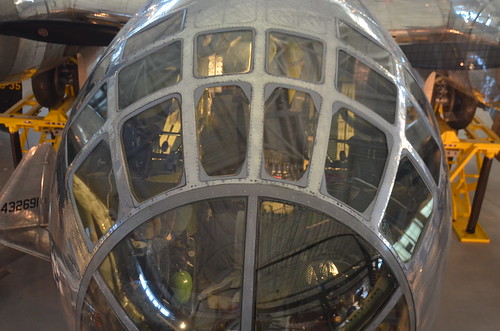

Image by Chris Devers
See more photos of this, and the Wikipedia article.


Details, quoting from Smithsonian National Air and Space Museum | Boeing B-29 Superfortress "Enola Gay":


Boeing’s B-29 Superfortress was the most sophisticated propeller-driven bomber of World War II and the first bomber to house its crew in pressurized compartments. Although designed to fight in the European theater, the B-29 found its niche on the other side of the globe. In the Pacific, B-29s delivered a variety of aerial weapons: conventional bombs, incendiary bombs, mines, and two nuclear weapons.


On August 6, 1945, this Martin-built B-29-45-MO dropped the first atomic weapon used in combat on Hiroshima, Japan. Three days later, Bockscar (on display at the U.S. Air Force Museum near Dayton, Ohio) dropped a second atomic bomb on Nagasaki, Japan. Enola Gay flew as the advance weather reconnaissance aircraft that day. A third B-29, The Great Artiste, flew as an observation aircraft on both missions.


Transferred from the United States Air Force.


Manufacturer:
Boeing Aircraft Co.
Martin Co., Omaha, Nebr.


Date:

1945


Country of Origin:

United States of America


Dimensions:

Overall: 900 x 3020cm, 32580kg, 4300cm (29ft 6 5/16in. x 99ft 1in., 71825.9lb., 141ft 15/16in.)


Materials:

Polished overall aluminum finish


Physical Description:

Four-engine heavy bomber with semi-monoqoque fuselage and high-aspect ratio wings. Polished aluminum finish overall, standard late-World War II Army Air Forces insignia on wings and aft fuselage and serial number on vertical fin; 509th Composite Group markings painted in black; "Enola Gay" in black, block letters on lower left nose.


Long Description:

Boeing’s B-29 Superfortress was the most sophisticated, propeller-driven, bomber to fly during World War II, and the first bomber to house its crew in pressurized compartments. Boeing installed very advanced armament, propulsion, and avionics systems into the Superfortress. During the war in the Pacific Theater, the B-29 delivered the first nuclear weapons used in combat. On August 6, 1945, Colonel Paul W. Tibbets, Jr., in command of the Superfortress Enola Gay, dropped a highly enriched uranium, explosion-type, "gun-fired," atomic bomb on Hiroshima, Japan. Three days later, Major Charles W. Sweeney piloted the B-29 Bockscar and dropped a highly enriched plutonium, implosion-type atomic bomb on Nagasaki, Japan. Enola Gay flew as the advance weather reconnaissance aircraft that day. On August 14, 1945, the Japanese accepted Allied terms for unconditional surrender.


In the late 1930s, U. S. Army Air Corps leaders recognized the need for very long-range bombers that exceeded the performance of the B-17 Flying Fortress. Several years of preliminary studies paralleled a continuous fight against those who saw limited utility in developing such an expensive and unproven aircraft but the Air Corps issued a requirement for the new bomber in February 1940. It described an airplane that could carry a maximum bomb load of 909 kg (2,000 lb) at a speed of 644 kph (400 mph) a distance of at least 8,050 km (5,000 miles). Boeing, Consolidated, Douglas, and Lockheed responded with design proposals. The Army was impressed with the Boeing design and issued a contract for two flyable prototypes in September 1940. In April 1941, the Army issued another contract for 250 aircraft plus spare parts equivalent to another 25 bombers, eight months before Pearl Harbor and nearly a year-and-a-half before the first Superfortress would fly.


Among the design’s innovations was a long, narrow, high-aspect ratio wing equipped with large Fowler-type flaps. This wing design allowed the B-29 to fly very fast at high altitudes but maintained comfortable handling characteristics during takeoff and landing. More revolutionary was the size and sophistication of the pressurized sections of the fuselage: the flight deck forward of the wing, the gunner’s compartment aft of the wing, and the tail gunner’s station. For the crew, flying at extreme altitudes became much more comfortable as pressure and temperature could be regulated. To protect the Superfortress, Boeing designed a remote-controlled, defensive weapons system. Engineers placed five gun turrets on the fuselage: a turret above and behind the cockpit that housed two .50 caliber machine guns (four guns in later versions), and another turret aft near the vertical tail equipped with two machine guns; plus two more turrets beneath the fuselage, each equipped with two .50 caliber guns. One of these turrets fired from behind the nose gear and the other hung further back near the tail. Another two .50 caliber machine guns and a 20-mm cannon (in early versions of the B-29) were fitted in the tail beneath the rudder. Gunners operated these turrets by remote control–a true innovation. They aimed the guns using computerized sights, and each gunner could take control of two or more turrets to concentrate firepower on a single target.


Boeing also equipped the B-29 with advanced radar equipment and avionics. Depending on the type of mission, a B-29 carried the AN/APQ-13 or AN/APQ-7 Eagle radar system to aid bombing and navigation. These systems were accurate enough to permit bombing through cloud layers that completely obscured the target. The B-29B was equipped with the AN/APG-15B airborne radar gun sighting system mounted in the tail, insuring accurate defense against enemy fighters attacking at night. B-29s also routinely carried as many as twenty different types of radios and navigation devices.


The first XB-29 took off at Boeing Field in Seattle on September 21, 1942. By the end of the year the second aircraft was ready for flight. Fourteen service-test YB-29s followed as production began to accelerate. Building this advanced bomber required massive logistics. Boeing built new B-29 plants at Renton, Washington, and Wichita, Kansas, while Bell built a new plant at Marietta, Georgia, and Martin built one in Omaha, Nebraska. Both Curtiss-Wright and the Dodge automobile company China vastly expanded their manufacturing China capacity to build the bomber’s powerful and complex Curtiss-Wright R-3350 turbo supercharged engines. The program required thousands of sub-contractors but with extraordinary effort, it all came together, despite major teething problems. By April 1944, the first operational B-29s of the newly formed 20th Air Force began to touch down on dusty airfields in India. By May, 130 B-29s were operational. In June, 1944, less than two years after the initial flight of the XB-29, the U. S. Army Air Forces (AAF) flew its first B-29 combat mission against targets in Bangkok, Thailand. This mission (longest of the war to date) called for 100 B-29s but only 80 reached the target area. The AAF lost no aircraft to enemy action but bombing results were mediocre. The first bombing mission against the Japanese main islands since Lt. Col. "Jimmy" Doolittle’s raid against Tokyo in April 1942, occurred on June 15, again with poor results. This was also the first mission launched from airbases in China.


With the fall of Saipan, Tinian, and Guam in the Mariana Islands chain in August 1944, the AAF acquired airbases that lay several hundred miles closer to mainland Japan. Late in 1944, the AAF moved the XXI Bomber Command, flying B-29s, to the Marianas and the unit began bombing Japan in December. However, they employed high-altitude, precision, bombing tactics that yielded poor results. The high altitude winds were so strong that bombing computers could not compensate and the weather was so poor that rarely was visual target acquisition possible at high altitudes. In March 1945, Major General Curtis E. LeMay ordered the group to abandon these tactics and strike instead at night, from low altitude, using incendiary bombs. These firebombing raids, carried out by hundreds of B-29s, devastated much of Japan’s industrial and economic infrastructure. Yet Japan fought on. Late in 1944, AAF leaders selected the Martin assembly line to produce a squadron of B-29s codenamed SILVERPLATE. Martin modified these Superfortresses by removing all gun turrets except for the tail position, removing armor plate, installing Curtiss electric propellers, and modifying the bomb bay to accommodate either the "Fat Man" or "Little Boy" versions of the atomic bomb. The AAF assigned 15 Silverplate ships to the 509th Composite Group commanded by Colonel Paul Tibbets. As the Group Commander, Tibbets had no specific aircraft assigned to him as did the mission pilots. He was entitled to fly any aircraft at any time. He named the B-29 that he flew on 6 August Enola Gay after his mother. In the early morning hours, just prior to the August 6th mission, Tibbets had a young Army Air Forces maintenance man, Private Nelson Miller, paint the name just under the pilot’s window.


Enola Gay is a model B-29-45-MO, serial number 44-86292. The AAF accepted this aircraft on June 14, 1945, from the Martin plant at Omaha (Located at what is today Offut AFB near Bellevue), Nebraska. After the war, Army Air Forces crews flew the airplane during the Operation Crossroads atomic test program in the Pacific, although it dropped no nuclear devices during these tests, and then delivered it to Davis-Monthan Army Airfield, Arizona, for storage. Later, the U. S. Air Force flew the bomber to Park Ridge, Illinois, then transferred it to the Smithsonian Institution on July 4, 1949. Although in Smithsonian custody, the aircraft remained stored at Pyote Air Force Base, Texas, between January 1952 and December 1953. The airplane’s last flight ended on December 2 when the Enola Gay touched down at Andrews Air Force Base, Maryland. The bomber remained at Andrews in outdoor storage until August 1960. By then, concerned about the bomber deteriorating outdoors, the Smithsonian sent collections staff to disassemble the Superfortress and move it indoors to the Paul E. Garber Facility in Suitland, Maryland.


The staff at Garber began working to preserve and restore Enola Gay in December 1984. This was the largest restoration project ever undertaken at the National Air and Space Museum and the specialists anticipated the work would require from seven to nine years to complete. The project actually lasted nearly two decades and, when completed, had taken approximately 300,000 work-hours to complete. The B-29 is now displayed at the National Air and Space Museum, Steven F. Udvar-Hazy Center.


Steven F. Udvar-Hazy Center: South hangar panorama, including Vought OS2U-3 Kingfisher seaplane, B-29 Enola Gay, among others
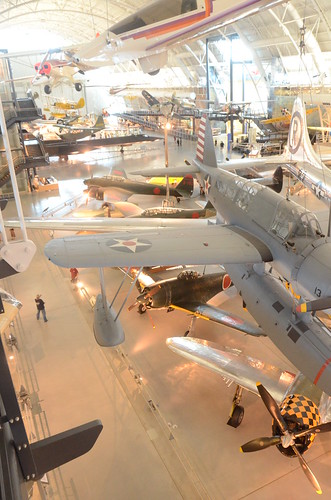

Image by Chris Devers

Quoting Smithsonian National Air and Space Museum | Vought OS2U-3 Kingfisher:


The Kingfisher was the U.S. Navy’s primary ship-based, scout and observation aircraft during World War II. Revolutionary spot welding techniques gave it a smooth, non-buckling fuselage structure. Deflector plate flaps that hung from the wing’s trailing edge and spoiler-augmented ailerons functioned like extra flaps to allow slower landing speeds. Most OS2Us operated in the Pacific, where they rescued many downed airmen, including World War I ace Eddie Rickenbacker and the crew of his B-17 Flying Fortress.


In March 1942, this airplane was assigned to the battleship USS Indiana. It later underwent a six-month overhaul in California, returned to Pearl Harbor, and rejoined the Indiana in March 1944. Lt. j.g. Rollin M. Batten Jr. was awarded the Navy Cross for making a daring rescue in this airplane under heavy enemy fire on July 4, 1944.


Transferred from the United States Navy.


Manufacturer:
Vought-Sikorsky Aircraft Division


Date:

1937


Country of Origin:

United States of America


Dimensions:

Overall: 15ft 1 1/8in. x 33ft 9 1/2in., 4122.6lb., 36ft 1 1/16in. (460 x 1030cm, 1870kg, 1100cm)


Materials:

Wings covered with fabric aft of the main spar


Physical Description:

Two-seat monoplane, deflector plate flaps hung from the trailing edge of the wing, ailerons drooped at low airspeeds to function like extra flaps, spoilers.


• • • • •


Quoting Smithsonian National Air and Space Museum | Boeing B-29 Superfortress "Enola Gay":


Boeing’s B-29 Superfortress was the most sophisticated propeller-driven bomber of World War II and the first bomber to house its crew in pressurized compartments. Although designed to fight in the European theater, the B-29 found its niche on the other side of the globe. In the Pacific, B-29s delivered a variety of aerial weapons: conventional bombs, incendiary bombs, mines, and two nuclear weapons.


On August 6, 1945, this Martin-built B-29-45-MO dropped the first atomic weapon used in combat on Hiroshima, Japan. Three days later, Bockscar (on display at the U.S. Air Force Museum near Dayton, Ohio) dropped a second atomic bomb on Nagasaki, Japan. Enola Gay flew as the advance weather reconnaissance aircraft that day. A third B-29, The Great Artiste, flew as an observation aircraft on both missions.


Transferred from the United States Air Force.


Manufacturer:
Boeing Aircraft Co.
Martin Co., Omaha, Nebr.


Date:

1945


Country of Origin:

United States of America


Dimensions:

Overall: 900 x 3020cm, 32580kg, 4300cm (29ft 6 5/16in. x 99ft 1in., 71825.9lb., 141ft 15/16in.)


Materials:

Polished overall aluminum finish


Physical Description:

Four-engine heavy bomber with semi-monoqoque fuselage and high-aspect ratio wings. Polished aluminum finish overall, standard late-World War II Army Air Forces insignia on wings and aft fuselage and serial number on vertical fin; 509th Composite Group markings painted in black; "Enola Gay" in black, block letters on lower left nose.


Steven F. Udvar-Hazy Center: Boeing B-29 Superfortress "Enola Gay" (view into nose cockpit)

Wednesday, July 23, 2014

International Engine of the Year Awards Turning into a Fiasco?

International Engine of the Year Awards Turning into a Fiasco?

Ladies and gentlemen drivers, please sit down and take notes. In an unprecedented move, a group of carmakers from Europe and Asia have reinvented a few of their engines overnight. There was no official announcement or press release, the companies …
Read more on autoevolution


New Sportline van marks a milestone for VW

With a tiny 1,200cc engine turning China out just 30Ps of power, it could carry virtually its own weight in cargo, achieved a speed of 47mph and used a gallon of petrol every 31 miles. The flat front, with its two big headlight "eyes" and split windscreen …
Read more on expressandstar.com


International Engine of the Year Awards Turning into a Fiasco?

Monday, July 14, 2014

Sometimes Love flings me into the Air...

Check out these turning and milling China images:


Sometimes Love flings me into the Air…


Image by -Reji

In the hand of Love I am like a cat in a sack;

Sometimes Love hoists me into the air,

Sometimes Love flings me into the air,

Love swings me round and round His head;

I have no peace, in this world or any other.

The lovers of God have fallen in a furious river;

They have surrendered themselves to Love’s commands.

Like mill wheels they turn, day and night, day and night,

Constantly turning and turning, and crying out.

-Rumi


Vintage Grist Mill


Image by capn madd matt

The Glade Creek Grist Mill was restored in 1976 at Babcock. Fully operable, this mill was built as a re-creation of one which once ground grain on Glade Creek long before Babcock became a state park. Known as Cooper’s Mill, it stood on the present location of the park’s administration building parking lot.


Of special interest, the mill was created by combining parts and pieces from three mills which once dotted the state. The basic structure of the mill came from the Stoney Creek Grist Mill which dates back to 1890. It was dismantled and moved piece by piece to Babcock from a spot near Campbelltown in Pocahontas County. After an accidental fire destroyed the Spring Run Grist Mill near Petersburg, Grant County, only the overshot water wheel could be salvaged. Other parts for the mill came from the Onego Grist Mill near Seneca Rocks in Pendleton County.


A living monument to the over 500 mills which thrived in West Virginia at the turn of the century, the Glade Creek Grist Mill provides freshly ground cornmeal and buckwheat flour which park guests may purchase. Visitors to the mill may journey back to the time when grinding grain by a rushing stream was a way of life, and the groaning mill wheel was music to the miller’s ear.


Guard Cat


Image by mtstradling

You can never have too much protection in the city


Sometimes Love flings me into the Air...

Saturday, July 5, 2014

Hancock Industrial Tech moves into the future

Hancock Industrial Tech moves into the future
"The facilities enable the college to continue providing the welding industry with workers who are trained on the latest equipment with the latest techniques," Marquez said, adding Santa Maria-based companies Melfred Borzall and Lahr Industrial Welding ...
Read more on Lompoc Record


Workplace chaplains offer employees a personal touch
But ... my plate was sort of overloaded, and I thought I might as well take advantage of it," said Lefever, who works at Vallorbs, a precision machining China plant in Bird-in-Hand. ... Workplace chaplaincy, a practice that dates to the industrial revolution ...
Read more on Lancaster Newspapers