Showing posts with label Boeing. Show all posts

Monday, August 11, 2014

Boeing 737-300-400-500 structure from beneath, electrical transformers.

A few nice subcontract machining images I found:


Boeing 737-300-400-500 structure from beneath, electrical transformers.


Image by wbaiv

Here’s a page from the Alaska Airlines service manual. Its a standard drawing and text Boeing supply to the owners of their airplanes so the owners can construct the manuals that they are responsible for. Don’t they just buy the Haynes manual or the Bentley one when they are picking up parts? Nope. FAA regulations make the airline responsible for the complete and correct manual for the level of maintenance they provide. Lots of airlines subcontract the heavy checks, "C" and "D", and so people like Lufthansa Technik have the really deep stuff, but every airline does some of its own maintenance. The marked similarity between the drawing style here and in, for example, Bentley car manuals, comes in part from both being distributed via microfiche, as well as paper and computer. Hence the dry style with constant line widths and very few photographs.


Boeing 737-300-400-500 structure from beneath, electrical transformers.

Thursday, July 24, 2014

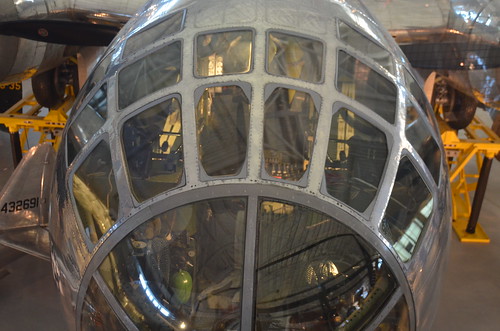
Steven F. Udvar-Hazy Center: Boeing B-29 Superfortress "Enola Gay" (view into nose cockpit)

A few nice advanced precision machining images I found:


Steven F. Udvar-Hazy Center: Boeing B-29 Superfortress “Enola Gay” (view into nose cockpit)


Image by Chris Devers
See more photos of this, and the Wikipedia article.


Details, quoting from Smithsonian National Air and Space Museum | Boeing B-29 Superfortress "Enola Gay":


Boeing’s B-29 Superfortress was the most sophisticated propeller-driven bomber of World War II and the first bomber to house its crew in pressurized compartments. Although designed to fight in the European theater, the B-29 found its niche on the other side of the globe. In the Pacific, B-29s delivered a variety of aerial weapons: conventional bombs, incendiary bombs, mines, and two nuclear weapons.


On August 6, 1945, this Martin-built B-29-45-MO dropped the first atomic weapon used in combat on Hiroshima, Japan. Three days later, Bockscar (on display at the U.S. Air Force Museum near Dayton, Ohio) dropped a second atomic bomb on Nagasaki, Japan. Enola Gay flew as the advance weather reconnaissance aircraft that day. A third B-29, The Great Artiste, flew as an observation aircraft on both missions.


Transferred from the United States Air Force.


Manufacturer:
Boeing Aircraft Co.
Martin Co., Omaha, Nebr.


Date:

1945


Country of Origin:

United States of America


Dimensions:

Overall: 900 x 3020cm, 32580kg, 4300cm (29ft 6 5/16in. x 99ft 1in., 71825.9lb., 141ft 15/16in.)


Materials:

Polished overall aluminum finish


Physical Description:

Four-engine heavy bomber with semi-monoqoque fuselage and high-aspect ratio wings. Polished aluminum finish overall, standard late-World War II Army Air Forces insignia on wings and aft fuselage and serial number on vertical fin; 509th Composite Group markings painted in black; "Enola Gay" in black, block letters on lower left nose.


Long Description:

Boeing’s B-29 Superfortress was the most sophisticated, propeller-driven, bomber to fly during World War II, and the first bomber to house its crew in pressurized compartments. Boeing installed very advanced armament, propulsion, and avionics systems into the Superfortress. During the war in the Pacific Theater, the B-29 delivered the first nuclear weapons used in combat. On August 6, 1945, Colonel Paul W. Tibbets, Jr., in command of the Superfortress Enola Gay, dropped a highly enriched uranium, explosion-type, "gun-fired," atomic bomb on Hiroshima, Japan. Three days later, Major Charles W. Sweeney piloted the B-29 Bockscar and dropped a highly enriched plutonium, implosion-type atomic bomb on Nagasaki, Japan. Enola Gay flew as the advance weather reconnaissance aircraft that day. On August 14, 1945, the Japanese accepted Allied terms for unconditional surrender.


In the late 1930s, U. S. Army Air Corps leaders recognized the need for very long-range bombers that exceeded the performance of the B-17 Flying Fortress. Several years of preliminary studies paralleled a continuous fight against those who saw limited utility in developing such an expensive and unproven aircraft but the Air Corps issued a requirement for the new bomber in February 1940. It described an airplane that could carry a maximum bomb load of 909 kg (2,000 lb) at a speed of 644 kph (400 mph) a distance of at least 8,050 km (5,000 miles). Boeing, Consolidated, Douglas, and Lockheed responded with design proposals. The Army was impressed with the Boeing design and issued a contract for two flyable prototypes in September 1940. In April 1941, the Army issued another contract for 250 aircraft plus spare parts equivalent to another 25 bombers, eight months before Pearl Harbor and nearly a year-and-a-half before the first Superfortress would fly.


Among the design’s innovations was a long, narrow, high-aspect ratio wing equipped with large Fowler-type flaps. This wing design allowed the B-29 to fly very fast at high altitudes but maintained comfortable handling characteristics during takeoff and landing. More revolutionary was the size and sophistication of the pressurized sections of the fuselage: the flight deck forward of the wing, the gunner’s compartment aft of the wing, and the tail gunner’s station. For the crew, flying at extreme altitudes became much more comfortable as pressure and temperature could be regulated. To protect the Superfortress, Boeing designed a remote-controlled, defensive weapons system. Engineers placed five gun turrets on the fuselage: a turret above and behind the cockpit that housed two .50 caliber machine guns (four guns in later versions), and another turret aft near the vertical tail equipped with two machine guns; plus two more turrets beneath the fuselage, each equipped with two .50 caliber guns. One of these turrets fired from behind the nose gear and the other hung further back near the tail. Another two .50 caliber machine guns and a 20-mm cannon (in early versions of the B-29) were fitted in the tail beneath the rudder. Gunners operated these turrets by remote control–a true innovation. They aimed the guns using computerized sights, and each gunner could take control of two or more turrets to concentrate firepower on a single target.


Boeing also equipped the B-29 with advanced radar equipment and avionics. Depending on the type of mission, a B-29 carried the AN/APQ-13 or AN/APQ-7 Eagle radar system to aid bombing and navigation. These systems were accurate enough to permit bombing through cloud layers that completely obscured the target. The B-29B was equipped with the AN/APG-15B airborne radar gun sighting system mounted in the tail, insuring accurate defense against enemy fighters attacking at night. B-29s also routinely carried as many as twenty different types of radios and navigation devices.


The first XB-29 took off at Boeing Field in Seattle on September 21, 1942. By the end of the year the second aircraft was ready for flight. Fourteen service-test YB-29s followed as production began to accelerate. Building this advanced bomber required massive logistics. Boeing built new B-29 plants at Renton, Washington, and Wichita, Kansas, while Bell built a new plant at Marietta, Georgia, and Martin built one in Omaha, Nebraska. Both Curtiss-Wright and the Dodge automobile company China vastly expanded their manufacturing China capacity to build the bomber’s powerful and complex Curtiss-Wright R-3350 turbo supercharged engines. The program required thousands of sub-contractors but with extraordinary effort, it all came together, despite major teething problems. By April 1944, the first operational B-29s of the newly formed 20th Air Force began to touch down on dusty airfields in India. By May, 130 B-29s were operational. In June, 1944, less than two years after the initial flight of the XB-29, the U. S. Army Air Forces (AAF) flew its first B-29 combat mission against targets in Bangkok, Thailand. This mission (longest of the war to date) called for 100 B-29s but only 80 reached the target area. The AAF lost no aircraft to enemy action but bombing results were mediocre. The first bombing mission against the Japanese main islands since Lt. Col. "Jimmy" Doolittle’s raid against Tokyo in April 1942, occurred on June 15, again with poor results. This was also the first mission launched from airbases in China.


With the fall of Saipan, Tinian, and Guam in the Mariana Islands chain in August 1944, the AAF acquired airbases that lay several hundred miles closer to mainland Japan. Late in 1944, the AAF moved the XXI Bomber Command, flying B-29s, to the Marianas and the unit began bombing Japan in December. However, they employed high-altitude, precision, bombing tactics that yielded poor results. The high altitude winds were so strong that bombing computers could not compensate and the weather was so poor that rarely was visual target acquisition possible at high altitudes. In March 1945, Major General Curtis E. LeMay ordered the group to abandon these tactics and strike instead at night, from low altitude, using incendiary bombs. These firebombing raids, carried out by hundreds of B-29s, devastated much of Japan’s industrial and economic infrastructure. Yet Japan fought on. Late in 1944, AAF leaders selected the Martin assembly line to produce a squadron of B-29s codenamed SILVERPLATE. Martin modified these Superfortresses by removing all gun turrets except for the tail position, removing armor plate, installing Curtiss electric propellers, and modifying the bomb bay to accommodate either the "Fat Man" or "Little Boy" versions of the atomic bomb. The AAF assigned 15 Silverplate ships to the 509th Composite Group commanded by Colonel Paul Tibbets. As the Group Commander, Tibbets had no specific aircraft assigned to him as did the mission pilots. He was entitled to fly any aircraft at any time. He named the B-29 that he flew on 6 August Enola Gay after his mother. In the early morning hours, just prior to the August 6th mission, Tibbets had a young Army Air Forces maintenance man, Private Nelson Miller, paint the name just under the pilot’s window.


Enola Gay is a model B-29-45-MO, serial number 44-86292. The AAF accepted this aircraft on June 14, 1945, from the Martin plant at Omaha (Located at what is today Offut AFB near Bellevue), Nebraska. After the war, Army Air Forces crews flew the airplane during the Operation Crossroads atomic test program in the Pacific, although it dropped no nuclear devices during these tests, and then delivered it to Davis-Monthan Army Airfield, Arizona, for storage. Later, the U. S. Air Force flew the bomber to Park Ridge, Illinois, then transferred it to the Smithsonian Institution on July 4, 1949. Although in Smithsonian custody, the aircraft remained stored at Pyote Air Force Base, Texas, between January 1952 and December 1953. The airplane’s last flight ended on December 2 when the Enola Gay touched down at Andrews Air Force Base, Maryland. The bomber remained at Andrews in outdoor storage until August 1960. By then, concerned about the bomber deteriorating outdoors, the Smithsonian sent collections staff to disassemble the Superfortress and move it indoors to the Paul E. Garber Facility in Suitland, Maryland.


The staff at Garber began working to preserve and restore Enola Gay in December 1984. This was the largest restoration project ever undertaken at the National Air and Space Museum and the specialists anticipated the work would require from seven to nine years to complete. The project actually lasted nearly two decades and, when completed, had taken approximately 300,000 work-hours to complete. The B-29 is now displayed at the National Air and Space Museum, Steven F. Udvar-Hazy Center.


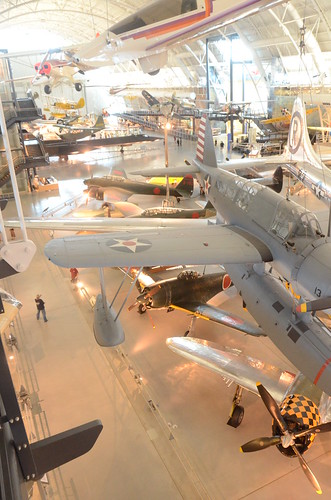
Steven F. Udvar-Hazy Center: South hangar panorama, including Vought OS2U-3 Kingfisher seaplane, B-29 Enola Gay, among others


Image by Chris Devers

Quoting Smithsonian National Air and Space Museum | Vought OS2U-3 Kingfisher:


The Kingfisher was the U.S. Navy’s primary ship-based, scout and observation aircraft during World War II. Revolutionary spot welding techniques gave it a smooth, non-buckling fuselage structure. Deflector plate flaps that hung from the wing’s trailing edge and spoiler-augmented ailerons functioned like extra flaps to allow slower landing speeds. Most OS2Us operated in the Pacific, where they rescued many downed airmen, including World War I ace Eddie Rickenbacker and the crew of his B-17 Flying Fortress.


In March 1942, this airplane was assigned to the battleship USS Indiana. It later underwent a six-month overhaul in California, returned to Pearl Harbor, and rejoined the Indiana in March 1944. Lt. j.g. Rollin M. Batten Jr. was awarded the Navy Cross for making a daring rescue in this airplane under heavy enemy fire on July 4, 1944.


Transferred from the United States Navy.


Manufacturer:
Vought-Sikorsky Aircraft Division


Date:

1937


Country of Origin:

United States of America


Dimensions:

Overall: 15ft 1 1/8in. x 33ft 9 1/2in., 4122.6lb., 36ft 1 1/16in. (460 x 1030cm, 1870kg, 1100cm)


Materials:

Wings covered with fabric aft of the main spar


Physical Description:

Two-seat monoplane, deflector plate flaps hung from the trailing edge of the wing, ailerons drooped at low airspeeds to function like extra flaps, spoilers.


• • • • •


Quoting Smithsonian National Air and Space Museum | Boeing B-29 Superfortress "Enola Gay":


Boeing’s B-29 Superfortress was the most sophisticated propeller-driven bomber of World War II and the first bomber to house its crew in pressurized compartments. Although designed to fight in the European theater, the B-29 found its niche on the other side of the globe. In the Pacific, B-29s delivered a variety of aerial weapons: conventional bombs, incendiary bombs, mines, and two nuclear weapons.


On August 6, 1945, this Martin-built B-29-45-MO dropped the first atomic weapon used in combat on Hiroshima, Japan. Three days later, Bockscar (on display at the U.S. Air Force Museum near Dayton, Ohio) dropped a second atomic bomb on Nagasaki, Japan. Enola Gay flew as the advance weather reconnaissance aircraft that day. A third B-29, The Great Artiste, flew as an observation aircraft on both missions.


Transferred from the United States Air Force.


Manufacturer:
Boeing Aircraft Co.
Martin Co., Omaha, Nebr.


Date:

1945


Country of Origin:

United States of America


Dimensions:

Overall: 900 x 3020cm, 32580kg, 4300cm (29ft 6 5/16in. x 99ft 1in., 71825.9lb., 141ft 15/16in.)


Materials:

Polished overall aluminum finish


Physical Description:

Four-engine heavy bomber with semi-monoqoque fuselage and high-aspect ratio wings. Polished aluminum finish overall, standard late-World War II Army Air Forces insignia on wings and aft fuselage and serial number on vertical fin; 509th Composite Group markings painted in black; "Enola Gay" in black, block letters on lower left nose.


Steven F. Udvar-Hazy Center: Boeing B-29 Superfortress "Enola Gay" (view into nose cockpit)

Monday, July 7, 2014

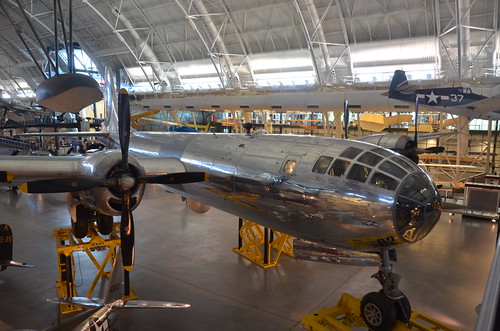
Steven F. Udvar-Hazy Center: Boeing B-29 Superfortress "Enola Gay" (front starboard view), with Grumman F6F-3 Hellcat at back-right, among others

A few nice precision grinding China and manufacturing China images I found:


Steven F. Udvar-Hazy Center: Boeing B-29 Superfortress "Enola Gay" (front starboard view), with Grumman F6F-3 Hellcat at back-right, among others

Image by Chris Devers
See more photos of this, and the Wikipedia article.

Details, quoting from Smithsonian National Air and Space Museum: Steven F. Udvar-Hazy | Boeing B-29 Superfortress "Enola Gay":

Boeing"s B-29 Superfortress was the most sophisticated propeller-driven bomber of World War II and the first bomber to house its crew in pressurized compartments. Although designed to fight in the European theater, the B-29 found its niche on the other side of the globe. In the Pacific, B-29s delivered a variety of aerial weapons: conventional bombs, incendiary bombs, mines, and two nuclear weapons.

On August 6, 1945, this Martin-built B-29-45-MO dropped the first atomic weapon used in combat on Hiroshima, Japan. Three days later, Bockscar (on display at the U.S. Air Force Museum near Dayton, Ohio) dropped a second atomic bomb on Nagasaki, Japan. Enola Gay flew as the advance weather reconnaissance aircraft that day. A third B-29, The Great Artiste, flew as an observation aircraft on both missions.

Transferred from the United States Air Force.

Manufacturer:
Boeing Aircraft Co.
Martin Co., Omaha, Nebr.

Date:
1945

Country of Origin:
United States of America

Dimensions:
Overall: 900 x 3020cm, 32580kg, 4300cm (29ft 6 5/16in. x 99ft 1in., 71825.9lb., 141ft 15/16in.)

Materials:
Polished overall aluminum finish

Physical Description:
Four-engine heavy bomber with semi-monoqoque fuselage and high-aspect ratio wings. Polished aluminum finish overall, standard late-World War II Army Air Forces insignia on wings and aft fuselage and serial number on vertical fin; 509th Composite Group markings painted in black; "Enola Gay" in black, block letters on lower left nose.

• • • • •

Quoting Smithsonian National Air and Space Museum | Grumman F6F-3 Hellcat:

The Grumman F6F Hellcat was originally conceived as an advanced version of the U.S. Navy"s then current front-line fighter, the F4F Wildcat (see NASM collection). The Wildcat"s intended replacement, the Vought F4U Corsair (see NASM collection), first flown in 1940, was showing great promise, but development was slowed by problems, including the crash of the prototype.

The National Air and Space Museum"s F6F-3 Hellcat, BuNo. 41834, was built at Grumman"s Bethpage, New York, factory in February 1944 under contract NOA-(S)846. It was delivered to the Navy on February 7, and arrived in San Diego, California, on the 18th. It was assigned to Fighter Squadron 15 (VF-15) on USS Hornet (CV12) bound for Hawaii. On arrival, it was assigned to VF-3 where it sustained damage in a wheels-up landing at NAS Barbers Point, Hawaii. After repair, it was assigned to VF-83 where it was used in a training role until February 21, 1945. After numerous transfers 41834 was converted to an F6F-3K target drone with the installation of sophisticated radio-control equipment. It was painted red with a pink tail that carried the number 14. Its mission was to be used in Operation Crossroads - the atomic bomb tests at Bikini Atoll. It flew on June 24, 1946, with a pilot, on a practice flight and was launched, unmanned, soon after the first bomb test. Instrumentation on board and photographic plates taped to the control stick obtained data on radioactivity. Three more manned flights preceded the final unmanned flight on July 25, 1946, which evaluated the first underwater explosion. Records indicate that exposure of this aircraft to the radioactive cloud was minimal and residual radiation is negligible.

F6F-3K 41834 was transferred to NAS Norfolk and logged its last flight on March 25, 1947, with a total of 430.2 flying hours. It was assigned to the National Air Museum on November 3, 1948, and remained at Norfolk until October 4, 1960, when it was moved by barge to Washington and placed in storage. In 1976 this Hellcat was loaned to the USS Yorktown Museum at Charleston, South Carolina. A superficial restoration was performed at the museum, but because of the harsh environment and its poor condition the Hellcat was returned to NASM on March 16, 1982. In 1983, it was sent to Grumman Aerospace where a team of volunteers completely restored the aircraft. In 1985, it was shipped back to the Paul E. Garber Preservation, Restoration and Storage Facility in Suitland, Maryland, and put in storage. NASM"s F6F-3 Hellcat is scheduled to be displayed in the new Steven F. Udvar-Hazy center at Dulles International Airport in Virginia in 2004.

Transferred from the United States Navy.

Manufacturer:
Grumman Aircraft Engineering China Corporation

Date:
1943

Country of Origin:
United States of America

Dimensions:
Overall: 338 x 1021cm, 4092kg, 1304cm (11ft 1 1/16in. x 33ft 5 15/16in., 9021.2lb., 42ft 9 3/8in.)

Physical Description:
Heavy armor plate, reinforced empennage, R-2800-10W engine, spring tabs on the ailerons (increased maneuverability), could carry rockets as well as bombs.


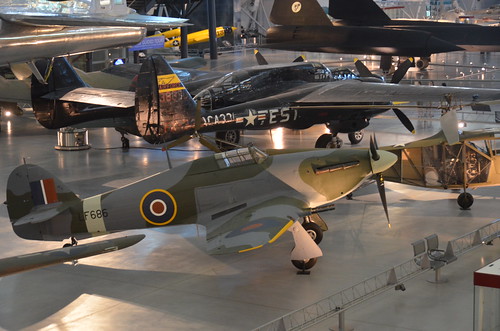
Steven F. Udvar-Hazy Center: Hawker Hurricane Mk. IIC, with Northrop P-61C Black Widow, B-29 Superfortress "Enola Gay", and SR-71 Blackbird in the background

Image by Chris Devers
See more photos of this, and the Wikipedia article.

Details, quoting from Smithsonian National Air and Space Museum: Steven F. Udvar-Hazy | Hawker Hurricane Mk. IIC:

Hawker Chief Designer Sydney Camm"s Hurricane ranks with the most important aircraft designs in military aviation history. Designed in the late 1930s, when monoplanes were considered unstable and too radical to be successful, the Hurricane was the first British monoplane fighter and the first British fighter to exceed 483 kilometers (300 miles) per hour in level flight. Hurricane pilots fought the Luftwaffe and helped win the Battle of Britain in the summer of 1940.

This Mark IIC was built at the Langley factory, near what is now Heathrow Airport, early in 1944. It served as a training aircraft during the World War II in the Royal Air Force"s 41 OTU.

Donated by the Royal Air Force Museum

Manufacturer:
Hawker Aircraft Ltd.

Date:
1944

Country of Origin:
United Kingdom

Dimensions:
Wingspan: 12.2 m (40 ft)
Length: 9.8 m (32 ft 3 in)
Height: 4 m (13 ft)
Weight, empty: 2,624 kg (5,785 lb)
Weight, gross: 3,951 kg (8,710 lb)
Top speed:538 km/h (334 mph)
Engine:Rolls-Royce Merlin XX, liquid-cooled in-line V, 1,300 hp
Armament:four 20 mm Hispano cannons
Ordnance:two 250-lb or two 500-lb bombs or eight 3-in rockets

Materials:
Fuselage: Steel tube with aircraft spruce forms and fabric, aluminum cowling
Wings: Stressed Skin Aluminum
Horizontal Stablizer: Stress Skin aluminum
Rudder: fabric covered aluminum
Control Surfaces: fabric covered aluminum

Physical Description:
Hawker Hurricane Mk. IIC single seat, low wing monoplane ground attack fighter; enclosed cockpit; steel tube fuselage with aircraft spruce forms and fabric, aluminum cowling, stressed skin aluminum wings and horizontal stablizer, fabric covered aluminum rudder and control surfaces; grey green camoflage top surface paint scheme with dove grey underside; red and blue national roundel on upper wing surface and red, white, and blue roundel lower wing surface; red, white, blue, and yellow roundel fuselage sides; red, white and blue tail flash; Rolls-Royce Merlin XX, liquid cooled V-12, 1,280 horsepower engine; Armament, 4: 20mm Hispano cannons.

• • • • •

See more photos of this, and the Wikipedia article.

Details, quoting from Smithsonian National Air and Space Museum: Steven F. Udvar-Hazy | Northrop P-61C Black Widow:

The P-61 Black Widow was the first U.S. aircraft designed to locate and destroy enemy aircraft at night and in bad weather, a feat made possible by the use of on-board radar. The prototype first flew in 1942. P-61 combat operations began just after D-Day, June 6, 1944, when Black Widows flew deep into German airspace, bombing and strafing trains and road traffic. Operations in the Pacific began at about the same time. By the end of World War II, Black Widows had seen combat in every theater and had destroyed 127 enemy aircraft and 18 German V-1 buzz bombs.

The Museum’s Black Widow, a P-61C-1-NO, was delivered to the Army Air Forces in July 1945. It participated in cold-weather tests, high-altitude drop tests, and in the National Thunderstorm Project, for which the top turret was removed to make room for thunderstorm monitoring equipment.

Transferred from the United States Air Force.

Manufacturer:
Northrop Aircraft Inc.

Date:
1943

Country of Origin:
United States of America

Dimensions:
Overall: 450 x 1500cm, 10637kg, 2000cm (14ft 9 3/16in. x 49ft 2 9/16in., 23450.3lb., 65ft 7 3/8in.)

• • • • •

Quoting Smithsonian National Air and Space Museum | Boeing B-29 Superfortress "Enola Gay":

Boeing"s B-29 Superfortress was the most sophisticated propeller-driven bomber of World War II and the first bomber to house its crew in pressurized compartments. Although designed to fight in the European theater, the B-29 found its niche on the other side of the globe. In the Pacific, B-29s delivered a variety of aerial weapons: conventional bombs, incendiary bombs, mines, and two nuclear weapons.

On August 6, 1945, this Martin-built B-29-45-MO dropped the first atomic weapon used in combat on Hiroshima, Japan. Three days later, Bockscar (on display at the U.S. Air Force Museum near Dayton, Ohio) dropped a second atomic bomb on Nagasaki, Japan. Enola Gay flew as the advance weather reconnaissance aircraft that day. A third B-29, The Great Artiste, flew as an observation aircraft on both missions.

Transferred from the United States Air Force.

Manufacturer:
Boeing Aircraft Co.
Martin Co., Omaha, Nebr.

Date:
1945

Country of Origin:
United States of America

Dimensions:
Overall: 900 x 3020cm, 32580kg, 4300cm (29ft 6 5/16in. x 99ft 1in., 71825.9lb., 141ft 15/16in.)

Materials:
Polished overall aluminum finish

Physical Description:
Four-engine heavy bomber with semi-monoqoque fuselage and high-aspect ratio wings. Polished aluminum finish overall, standard late-World War II Army Air Forces insignia on wings and aft fuselage and serial number on vertical fin; 509th Composite Group markings painted in black; "Enola Gay" in black, block letters on lower left nose.

• • • • •

See more photos of this, and the Wikipedia article.

Details, quoting from Smithsonian National Air and Space Museum | Lockheed SR-71 Blackbird:

No reconnaissance aircraft in history has operated globally in more hostile airspace or with such complete impunity than the SR-71, the world"s fastest jet-propelled aircraft. The Blackbird"s performance and operational achievements placed it at the pinnacle of aviation technology developments during the Cold War.

This Blackbird accrued about 2,800 hours of flight time during 24 years of active service with the U.S. Air Force. On its last flight, March 6, 1990, Lt. Col. Ed Yielding and Lt. Col. Joseph Vida set a speed record by flying from Los Angeles to Washington, D.C., in 1 hour, 4 minutes, and 20 seconds, averaging 3,418 kilometers (2,124 miles) per hour. At the flight"s conclusion, they landed at Washington-Dulles International Airport and turned the airplane over to the Smithsonian.

Transferred from the United States Air Force.

Manufacturer:
Lockheed Aircraft Corporation

Designer:
Clarence L. "Kelly" Johnson

Date:
1964

Country of Origin:
United States of America

Dimensions:
Overall: 18ft 5 15/16in. x 55ft 7in. x 107ft 5in., 169998.5lb. (5.638m x 16.942m x 32.741m, 77110.8kg)
Other: 18ft 5 15/16in. x 107ft 5in. x 55ft 7in. (5.638m x 32.741m x 16.942m)

Materials:
Titanium

Physical Description:
Twin-engine, two-seat, supersonic strategic reconnaissance aircraft; airframe constructed largley of titanium and its alloys; vertical tail fins are constructed of a composite (laminated plastic-type material) to reduce radar cross-section; Pratt and Whitney J58 (JT11D-20B) turbojet engines feature large inlet shock cones.

Thursday, June 26, 2014

Steven F. Udvar-Hazy Center: Yellow Northrop N1M flying wing airplane, in front of Northrop P-61C Black Widow and tail of the Boeing B-29 Superfortress "Enola Gay", et al

Some cool precision grinding and manufacturing images:


Steven F. Udvar-Hazy Center: Yellow Northrop N1M flying wing airplane, in front of Northrop P-61C Black Widow and tail of the Boeing B-29 Superfortress “Enola Gay”, et al
precision grinding and manufacturing

Image by Chris Devers
See more photographs of this, and the Wikipedia report.


Details, quoting from Smithsonian National Air and Space Museum: Steven F. Udvar-Hazy | Northrop N1M:


John K. &quotJack&quot Northrop’s dream of a flying wing became a reality on July 3, 1940, when his N-1M (Northrop Model 1 Mockup) 1st flew. One of the world’s preeminent aircraft designers and creator of the Lockheed Vega and Northrop Alpha, Northrop had experimented with flying wings for more than a decade, believing they would have much less drag and greater efficiency than standard styles. His 1929 flying wing, even though profitable, had twin tail booms and a traditional tail. In the N-1M he created a accurate flying wing.


Constructed of plywood around a tubular steel frame, the N-1M was powered by two 65-horsepower Lycoming engines, later replaced with two 120-horsepower Franklins. Even though its flying qualities have been marginal, the N-1M led to other designs, which includes the Northrop XB-35 and YB-49 strategic bombers and eventually the B-2 stealth bomber.


Transferred from the United States Air Force.


Manufacturer:
Northrop Aircraft Inc.


Date:

1940


Country of Origin:

United States of America


Dimensions:

Wingspan: 11.6 m (38 ft)

Length: 5.2 m (17 ft)

Height: 1.5 m (5 ft)

Weight, gross: 1,814 kg (4,000 lb)

Top speed: 322 km/h (200 mph)

Engine: two Franklin 6AC264F2, 120 hp

All round: 72in. (182.9cm)

Other: 72 x 204 x 456in. (182.9 x 518.2 x 1158.2cm)


Supplies:

General: Plywood


Physical Description:

Twin engine flying wing: Wood, painted yellow.


Lengthy Description:

The N-1M (Northrop Model 1 Mockup) Flying Wing was a organic outgrowth of John K. &quotJack&quot Northrop’s lifelong concern for an aerodynamically clean style in which all unnecessary drag caused by protruding engine nacelles, fuselage, and vertical and horizontal tail surfaces would be eliminated. Created in 1939 and 1940, the N-1lM was the initial pure all-wing airplane to be developed in the United States. Its design and style was the forerunner of the bigger all-wing XB-35 and YB-49 bomber! reconnaissance prototypes that Northrop hoped would win Air Force production contracts and at some point modify the shape of modern day aircraft.


Soon after serving apprenticeships with the Lockheed brothers and Donald Douglas in the early 1920s and designing the extremely successful and revolutionary Lockheed Vega in 1927, Northrop in the late 192Os turned his interest to all-wing aircraft. In 1928, he left the employ of Lockheed and organized the Avion Corporation a year later he created his first flying wing, which incorporated such revolutionary functions as all-metal, multicellular wing and stressed-skin building. Despite the fact that the 1929 flying wing was not a accurate all-wing style due to the fact it produced use of external handle surfaces and outrigger tail booms, it paved the way for the later N-1 M, which proved the basic soundness of Northrop’s thought for an all-wing aircraft. At the time, nevertheless, Northrop did not have the income to continue building the all-wing thought.


In 1939, Northrop formed his own aircraft business, Northrop Aircraft, Inc., and as a result was in a position to finance study and improvement of the N-1M. For help in designing the aircraft, Northrop enlisted the not aerodynamicist Dr. Theodore von Karman, who was at the time Director of the Guggenheim Aeronautical Laboratory at the California Institute Technology, and von Karman’s assistant, Dr. William R. Sears. Walter J. Cerny, Northrop’s assistant design and style chief, became the general supervisor for the project. To decide the flight characteristics of an all-wing style, Northrop Cerny performed comprehensive wind tunnel tests or flying wing models. Ultimately, the design and style of the N-1 M benefited from the new low-drag, boost stability NACA airfoils as properly as enhanced flaps spoilers, and other aerodynamic devices.


Right after a period of a year, the N-1M, nicknamed the &quotJeep,&quot emerged in July 1940 as a boomerang-shaped flying scale mockup built 01 wood and tubular steel with a wingspan of 38 feet a length of 17 feet, and a height of five feet. Pitch and roll handle was achieved by means of elevons on the trailing edge of the wing, which served the function of both elevator and aileron the location of the traditional rudder was a split flap device on the wing ideas these had been initially drooped downward for what was thought to be better directional stability but later straightened.


Controlled by rudder pedals, the split flaps, or &quotclamshells,&quot could be opened to enhance the angle of glide or reduce airspeed and as a result act as air brakes. The center of gravity, wing sweep, arrangement of manage surfaces, and dihedral have been adjustable on the ground. To lower drag, the aircraft’s two 65-hp Lycoming -145 four-cylinder engines had been buried within the fuselage. These were later discovered to be lacking in sufficient power to sustain lift and were replaced by two 120-hp six-cylinder 6AC264F2 air-cooled Franklin engines.


The N-1M produced its initial test flight on July three, 1940, at Baker Dry Lake, California, with Vance Breese at the controls. Breese’s inaugural flight in the N-1 M was inauspicious. During a high-speed taxi run, the aircraft hit a rough spot in the dry lake bed, bounced into the air and accidentally became airborne for a handful of hundred yards. In the initial stages of flight testing, Breese reported that the aircraft could fly no larger than five feet off the ground and that flight could only be sustained by preserving a precise angle of attack. Von Karman was known as in and he solved the dilemma by making adjustments to the trailing edges of the elevons.


When Vance Breese left the N-1 M plan to test-fly the North American B-25, Moye Stephens, the Northrop organization secretary, took over testing of the aircraft. By November 1941, after possessing created some 28 flights, Stephens reported that when attempting to move the N-1M about its vertical axis, the aircraft had a tendency to oscillate in what is called a Dutch roll. That is, the aircraft’s wings alternately rose and fell tracing a circular path in a plane that lies between the horizontal and the vertical. Despite the fact that Stephens was fearful that the oscillations might not be controllable, he discovered that adjustments to the aircraft’s configuration cleared up the problem. In May possibly 1942, Stephens was replaced by John Myers, who served as test pilot on the project for about six months.


Although the precise period of flight testing for the N-1M is tough to figure out because both Northrop and Army Air Forces records have been lost, we do know that after its initial test flight at Baker Dry Lake, the aircraft was flown at Muroc and Rosamond Dry Lake, and at Hawthorne, California, and that late in the testing system (probably after January 1943) it was towed by a C-47 from Muroc to Hawthorne on its final flight with Myers as the pilot.


From its inception, the N-1M was plagued by poor performance since it was each overweight and chronically underpowered. In spite of these difficulties, Northrop convinced Common H. H. Hap&quot Arnold that the N-1 M was successful enough to serve as the forerunner of much more sophisticated flying wing concepts, and the aircraft did kind the basis for Northrop’s subsequent development of the N-M9 and of the larger and longer-ranged XB-35 and YB-49 flying wings.


In 1945, Northrop turned the N-1M more than to the Army Air Forces in the hope that it would someday be placed on exhibit. On July 12, 1946, the aircraft was delivered to Freeman Field, Indiana. A little over a month later, the N-1M was given to the National Air Museum and placed in storage at Park Ridge, Illinois. On Could 1,1949, the aircraft was placed in the Museum’s collection, and a handful of years later moved in packing crates to the Museum’s Preservation, Restoration and Storage Facility in Suitland, Maryland. In 1979, the restoration of the N-1M began, and by early 1983, some four decades soon after it had created its final flight, the aircraft had been returned to its original situation.


• • • • •


Quoting Smithsonian National Air and Space Museum | Northrop P-61C Black Widow:


The P-61 Black Widow was the initial U.S. aircraft designed to locate and destroy enemy aircraft at evening and in bad climate, a feat produced possible by the use of on-board radar. The prototype first flew in 1942. P-61 combat operations began just following D-Day, June 6, 1944, when Black Widows flew deep into German airspace, bombing and strafing trains and road site visitors. Operations in the Pacific started at about the identical time. By the end of Globe War II, Black Widows had noticed combat in every theater and had destroyed 127 enemy aircraft and 18 German V-1 buzz bombs.


The Museum’s Black Widow, a P-61C-1-NO, was delivered to the Army Air Forces in July 1945. It participated in cold-weather tests, high-altitude drop tests, and in the National Thunderstorm Project, for which the prime turret was removed to make space for thunderstorm monitoring equipment.


Transferred from the United States Air Force.


Manufacturer:
Northrop Aircraft Inc.


Date:

1943


Country of Origin:

United States of America


Dimensions:

General: 450 x 1500cm, 10637kg, 2000cm (14ft 9 three/16in. x 49ft 2 9/16in., 23450.3lb., 65ft 7 3/8in.)


• • • • •


Quoting Smithsonian National Air and Space Museum | Boeing B-29 Superfortress &quotEnola Gay&quot:


Boeing’s B-29 Superfortress was the most sophisticated propeller-driven bomber of Globe War II and the initial bomber to house its crew in pressurized compartments. Although designed to fight in the European theater, the B-29 discovered its niche on the other side of the globe. In the Pacific, B-29s delivered a selection of aerial weapons: standard bombs, incendiary bombs, mines, and two nuclear weapons.


On August 6, 1945, this Martin-built B-29-45-MO dropped the very first atomic weapon employed in combat on Hiroshima, Japan. 3 days later, Bockscar (on display at the U.S. Air Force Museum near Dayton, Ohio) dropped a second atomic bomb on Nagasaki, Japan. Enola Gay flew as the advance weather reconnaissance aircraft that day. A third B-29, The Great Artiste, flew as an observation aircraft on both missions.


Transferred from the United States Air Force.


Manufacturer:
Boeing Aircraft Co.
Martin Co., Omaha, Nebr.


Date:

1945


Country of Origin:

United States of America


Dimensions:

All round: 900 x 3020cm, 32580kg, 4300cm (29ft six 5/16in. x 99ft 1in., 71825.9lb., 141ft 15/16in.)


Materials:

Polished overall aluminum finish


Physical Description:

4-engine heavy bomber with semi-monoqoque fuselage and higher-aspect ratio wings. Polished aluminum finish all round, common late-Globe War II Army Air Forces insignia on wings and aft fuselage and serial number on vertical fin 509th Composite Group markings painted in black &quotEnola Gay&quot in black, block letters on lower left nose.


Steven F. Udvar-Hazy Center: British Hawker Hurricane, with P-38 Lightning and B-29 Enola Gay behind it
precision grinding and manufacturing

Image by Chris Devers

Quoting Smithsonian National Air and Space Museum | Hawker Hurricane Mk. IIC:


Hawker Chief Designer Sydney Camm’s Hurricane ranks with the most important aircraft designs in military aviation history. Designed in the late 1930s, when monoplanes had been regarded as unstable and as well radical to be productive, the Hurricane was the initial British monoplane fighter and the very first British fighter to exceed 483 kilometers (300 miles) per hour in level flight. Hurricane pilots fought the Luftwaffe and helped win the Battle of Britain in the summer of 1940.


This Mark IIC was built at the Langley factory, near what is now Heathrow Airport, early in 1944. It served as a instruction aircraft during the World War II in the Royal Air Force’s 41 OTU.


Donated by the Royal Air Force Museum


Manufacturer:
Hawker Aircraft Ltd.


Date:

1944


Nation of Origin:

United Kingdom


Dimensions:

Wingspan: 12.two m (40 ft)

Length: 9.eight m (32 ft 3 in)

Height: four m (13 ft)

Weight, empty: 2,624 kg (5,785 lb)

Weight, gross: three,951 kg (8,710 lb)

Best speed:538 km/h (334 mph)

Engine:Rolls-Royce Merlin XX, liquid-cooled in-line V, 1,300 hp

Armament:4 20 mm Hispano cannons

Ordnance:two 250-lb or two 500-lb bombs or eight three-in rockets


Supplies:

Fuselage: Steel tube with aircraft spruce forms and fabric, aluminum cowling

Wings: Stressed Skin Aluminum

Horizontal Stablizer: Anxiety Skin aluminum

Rudder: fabric covered aluminum

Manage Surfaces: fabric covered aluminum


Physical Description:

Hawker Hurricane Mk. IIC single seat, low wing monoplane ground attack fighter enclosed cockpit steel tube fuselage with aircraft spruce types and fabric, aluminum cowling, stressed skin aluminum wings and horizontal stablizer, fabric covered aluminum rudder and handle surfaces grey green camoflage top surface paint scheme with dove grey underside red and blue national roundel on upper wing surface and red, white, and blue roundel reduced wing surface red, white, blue, and yellow roundel fuselage sides red, white and blue tail flash Rolls-Royce Merlin XX, liquid cooled V-12, 1,280 horsepower engine Armament, four: 20mm Hispano cannons.


• • • • •


Quoting Smithsonian National Air and Space Museum | Boeing B-29 Superfortress &quotEnola Gay&quot:


Boeing’s B-29 Superfortress was the most sophisticated propeller-driven bomber of World War II and the initial bomber to home its crew in pressurized compartments. Although created to fight in the European theater, the B-29 identified its niche on the other side of the globe. In the Pacific, B-29s delivered a selection of aerial weapons: conventional bombs, incendiary bombs, mines, and two nuclear weapons.


On August six, 1945, this Martin-built B-29-45-MO dropped the 1st atomic weapon utilised in combat on Hiroshima, Japan. 3 days later, Bockscar (on show at the U.S. Air Force Museum near Dayton, Ohio) dropped a second atomic bomb on Nagasaki, Japan. Enola Gay flew as the advance weather reconnaissance aircraft that day. A third B-29, The Wonderful Artiste, flew as an observation aircraft on each missions.


Transferred from the United States Air Force.


Manufacturer:
Boeing Aircraft Co.
Martin Co., Omaha, Nebr.


Date:

1945


Nation of Origin:

United States of America


Dimensions:

Overall: 900 x 3020cm, 32580kg, 4300cm (29ft 6 five/16in. x 99ft 1in., 71825.9lb., 141ft 15/16in.)


Components:

Polished general aluminum finish


Physical Description:

4-engine heavy bomber with semi-monoqoque fuselage and high-aspect ratio wings. Polished aluminum finish overall, standard late-Planet War II Army Air Forces insignia on wings and aft fuselage and serial number on vertical fin 509th Composite Group markings painted in black &quotEnola Gay&quot in black, block letters on reduce left nose.


• • • • •


Quoting Smithsonian National Air and Space Museum | Lockheed P-38J-10-LO Lightning:


In the P-38 Lockheed engineer Clarence &quotKelly&quot Johnson and his team of designers created a single of the most productive twin-engine fighters ever flown by any nation. From 1942 to 1945, U. S. Army Air Forces pilots flew P-38s more than Europe, the Mediterranean, and the Pacific, and from the frozen Aleutian Islands to the sun-baked deserts of North Africa. Lightning pilots in the Pacific theater downed a lot more Japanese aircraft than pilots flying any other Allied warplane.


Maj. Richard I. Bong, America’s top fighter ace, flew this P-38J-ten-LO on April 16, 1945, at Wright Field, Ohio, to evaluate an experimental approach of interconnecting the movement of the throttle and propeller control levers. However, his proper engine exploded in flight ahead of he could conduct the experiment.


Transferred from the United States Air Force.


Manufacturer:
Lockheed Aircraft Business


Date:

1943


Country of Origin:

United States of America


Dimensions:

All round: 390 x 1170cm, 6345kg, 1580cm (12ft 9 9/16in. x 38ft 4 5/8in., 13988.2lb., 51ft ten 1/16in.)


Materials:

All-metal


Physical Description:

Twin-tail boom and twin-engine fighter tricycle landing gear.


Steven F. Udvar-Hazy Center: Yellow Northrop N1M flying wing airplane, in front of Northrop P-61C Black Widow and tail of the Boeing B-29 Superfortress "Enola Gay", et al