A few nice precision grinding China and manufacturing China images I found:
Steven F. Udvar-Hazy Center: Boeing B-29 Superfortress "Enola Gay" (front starboard view), with Grumman F6F-3 Hellcat at back-right, among others
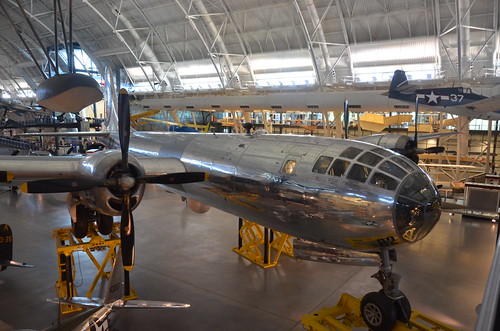
Image by Chris Devers
See more photos of this, and the Wikipedia article.
Details, quoting from Smithsonian National Air and Space Museum: Steven F. Udvar-Hazy | Boeing B-29 Superfortress "Enola Gay":
Boeing"s B-29 Superfortress was the most sophisticated propeller-driven bomber of World War II and the first bomber to house its crew in pressurized compartments. Although designed to fight in the European theater, the B-29 found its niche on the other side of the globe. In the Pacific, B-29s delivered a variety of aerial weapons: conventional bombs, incendiary bombs, mines, and two nuclear weapons.
On August 6, 1945, this Martin-built B-29-45-MO dropped the first atomic weapon used in combat on Hiroshima, Japan. Three days later, Bockscar (on display at the U.S. Air Force Museum near Dayton, Ohio) dropped a second atomic bomb on Nagasaki, Japan. Enola Gay flew as the advance weather reconnaissance aircraft that day. A third B-29, The Great Artiste, flew as an observation aircraft on both missions.
Transferred from the United States Air Force.
Manufacturer:
Boeing Aircraft Co.
Martin Co., Omaha, Nebr.
Date:
1945
Country of Origin:
United States of America
Dimensions:
Overall: 900 x 3020cm, 32580kg, 4300cm (29ft 6 5/16in. x 99ft 1in., 71825.9lb., 141ft 15/16in.)
Materials:
Polished overall aluminum finish
Physical Description:
Four-engine heavy bomber with semi-monoqoque fuselage and high-aspect ratio wings. Polished aluminum finish overall, standard late-World War II Army Air Forces insignia on wings and aft fuselage and serial number on vertical fin; 509th Composite Group markings painted in black; "Enola Gay" in black, block letters on lower left nose.
• • • • •
Quoting Smithsonian National Air and Space Museum | Grumman F6F-3 Hellcat:
The Grumman F6F Hellcat was originally conceived as an advanced version of the U.S. Navy"s then current front-line fighter, the F4F Wildcat (see NASM collection). The Wildcat"s intended replacement, the Vought F4U Corsair (see NASM collection), first flown in 1940, was showing great promise, but development was slowed by problems, including the crash of the prototype.
The National Air and Space Museum"s F6F-3 Hellcat, BuNo. 41834, was built at Grumman"s Bethpage, New York, factory in February 1944 under contract NOA-(S)846. It was delivered to the Navy on February 7, and arrived in San Diego, California, on the 18th. It was assigned to Fighter Squadron 15 (VF-15) on USS Hornet (CV12) bound for Hawaii. On arrival, it was assigned to VF-3 where it sustained damage in a wheels-up landing at NAS Barbers Point, Hawaii. After repair, it was assigned to VF-83 where it was used in a training role until February 21, 1945. After numerous transfers 41834 was converted to an F6F-3K target drone with the installation of sophisticated radio-control equipment. It was painted red with a pink tail that carried the number 14. Its mission was to be used in Operation Crossroads - the atomic bomb tests at Bikini Atoll. It flew on June 24, 1946, with a pilot, on a practice flight and was launched, unmanned, soon after the first bomb test. Instrumentation on board and photographic plates taped to the control stick obtained data on radioactivity. Three more manned flights preceded the final unmanned flight on July 25, 1946, which evaluated the first underwater explosion. Records indicate that exposure of this aircraft to the radioactive cloud was minimal and residual radiation is negligible.
F6F-3K 41834 was transferred to NAS Norfolk and logged its last flight on March 25, 1947, with a total of 430.2 flying hours. It was assigned to the National Air Museum on November 3, 1948, and remained at Norfolk until October 4, 1960, when it was moved by barge to Washington and placed in storage. In 1976 this Hellcat was loaned to the USS Yorktown Museum at Charleston, South Carolina. A superficial restoration was performed at the museum, but because of the harsh environment and its poor condition the Hellcat was returned to NASM on March 16, 1982. In 1983, it was sent to Grumman Aerospace where a team of volunteers completely restored the aircraft. In 1985, it was shipped back to the Paul E. Garber Preservation, Restoration and Storage Facility in Suitland, Maryland, and put in storage. NASM"s F6F-3 Hellcat is scheduled to be displayed in the new Steven F. Udvar-Hazy center at Dulles International Airport in Virginia in 2004.
Transferred from the United States Navy.
Manufacturer:
Grumman Aircraft Engineering China Corporation
Date:
1943
Country of Origin:
United States of America
Dimensions:
Overall: 338 x 1021cm, 4092kg, 1304cm (11ft 1 1/16in. x 33ft 5 15/16in., 9021.2lb., 42ft 9 3/8in.)
Physical Description:
Heavy armor plate, reinforced empennage, R-2800-10W engine, spring tabs on the ailerons (increased maneuverability), could carry rockets as well as bombs.
Steven F. Udvar-Hazy Center: Hawker Hurricane Mk. IIC, with Northrop P-61C Black Widow, B-29 Superfortress "Enola Gay", and SR-71 Blackbird in the background
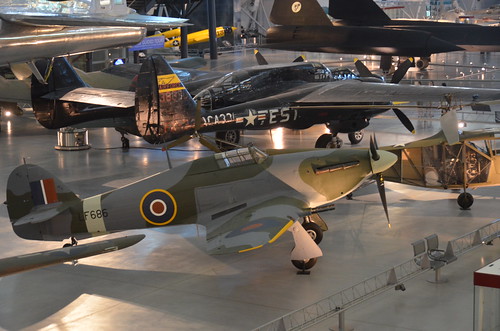
Image by Chris Devers
See more photos of this, and the Wikipedia article.
Details, quoting from Smithsonian National Air and Space Museum: Steven F. Udvar-Hazy | Hawker Hurricane Mk. IIC:
Hawker Chief Designer Sydney Camm"s Hurricane ranks with the most important aircraft designs in military aviation history. Designed in the late 1930s, when monoplanes were considered unstable and too radical to be successful, the Hurricane was the first British monoplane fighter and the first British fighter to exceed 483 kilometers (300 miles) per hour in level flight. Hurricane pilots fought the Luftwaffe and helped win the Battle of Britain in the summer of 1940.
This Mark IIC was built at the Langley factory, near what is now Heathrow Airport, early in 1944. It served as a training aircraft during the World War II in the Royal Air Force"s 41 OTU.
Donated by the Royal Air Force Museum
Manufacturer:
Hawker Aircraft Ltd.
Date:
1944
Country of Origin:
United Kingdom
Dimensions:
Wingspan: 12.2 m (40 ft)
Length: 9.8 m (32 ft 3 in)
Height: 4 m (13 ft)
Weight, empty: 2,624 kg (5,785 lb)
Weight, gross: 3,951 kg (8,710 lb)
Top speed:538 km/h (334 mph)
Engine:Rolls-Royce Merlin XX, liquid-cooled in-line V, 1,300 hp
Armament:four 20 mm Hispano cannons
Ordnance:two 250-lb or two 500-lb bombs or eight 3-in rockets
Materials:
Fuselage: Steel tube with aircraft spruce forms and fabric, aluminum cowling
Wings: Stressed Skin Aluminum
Horizontal Stablizer: Stress Skin aluminum
Rudder: fabric covered aluminum
Control Surfaces: fabric covered aluminum
Physical Description:
Hawker Hurricane Mk. IIC single seat, low wing monoplane ground attack fighter; enclosed cockpit; steel tube fuselage with aircraft spruce forms and fabric, aluminum cowling, stressed skin aluminum wings and horizontal stablizer, fabric covered aluminum rudder and control surfaces; grey green camoflage top surface paint scheme with dove grey underside; red and blue national roundel on upper wing surface and red, white, and blue roundel lower wing surface; red, white, blue, and yellow roundel fuselage sides; red, white and blue tail flash; Rolls-Royce Merlin XX, liquid cooled V-12, 1,280 horsepower engine; Armament, 4: 20mm Hispano cannons.
• • • • •
See more photos of this, and the Wikipedia article.
Details, quoting from Smithsonian National Air and Space Museum: Steven F. Udvar-Hazy | Northrop P-61C Black Widow:
The P-61 Black Widow was the first U.S. aircraft designed to locate and destroy enemy aircraft at night and in bad weather, a feat made possible by the use of on-board radar. The prototype first flew in 1942. P-61 combat operations began just after D-Day, June 6, 1944, when Black Widows flew deep into German airspace, bombing and strafing trains and road traffic. Operations in the Pacific began at about the same time. By the end of World War II, Black Widows had seen combat in every theater and had destroyed 127 enemy aircraft and 18 German V-1 buzz bombs.
The Museum’s Black Widow, a P-61C-1-NO, was delivered to the Army Air Forces in July 1945. It participated in cold-weather tests, high-altitude drop tests, and in the National Thunderstorm Project, for which the top turret was removed to make room for thunderstorm monitoring equipment.
Transferred from the United States Air Force.
Manufacturer:
Northrop Aircraft Inc.
Date:
1943
Country of Origin:
United States of America
Dimensions:
Overall: 450 x 1500cm, 10637kg, 2000cm (14ft 9 3/16in. x 49ft 2 9/16in., 23450.3lb., 65ft 7 3/8in.)
• • • • •
Quoting Smithsonian National Air and Space Museum | Boeing B-29 Superfortress "Enola Gay":
Boeing"s B-29 Superfortress was the most sophisticated propeller-driven bomber of World War II and the first bomber to house its crew in pressurized compartments. Although designed to fight in the European theater, the B-29 found its niche on the other side of the globe. In the Pacific, B-29s delivered a variety of aerial weapons: conventional bombs, incendiary bombs, mines, and two nuclear weapons.
On August 6, 1945, this Martin-built B-29-45-MO dropped the first atomic weapon used in combat on Hiroshima, Japan. Three days later, Bockscar (on display at the U.S. Air Force Museum near Dayton, Ohio) dropped a second atomic bomb on Nagasaki, Japan. Enola Gay flew as the advance weather reconnaissance aircraft that day. A third B-29, The Great Artiste, flew as an observation aircraft on both missions.
Transferred from the United States Air Force.
Manufacturer:
Boeing Aircraft Co.
Martin Co., Omaha, Nebr.
Date:
1945
Country of Origin:
United States of America
Dimensions:
Overall: 900 x 3020cm, 32580kg, 4300cm (29ft 6 5/16in. x 99ft 1in., 71825.9lb., 141ft 15/16in.)
Materials:
Polished overall aluminum finish
Physical Description:
Four-engine heavy bomber with semi-monoqoque fuselage and high-aspect ratio wings. Polished aluminum finish overall, standard late-World War II Army Air Forces insignia on wings and aft fuselage and serial number on vertical fin; 509th Composite Group markings painted in black; "Enola Gay" in black, block letters on lower left nose.
• • • • •
See more photos of this, and the Wikipedia article.
Details, quoting from Smithsonian National Air and Space Museum | Lockheed SR-71 Blackbird:
No reconnaissance aircraft in history has operated globally in more hostile airspace or with such complete impunity than the SR-71, the world"s fastest jet-propelled aircraft. The Blackbird"s performance and operational achievements placed it at the pinnacle of aviation technology developments during the Cold War.
This Blackbird accrued about 2,800 hours of flight time during 24 years of active service with the U.S. Air Force. On its last flight, March 6, 1990, Lt. Col. Ed Yielding and Lt. Col. Joseph Vida set a speed record by flying from Los Angeles to Washington, D.C., in 1 hour, 4 minutes, and 20 seconds, averaging 3,418 kilometers (2,124 miles) per hour. At the flight"s conclusion, they landed at Washington-Dulles International Airport and turned the airplane over to the Smithsonian.
Transferred from the United States Air Force.
Manufacturer:
Lockheed Aircraft Corporation
Designer:
Clarence L. "Kelly" Johnson
Date:
1964
Country of Origin:
United States of America
Dimensions:
Overall: 18ft 5 15/16in. x 55ft 7in. x 107ft 5in., 169998.5lb. (5.638m x 16.942m x 32.741m, 77110.8kg)
Other: 18ft 5 15/16in. x 107ft 5in. x 55ft 7in. (5.638m x 32.741m x 16.942m)
Materials:
Titanium
Physical Description:
Twin-engine, two-seat, supersonic strategic reconnaissance aircraft; airframe constructed largley of titanium and its alloys; vertical tail fins are constructed of a composite (laminated plastic-type material) to reduce radar cross-section; Pratt and Whitney J58 (JT11D-20B) turbojet engines feature large inlet shock cones.