Showing posts with label Advanced. Show all posts

Monday, May 9, 2016

Rapid Prototyping the advanced designing technique of corporate world

Rapid Prototyping the advanced designing approach of corporate globe


Speedy Prototype has been turn into an crucial part of modern corporate world and a number of industries are using it for sophisticated designing at cheapest rate. The outcomes following making use of it are a lot more good.


Rapid Prototyping is a group of tactics utilised to quickly fabricate a scale model of an assembly making use of 3D CAD information. 3D is the initial fast prototype method, which was developed by 3D systems of Valencia, CA (USA). But right now various varieties of RP methods are offered in the market place globe-wide. It is also has been referred to as a solid cost-free-form manufacturing, 3D CAD manufacturing and layered manufacturing.


3E Speedy Prototype is a single of the most advanced tactics of contemporary designing. It’s manufacturing in China to provide finish to end solutions at competitive rate.


Today the Fast prototype has been grow to be backbone of all industries in proving new shape and style. It has been also reshaped the all industries in last handful of years. Many designers and engineers are used it for solution development with contemporary prototype models and delivered in extremely short time period. It is cheapest way of receiving advanced model of consumer products within time. A lot of largest screens of common movies have been created by this strategy and also it use in creating all new movie’s screen.


The animations technologies has begun to shift away from classic approach towards CG animation. Animation Coraline has changed every little thing according to the modern strategy of animation. The use of traditional approaches was much more expensive than fast prototype strategy. The standard tactics have been more time-consuming which had been stopped the operate a couple of years. But 3E Fast prototype has been changed the scenario of designing and animation.


3D and 3E printing have been also used to make costume components. By employing 3E scanning strategy it is feasible for costume designers to generate custom-fitted design and style to appear like real image. All the styles produced by this method are versatile and good good quality.


The 3E printing has been confirmed the most admired there is an up-and-coming for Rapid Prototyping of costume components as producers need to have ever a lot more efficient. Some of the methods are like CNC machining, vacuum casting, speedy tooling, and mass production injection tooling in property. In addition to it there are some other techniques of prototyping.


Now a day the sophisticated created and shaped which are employing in diverse industries produced by Rapid Prototyping in accordance to provide an advanced design model at cheapest rate globe-wide.


To know far more about Fast prototype go to at www.rapidprototyping-china.com

Monday, September 15, 2014

Advanced Precision Machining


Excellent Meridian Enterprise.
Video Rating: / five


SUN Tech’s Sophisticated Precision Machining system gives the chance to discover the technology and to develop the expertise essential to operate machine tools…
Video Rating: / five


(Posted by a CNC machining China Company and precision CNC machined parts China manufacturer)

Monday, August 25, 2014

Aerospace 101: Everett advanced manufacture training center to open this fall

Aerospace 101: Everett advanced manufacture training center to open this fall

By next fall, Everett Community College"s new 37,000-square-foot aerospace manufacturing training center should be airborne. The new center, converted from a former medical records storage facility for Providence Hospital, will contain hands-on …
Read more on Puget Sound Business Journal (Seattle)


Sciaky to supply EBAM system to major aerospace parts maker

Chicago, Illinois – Sciaky Inc., a subsidiary of Phillips Service Industries Inc. (PSI) and provider of large-scale additive manufacturing solutions, has received a purchase order from a major aerospace parts maker to provide an electron beam additive …
Read more on Aerospace Manufacturing China and Design


Coast Composites And Odyssey Industries Add New Machining Capabilities To

This represents a significant Capital Expenditure investment for these members of the AIP Aerospace Tooling Group, further augmenting their capability to meet their increasing demands for high quality tooling and shorter delivery schedules from …
Read more on Machine Tools Online (press release)


Aerospace 101: Everett advanced manufacture training center to open this fall

Thursday, August 21, 2014

The Role of Labor in Advanced Manufacturing China

The Role of Labor in Advanced Manufacturing China

A student at Southwestern Illinois College uses a CNC China machine to create a metal object to specifications programmed into the machine. If the skills gap in manufacturing positions is as wide as we are lead to believe, then it is even more imperative …
Read more on Area Development Online


£1.3m boost creates 13 local jobs

Milford Mercury: BUSINESS BOOST: Managing director Ed Spankie with Neil Owen, CNC China machine BUSINESS BOOST: Managing director Ed Spankie with Neil Owen, CNC China machine operator, with the new machine, which cost more than £400,000. PICTURE: …
Read more on Milford Mercury


The Role of Labor in Advanced Manufacturing China

Sunday, August 10, 2014

Advanced Laser Machining to expand facility, create jobs

Advanced Laser Machining to expand facility, create jobs

Chief Editor, Industrial Laser Solutions. Chippewa Falls, WI – Laser cutting and precision metal fabricator Advanced Laser Machining China (ALM) is expanding its facility—a project expected to create 27 new jobs and retain about 100 existing positions. The …
Read more on Industrial Laser Solutions Magazine


Counties developing .4M manufacturing lab

Bundy Baking Solutions in Urbana is one of several local manufacturers who are working together to develop a mobile manufacturing lab that can move between seven area counties, promoting the kinds of jobs available in manufacturing. The lab … In the …
Read more on Springfield News Sun


Advanced Laser Machining to expand facility, create jobs

Wednesday, August 6, 2014

Nice Advanced Precision Machining China photos

A few nice advanced precision machining images I found:


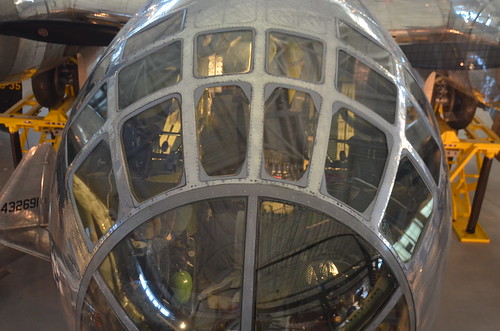
Steven F. Udvar-Hazy Center: Boeing B-29 Superfortress “Enola Gay” (view into nose cockpit)


Image by Chris Devers
See more photos of this, and the Wikipedia article.


Details, quoting from Smithsonian National Air and Space Museum | Boeing B-29 Superfortress "Enola Gay":


Boeing’s B-29 Superfortress was the most sophisticated propeller-driven bomber of World War II and the first bomber to house its crew in pressurized compartments. Although designed to fight in the European theater, the B-29 found its niche on the other side of the globe. In the Pacific, B-29s delivered a variety of aerial weapons: conventional bombs, incendiary bombs, mines, and two nuclear weapons.


On August 6, 1945, this Martin-built B-29-45-MO dropped the first atomic weapon used in combat on Hiroshima, Japan. Three days later, Bockscar (on display at the U.S. Air Force Museum near Dayton, Ohio) dropped a second atomic bomb on Nagasaki, Japan. Enola Gay flew as the advance weather reconnaissance aircraft that day. A third B-29, The Great Artiste, flew as an observation aircraft on both missions.


Transferred from the United States Air Force.


Manufacturer:
Boeing Aircraft Co.
Martin Co., Omaha, Nebr.


Date:

1945


Country of Origin:

United States of America


Dimensions:

Overall: 900 x 3020cm, 32580kg, 4300cm (29ft 6 5/16in. x 99ft 1in., 71825.9lb., 141ft 15/16in.)


Materials:

Polished overall aluminum finish


Physical Description:

Four-engine heavy bomber with semi-monoqoque fuselage and high-aspect ratio wings. Polished aluminum finish overall, standard late-World War II Army Air Forces insignia on wings and aft fuselage and serial number on vertical fin; 509th Composite Group markings painted in black; "Enola Gay" in black, block letters on lower left nose.


Long Description:

Boeing’s B-29 Superfortress was the most sophisticated, propeller-driven, bomber to fly during World War II, and the first bomber to house its crew in pressurized compartments. Boeing installed very advanced armament, propulsion, and avionics systems into the Superfortress. During the war in the Pacific Theater, the B-29 delivered the first nuclear weapons used in combat. On August 6, 1945, Colonel Paul W. Tibbets, Jr., in command of the Superfortress Enola Gay, dropped a highly enriched uranium, explosion-type, "gun-fired," atomic bomb on Hiroshima, Japan. Three days later, Major Charles W. Sweeney piloted the B-29 Bockscar and dropped a highly enriched plutonium, implosion-type atomic bomb on Nagasaki, Japan. Enola Gay flew as the advance weather reconnaissance aircraft that day. On August 14, 1945, the Japanese accepted Allied terms for unconditional surrender.


In the late 1930s, U. S. Army Air Corps leaders recognized the need for very long-range bombers that exceeded the performance of the B-17 Flying Fortress. Several years of preliminary studies paralleled a continuous fight against those who saw limited utility in developing such an expensive and unproven aircraft but the Air Corps issued a requirement for the new bomber in February 1940. It described an airplane that could carry a maximum bomb load of 909 kg (2,000 lb) at a speed of 644 kph (400 mph) a distance of at least 8,050 km (5,000 miles). Boeing, Consolidated, Douglas, and Lockheed responded with design proposals. The Army was impressed with the Boeing design and issued a contract for two flyable prototypes in September 1940. In April 1941, the Army issued another contract for 250 aircraft plus spare parts equivalent to another 25 bombers, eight months before Pearl Harbor and nearly a year-and-a-half before the first Superfortress would fly.


Among the design’s innovations was a long, narrow, high-aspect ratio wing equipped with large Fowler-type flaps. This wing design allowed the B-29 to fly very fast at high altitudes but maintained comfortable handling characteristics during takeoff and landing. More revolutionary was the size and sophistication of the pressurized sections of the fuselage: the flight deck forward of the wing, the gunner’s compartment aft of the wing, and the tail gunner’s station. For the crew, flying at extreme altitudes became much more comfortable as pressure and temperature could be regulated. To protect the Superfortress, Boeing designed a remote-controlled, defensive weapons system. Engineers placed five gun turrets on the fuselage: a turret above and behind the cockpit that housed two .50 caliber machine guns (four guns in later versions), and another turret aft near the vertical tail equipped with two machine guns; plus two more turrets beneath the fuselage, each equipped with two .50 caliber guns. One of these turrets fired from behind the nose gear and the other hung further back near the tail. Another two .50 caliber machine guns and a 20-mm cannon (in early versions of the B-29) were fitted in the tail beneath the rudder. Gunners operated these turrets by remote control–a true innovation. They aimed the guns using computerized sights, and each gunner could take control of two or more turrets to concentrate firepower on a single target.


Boeing also equipped the B-29 with advanced radar equipment and avionics. Depending on the type of mission, a B-29 carried the AN/APQ-13 or AN/APQ-7 Eagle radar system to aid bombing and navigation. These systems were accurate enough to permit bombing through cloud layers that completely obscured the target. The B-29B was equipped with the AN/APG-15B airborne radar gun sighting system mounted in the tail, insuring accurate defense against enemy fighters attacking at night. B-29s also routinely carried as many as twenty different types of radios and navigation devices.


The first XB-29 took off at Boeing Field in Seattle on September 21, 1942. By the end of the year the second aircraft was ready for flight. Fourteen service-test YB-29s followed as production began to accelerate. Building this advanced bomber required massive logistics. Boeing built new B-29 plants at Renton, Washington, and Wichita, Kansas, while Bell built a new plant at Marietta, Georgia, and Martin built one in Omaha, Nebraska. Both Curtiss-Wright and the Dodge automobile company vastly expanded their manufacturing capacity to build the bomber’s powerful and complex Curtiss-Wright R-3350 turbo supercharged engines. The program required thousands of sub-contractors but with extraordinary effort, it all came together, despite major teething problems. By April 1944, the first operational B-29s of the newly formed 20th Air Force began to touch down on dusty airfields in India. By May, 130 B-29s were operational. In June, 1944, less than two years after the initial flight of the XB-29, the U. S. Army Air Forces (AAF) flew its first B-29 combat mission against targets in Bangkok, Thailand. This mission (longest of the war to date) called for 100 B-29s but only 80 reached the target area. The AAF lost no aircraft to enemy action but bombing results were mediocre. The first bombing mission against the Japanese main islands since Lt. Col. "Jimmy" Doolittle’s raid against Tokyo in April 1942, occurred on June 15, again with poor results. This was also the first mission launched from airbases in China.


With the fall of Saipan, Tinian, and Guam in the Mariana Islands chain in August 1944, the AAF acquired airbases that lay several hundred miles closer to mainland Japan. Late in 1944, the AAF moved the XXI Bomber Command, flying B-29s, to the Marianas and the unit began bombing Japan in December. However, they employed high-altitude, precision, bombing tactics that yielded poor results. The high altitude winds were so strong that bombing computers could not compensate and the weather was so poor that rarely was visual target acquisition possible at high altitudes. In March 1945, Major General Curtis E. LeMay ordered the group to abandon these tactics and strike instead at night, from low altitude, using incendiary bombs. These firebombing raids, carried out by hundreds of B-29s, devastated much of Japan’s industrial and economic infrastructure. Yet Japan fought on. Late in 1944, AAF leaders selected the Martin assembly line to produce a squadron of B-29s codenamed SILVERPLATE. Martin modified these Superfortresses by removing all gun turrets except for the tail position, removing armor plate, installing Curtiss electric propellers, and modifying the bomb bay to accommodate either the "Fat Man" or "Little Boy" versions of the atomic bomb. The AAF assigned 15 Silverplate ships to the 509th Composite Group commanded by Colonel Paul Tibbets. As the Group Commander, Tibbets had no specific aircraft assigned to him as did the mission pilots. He was entitled to fly any aircraft at any time. He named the B-29 that he flew on 6 August Enola Gay after his mother. In the early morning hours, just prior to the August 6th mission, Tibbets had a young Army Air Forces maintenance man, Private Nelson Miller, paint the name just under the pilot’s window.


Enola Gay is a model B-29-45-MO, serial number 44-86292. The AAF accepted this aircraft on June 14, 1945, from the Martin plant at Omaha (Located at what is today Offut AFB near Bellevue), Nebraska. After the war, Army Air Forces crews flew the airplane during the Operation Crossroads atomic test program in the Pacific, although it dropped no nuclear devices during these tests, and then delivered it to Davis-Monthan Army Airfield, Arizona, for storage. Later, the U. S. Air Force flew the bomber to Park Ridge, Illinois, then transferred it to the Smithsonian Institution on July 4, 1949. Although in Smithsonian custody, the aircraft remained stored at Pyote Air Force Base, Texas, between January 1952 and December 1953. The airplane’s last flight ended on December 2 when the Enola Gay touched down at Andrews Air Force Base, Maryland. The bomber remained at Andrews in outdoor storage until August 1960. By then, concerned about the bomber deteriorating outdoors, the Smithsonian sent collections staff to disassemble the Superfortress and move it indoors to the Paul E. Garber Facility in Suitland, Maryland.


The staff at Garber began working to preserve and restore Enola Gay in December 1984. This was the largest restoration project ever undertaken at the National Air and Space Museum and the specialists anticipated the work would require from seven to nine years to complete. The project actually lasted nearly two decades and, when completed, had taken approximately 300,000 work-hours to complete. The B-29 is now displayed at the National Air and Space Museum, Steven F. Udvar-Hazy Center.


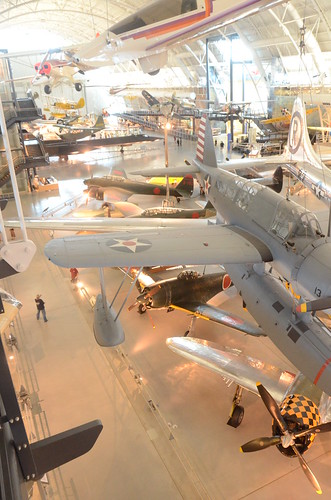
Steven F. Udvar-Hazy Center: South hangar panorama, including Vought OS2U-3 Kingfisher seaplane, B-29 Enola Gay, among others


Image by Chris Devers

Quoting Smithsonian National Air and Space Museum | Vought OS2U-3 Kingfisher:


The Kingfisher was the U.S. Navy’s primary ship-based, scout and observation aircraft during World War II. Revolutionary spot welding techniques gave it a smooth, non-buckling fuselage structure. Deflector plate flaps that hung from the wing’s trailing edge and spoiler-augmented ailerons functioned like extra flaps to allow slower landing speeds. Most OS2Us operated in the Pacific, where they rescued many downed airmen, including World War I ace Eddie Rickenbacker and the crew of his B-17 Flying Fortress.


In March 1942, this airplane was assigned to the battleship USS Indiana. It later underwent a six-month overhaul in California, returned to Pearl Harbor, and rejoined the Indiana in March 1944. Lt. j.g. Rollin M. Batten Jr. was awarded the Navy Cross for making a daring rescue in this airplane under heavy enemy fire on July 4, 1944.


Transferred from the United States Navy.


Manufacturer:
Vought-Sikorsky Aircraft Division


Date:

1937


Country of Origin:

United States of America


Dimensions:

Overall: 15ft 1 1/8in. x 33ft 9 1/2in., 4122.6lb., 36ft 1 1/16in. (460 x 1030cm, 1870kg, 1100cm)


Materials:

Wings covered with fabric aft of the main spar


Physical Description:

Two-seat monoplane, deflector plate flaps hung from the trailing edge of the wing, ailerons drooped at low airspeeds to function like extra flaps, spoilers.


• • • • •


Quoting Smithsonian National Air and Space Museum | Boeing B-29 Superfortress "Enola Gay":


Boeing’s B-29 Superfortress was the most sophisticated propeller-driven bomber of World War II and the first bomber to house its crew in pressurized compartments. Although designed to fight in the European theater, the B-29 found its niche on the other side of the globe. In the Pacific, B-29s delivered a variety of aerial weapons: conventional bombs, incendiary bombs, mines, and two nuclear weapons.


On August 6, 1945, this Martin-built B-29-45-MO dropped the first atomic weapon used in combat on Hiroshima, Japan. Three days later, Bockscar (on display at the U.S. Air Force Museum near Dayton, Ohio) dropped a second atomic bomb on Nagasaki, Japan. Enola Gay flew as the advance weather reconnaissance aircraft that day. A third B-29, The Great Artiste, flew as an observation aircraft on both missions.


Transferred from the United States Air Force.


Manufacturer:
Boeing Aircraft Co.
Martin Co., Omaha, Nebr.


Date:

1945


Country of Origin:

United States of America


Dimensions:

Overall: 900 x 3020cm, 32580kg, 4300cm (29ft 6 5/16in. x 99ft 1in., 71825.9lb., 141ft 15/16in.)


Materials:

Polished overall aluminum finish


Physical Description:

Four-engine heavy bomber with semi-monoqoque fuselage and high-aspect ratio wings. Polished aluminum finish overall, standard late-World War II Army Air Forces insignia on wings and aft fuselage and serial number on vertical fin; 509th Composite Group markings painted in black; "Enola Gay" in black, block letters on lower left nose.


Nice Advanced Precision Machining China photos

Wednesday, July 23, 2014

Know More About Precision Cnc Machining China Operations And Their Advanced Capabilities


Know More About Precision Cnc Machining China Operations And Their Advanced Capabilities

Precision CNC machining China is one of the latest discoveries in the field of engineering China that has led to a revolutionary change in the manufacture and designing capabilities of an engineering China firm. Traditional milling China methods have been nearly discarded as more advanced CNC or Computer Numerical Control milling China machines have taken over. High Precision Engineering China methods and techniques are now being continually used in most of the spheres of industrial operations. One of the most valuable benefits of these machines is that it requires much less time to complete a particular job, compared to the conventional milling China machines. They have the capability to increase productivity simultaneously adding to the profit share of the entrepreneurs.


A typical high precision CNC machining China shop can easily perform varied range of activities ranging from prototyping, fabrication and Shaping & molding of cutting tools. List of major components manufactured via high-precision process includes motor parts, car parts, engine parts and many such components that require higher safety and quality standards. Such a machining China shop requires a hefty investment from the owners side to install the complete set-up. Moreover, it requires trained professionals and engineers for operating. Therefore, having an in-house set-up for this purpose is not just troublesome but it also requires a lot if investment. Due to this reason most of the manufacturing China units outsource their precision CNC machining China job to advanced CNC centers for manufacturing China specific components through advanced CNC milling China machine. Following are some of the advanced capabilities to these high tech equipments:


-High-tech CNC machine Chinas can consistently fabricate complex components with absolute accuracy and precision. The latest CNC models can perform their operation based on CAD/CAM designs for multi-capable operations like multi-axis cutting and drilling operations.


-These advanced equipments are capable of manufacturing China a wide spectrum of components in different sizes. Larger machining China centers produce large parts and components whereas smaller units generate small size components.


-These machines are controlled and commanded through a software control panel. The operator just needs to set the command on the computer screen, and the rest of the work is done by the machine. It requires fully trained professionals, who are aware of the programming skills and commands, for operating these machines.


-One of the most interesting features of these machines is that they can repetitively perform intricate milling China operations over a long period of time.


-It provides a safer working environment as the operator can easily operate the machines (operating within enclosed areas) from a distant place.


-It provides an easy to use interface which also enables the operator to make necessary adjustments as and when required. It can be easily put to a temporary halt for fixing the related data fields or making necessary adjustments to the cutting tools, and then resume the usual milling China operations.


These days you can easily outsource your precision CNC machining China job to any of the CNC milling China companies. Dennis Ferranti Group is a popular engineering China firm that provides integrated manufacturing China solutions.


I webmaster of dferrantigroup.com which specializes in CNC Precision Engineering China Like precision engineering China and lots more. For more information about high precision machining China and precision machined parts China, Please visit http://www.dferrantigroup.com


More Precise Machining China And Manufacturing China Articles


Know More About Precision Cnc Machining China Operations And Their Advanced Capabilities

Monday, July 21, 2014

Gleason to Demonstrate Advanced Bevel and Cylindrical Gear Production and ...

Gleason to Demonstrate Advanced Bevel and Cylindrical Gear Production and

ROCHESTER, NEW YORK, USA — In its continuing mission to be the industry"s Total Gear Solutions Provider, Gleason will demonstrate advanced machines, tooling, and global customer support services at IMTS 2014, covering a wide array of processes for the …
Read more on ThomasNet News (press release)


Top five metal spring and stamping trends for 2014

The need to expand machining capabilities is a big focus of spring and stamping companies looking to support their customers by reducing costs and logistical complexities. … The Tsugami 5-axis CNC Swiss machining equipment is a bar-fed automatic …
Read more on Today’s Medical Developments


Gleason to Demonstrate Advanced Bevel and Cylindrical Gear Production and ...

Thursday, July 17, 2014

Cool Advanced Precision Machining China images

Check out these advanced precision machining images:


Steven F. Udvar-Hazy Center: Boeing B-29 Superfortress “Enola Gay” (nose view)


Image by Chris Devers

Quoting Smithsonian National Air and Space Museum | Boeing B-29 Superfortress "Enola Gay":


Boeing’s B-29 Superfortress was the most sophisticated propeller-driven bomber of World War II and the first bomber to house its crew in pressurized compartments. Although designed to fight in the European theater, the B-29 found its niche on the other side of the globe. In the Pacific, B-29s delivered a variety of aerial weapons: conventional bombs, incendiary bombs, mines, and two nuclear weapons.


On August 6, 1945, this Martin-built B-29-45-MO dropped the first atomic weapon used in combat on Hiroshima, Japan. Three days later, Bockscar (on display at the U.S. Air Force Museum near Dayton, Ohio) dropped a second atomic bomb on Nagasaki, Japan. Enola Gay flew as the advance weather reconnaissance aircraft that day. A third B-29, The Great Artiste, flew as an observation aircraft on both missions.


Transferred from the United States Air Force.


Manufacturer:
Boeing Aircraft Co.
Martin Co., Omaha, Nebr.


Date:

1945


Country of Origin:

United States of America


Dimensions:

Overall: 900 x 3020cm, 32580kg, 4300cm (29ft 6 5/16in. x 99ft 1in., 71825.9lb., 141ft 15/16in.)


Materials:

Polished overall aluminum finish


Physical Description:

Four-engine heavy bomber with semi-monoqoque fuselage and high-aspect ratio wings. Polished aluminum finish overall, standard late-World War II Army Air Forces insignia on wings and aft fuselage and serial number on vertical fin; 509th Composite Group markings painted in black; "Enola Gay" in black, block letters on lower left nose.


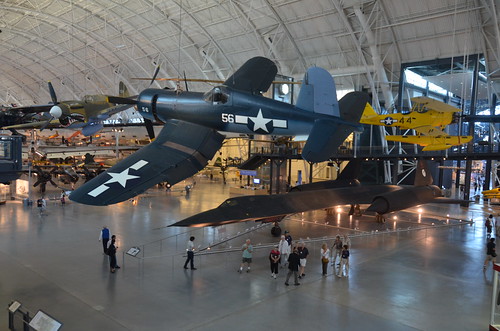
Steven F. Udvar-Hazy Center: Vought F4U-1D Corsair, with P-40 Warhawk and SR-71 Blackbird in background


Image by Chris Devers

Quoting Smithsonian National Air and Space Museum | Curtiss P-40E Warhawk (Kittyhawk IA):


Whether known as the Warhawk, Tomahawk, or Kittyhawk, the Curtiss P-40 proved to be a successful, versatile fighter during the first half of World War II. The shark-mouthed Tomahawks that Gen. Claire Chennault’s "Flying Tigers" flew in China against the Japanese remain among the most popular airplanes of the war. P-40E pilot Lt. Boyd D. Wagner became the first American ace of World War II when he shot down six Japanese aircraft in the Philippines in mid-December 1941.


Curtiss-Wright built this airplane as Model 87-A3 and delivered it to Canada as a Kittyhawk I in 1941. It served until 1946 in No. 111 Squadron, Royal Canadian Air Force. U.S. Air Force personnel at Andrews Air Force Base restored it in 1975 to represent an aircraft of the 75th Fighter Squadron, 23rd Fighter Group, 14th Air Force.


Donated by the Exchange Club in Memory of Kellis Forbes.


Manufacturer:
Curtiss Aircraft Company


Date:

1939


Country of Origin:

United States of America


Dimensions:

Overall: 330 x 970cm, 2686kg, 1140cm (10ft 9 15/16in. x 31ft 9 7/8in., 5921.6lb., 37ft 4 13/16in.)


Materials:

All-metal, semi-monocoque


Physical Description:

Single engine, single seat, fighter aircraft.


• • • • •


Quoting Smithsonian National Air and Space Museum | Lockheed SR-71 Blackbird:


No reconnaissance aircraft in history has operated globally in more hostile airspace or with such complete impunity than the SR-71, the world’s fastest jet-propelled aircraft. The Blackbird’s performance and operational achievements placed it at the pinnacle of aviation technology developments during the Cold War.


This Blackbird accrued about 2,800 hours of flight time during 24 years of active service with the U.S. Air Force. On its last flight, March 6, 1990, Lt. Col. Ed Yielding and Lt. Col. Joseph Vida set a speed record by flying from Los Angeles to Washington, D.C., in 1 hour, 4 minutes, and 20 seconds, averaging 3,418 kilometers (2,124 miles) per hour. At the flight’s conclusion, they landed at Washington-Dulles International Airport and turned the airplane over to the Smithsonian.


Transferred from the United States Air Force.


Manufacturer:
Lockheed Aircraft Corporation


Designer:
Clarence L. "Kelly" Johnson


Date:

1964


Country of Origin:

United States of America


Dimensions:

Overall: 18ft 5 15/16in. x 55ft 7in. x 107ft 5in., 169998.5lb. (5.638m x 16.942m x 32.741m, 77110.8kg)

Other: 18ft 5 15/16in. x 107ft 5in. x 55ft 7in. (5.638m x 32.741m x 16.942m)


Materials:

Titanium


Physical Description:

Twin-engine, two-seat, supersonic strategic reconnaissance aircraft; airframe constructed largley of titanium and its alloys; vertical tail fins are constructed of a composite (laminated plastic-type material) to reduce radar cross-section; Pratt and Whitney J58 (JT11D-20B) turbojet engines feature large inlet shock cones.


• • • • •


Quoting Smithsonian National Air and Space Museum | Vought F4U-1D Corsair :


By V-J Day, September 2, 1945, Corsair pilots had amassed an 11:1 kill ratio against enemy aircraft. The aircraft’s distinctive inverted gull-wing design allowed ground clearance for the huge, three-bladed Hamilton Standard Hydromatic propeller, which spanned more than 4 meters (13 feet). The Pratt and Whitney R-2800 radial engine and Hydromatic propeller was the largest and one of the most powerful engine-propeller combinations ever flown on a fighter aircraft.


Charles Lindbergh flew bombing missions in a Corsair with Marine Air Group 31 against Japanese strongholds in the Pacific in 1944. This airplane is painted in the colors and markings of the Corsair Sun Setter, a Marine close-support fighter assigned to the USS Essex in July 1944.


Transferred from the United States Navy.


Manufacturer:
Vought Aircraft Company


Date:

1940


Country of Origin:

United States of America


Dimensions:

Overall: 460 x 1020cm, 4037kg, 1250cm (15ft 1 1/8in. x 33ft 5 9/16in., 8900lb., 41ft 1/8in.)


Materials:

All metal with fabric-covered wings behind the main spar.


Physical Description:

R-2800 radial air-cooled engine with 1,850 horsepower, turned a three-blade Hamilton Standard Hydromatic propeller with solid aluminum blades spanning 13 feet 1 inch; wing bent gull-shaped on both sides of the fuselage.


Cool Advanced Precision Machining China images

Monday, July 14, 2014

Nice Advanced Precision Machining China photos

A few nice advanced precision machining images I found:


Steven F. Udvar-Hazy Center: North American P-51C, "Excalibur III", with tails of Concorde & Boeing 707 in background


Image by Chris Devers

Quoting Smithsonian National Air and Space Museum | North American P-51C, "Excalibur III":


On May 29, 1951, Capt. Charles F. Blair flew Excalibur III from Norway across the North Pole to Alaska in a record-setting 10½ hours. Using a system of carefully plotted "sun lines" he developed, Blair was able to navigate with precision where conventional magnetic compasses often failed. Four months earlier, he had flown Excalibur III from New York to London in less than 8 hours, breaking the existing mark by over an hour.


Excalibur III first belonged to famed aviator A. Paul Mantz, who added extra fuel tanks for long-distance racing to this standard P-51C fighter. With it Mantz won the 1946 and 1947 Bendix air race and set a transcontinental speed record in 1947 when the airplane was named Blaze of Noon. Blair purchased it from Mantz in 1949 and renamed it Excalibur III, after the Sikorsky VS-44 flying boat he flew for American Export Airlines.


Gift of Pan American World Airways


Manufacturer:
North American Aircraft Company


Date:

1944


Country of Origin:

United States of America


Dimensions:

Wingspan: 11.3 m (37 ft)

Length: 9.8 m (32 ft 3 in)

Height: 3.9 m (12 ft 10 in)

Weight, empty: 4,445 kg (9,800 lb)

Weight, gross: 5,052 kg (11,800 lb)

Top speed: 700 km/h (435 mph)


Materials:

Overall: Aluminum


Physical Description:

Single seat, single engine, low wing monoplane, World War II fighter modified for racing.


• • • • •


Quoting Smithsonian National Air and Space Museum | Boeing 367-80 Jet Transport:


On July 15, 1954, a graceful, swept-winged aircraft, bedecked in brown and yellow paint and powered by four revolutionary new engines first took to the sky above Seattle. Built by the Boeing Aircraft Company, the 367-80, better known as the Dash 80, would come to revolutionize commercial air transportation when its developed version entered service as the famous Boeing 707, America’s first jet airliner.


In the early 1950s, Boeing had begun to study the possibility of creating a jet-powered military transport and tanker to complement the new generation of Boeing jet bombers entering service with the U.S. Air Force. When the Air Force showed no interest, Boeing invested million of its own capital to build a prototype jet transport in a daring gamble that the airlines and the Air Force would buy it once the aircraft had flown and proven itself. As Boeing had done with the B-17, it risked the company on one roll of the dice and won.


Boeing engineers had initially based the jet transport on studies of improved designs of the Model 367, better known to the public as the C-97 piston-engined transport and aerial tanker. By the time Boeing progressed to the 80th iteration, the design bore no resemblance to the C-97 but, for security reasons, Boeing decided to let the jet project be known as the 367-80.


Work proceeded quickly after the formal start of the project on May 20, 1952. The 367-80 mated a large cabin based on the dimensions of the C-97 with the 35-degree swept-wing design based on the wings of the B-47 and B-52 but considerably stiffer and incorporating a pronounced dihedral. The wings were mounted low on the fuselage and incorporated high-speed and low-speed ailerons as well as a sophisticated flap and spoiler system. Four Pratt & Whitney JT3 turbojet engines, each producing 10,000 pounds of thrust, were mounted on struts beneath the wings.


Upon the Dash 80′s first flight on July 15, 1954, (the 34th anniversary of the founding of the Boeing Company) Boeing clearly had a winner. Flying 100 miles per hour faster than the de Havilland Comet and significantly larger, the new Boeing had a maximum range of more than 3,500 miles. As hoped, the Air Force bought 29 examples of the design as a tanker/transport after they convinced Boeing to widen the design by 12 inches. Satisfied, the Air Force designated it the KC-135A. A total of 732 KC-135s were built.


Quickly Boeing turned its attention to selling the airline industry on this new jet transport. Clearly the industry was impressed with the capabilities of the prototype 707 but never more so than at the Gold Cup hydroplane races held on Lake Washington in Seattle, in August 1955. During the festivities surrounding this event, Boeing had gathered many airline representatives to enjoy the competition and witness a fly past of the new Dash 80. To the audience’s intense delight and Boeing’s profound shock, test pilot Alvin "Tex" Johnston barrel-rolled the Dash 80 over the lake in full view of thousands of astonished spectators. Johnston vividly displayed the superior strength and performance of this new jet, readily convincing the airline industry to buy this new airliner.


In searching for a market, Boeing found a ready customer in Pan American Airway’s president Juan Trippe. Trippe had been spending much of his time searching for a suitable jet airliner to enable his pioneering company to maintain its leadership in international air travel. Working with Boeing, Trippe overcame Boeing’s resistance to widening the Dash-80 design, now known as the 707, to seat six passengers in each seat row rather than five. Trippe did so by placing an order with Boeing for 20 707s but also ordering 25 of Douglas’s competing DC-8, which had yet to fly but could accommodate six-abreast seating. At Pan Am’s insistence, the 707 was made four inches wider than the Dash 80 so that it could carry 160 passengers six-abreast. The wider fuselage developed for the 707 became the standard design for all of Boeing’s subsequent narrow-body airliners.


Although the British de Havilland D.H. 106 Comet and the Soviet Tupolev Tu-104 entered service earlier, the Boeing 707 and Douglas DC-8 were bigger, faster, had greater range, and were more profitable to fly. In October 1958 Pan American ushered the jet age into the United States when it opened international service with the Boeing 707 in October 1958. National Airlines inaugurated domestic jet service two months later using a 707-120 borrowed from Pan Am. American Airlines flew the first domestic 707 jet service with its own aircraft in January 1959. American set a new speed mark when it opened the first regularly-scheduled transcontinental jet service in 1959. Subsequent nonstop flights between New York and San Francisco took only 5 hours – 3 hours less than by the piston-engine DC-7. The one-way fare, including a surcharge for jet service, was 5.50, or 1 round trip. The flight was almost 40 percent faster and almost 25 percent cheaper than flying by piston-engine airliners. The consequent surge of traffic demand was substantial.


The 707 was originally designed for transcontinental or one-stop transatlantic range. But modified with extra fuel tanks and more efficient turbofan engines, the 707-300 Intercontinental series aircraft could fly nonstop across the Atlantic with full payload under any conditions. Boeing built 855 707s, of which 725 were bought by airlines worldwide.


Having launched the Boeing Company into the commercial jet age, the Dash 80 soldiered on as a highly successful experimental aircraft. Until its retirement in 1972, the Dash 80 tested numerous advanced systems, many of which were incorporated into later generations of jet transports. At one point, the Dash 80 carried three different engine types in its four nacelles. Serving as a test bed for the new 727, the Dash 80 was briefly equipped with a fifth engine mounted on the rear fuselage. Engineers also modified the wing in planform and contour to study the effects of different airfoil shapes. Numerous flap configurations were also fitted including a highly sophisticated system of "blown" flaps which redirected engine exhaust over the flaps to increase lift at low speeds. Fin height and horizontal stabilizer width was later increased and at one point, a special multiple wheel low pressure landing gear was fitted to test the feasibility of operating future heavy military transports from unprepared landing fields.


After a long and distinguished career, the Boeing 367-80 was finally retired and donated to the Smithsonian in 1972. At present, the aircraft is installated at the National Air and Space Museum’s new facility at Washington Dulles International Airport.


Gift of the Boeing Company


Manufacturer:
Boeing Aircraft Co.


Date:

1954


Country of Origin:

United States of America


Dimensions:

Height 19′ 2": Length 73′ 10": Wing Span 129′ 8": Weight 33,279 lbs.


Physical Description:

Prototype Boeing 707; yellow and brown.


• • • • •


Quoting Smithsonian National Air and Space Museum | Concorde, Fox Alpha, Air France:


The first supersonic airliner to enter service, the Concorde flew thousands of passengers across the Atlantic at twice the speed of sound for over 25 years. Designed and built by Aérospatiale of France and the British Aviation Corporation, the graceful Concorde was a stunning technological achievement that could not overcome serious economic problems.


In 1976 Air France and British Airways jointly inaugurated Concorde service to destinations around the globe. Carrying up to 100 passengers in great comfort, the Concorde catered to first class passengers for whom speed was critical. It could cross the Atlantic in fewer than four hours – half the time of a conventional jet airliner. However its high operating costs resulted in very high fares that limited the number of passengers who could afford to fly it. These problems and a shrinking market eventually forced the reduction of service until all Concordes were retired in 2003.


In 1989, Air France signed a letter of agreement to donate a Concorde to the National Air and Space Museum upon the aircraft’s retirement. On June 12, 2003, Air France honored that agreement, donating Concorde F-BVFA to the Museum upon the completion of its last flight. This aircraft was the first Air France Concorde to open service to Rio de Janeiro, Washington, D.C., and New York and had flown 17,824 hours.


Gift of Air France.


Manufacturer:
Societe Nationale Industrielle Aerospatiale
British Aircraft Corporation


Dimensions:

Wingspan: 25.56 m (83 ft 10 in)

Length: 61.66 m (202 ft 3 in)

Height: 11.3 m (37 ft 1 in)

Weight, empty: 79,265 kg (174,750 lb)

Weight, gross: 181,435 kg (400,000 lb)

Top speed: 2,179 km/h (1350 mph)

Engine: Four Rolls-Royce/SNECMA Olympus 593 Mk 602, 17,259 kg (38,050 lb) thrust each

Manufacturer: Société Nationale Industrielle Aérospatiale, Paris, France, and British Aircraft Corporation, London, United Kingdom


Physical Description:

Aircaft Serial Number: 205. Including four (4) engines, bearing respectively the serial number: CBE066, CBE062, CBE086 and CBE085.

Also included, aircraft plaque: "AIR FRANCE Lorsque viendra le jour d’exposer Concorde dans un musee, la Smithsonian Institution a dores et deja choisi, pour le Musee de l’Air et de l’Espace de Washington, un appariel portant le couleurs d’Air France."


Steven F. Udvar-Hazy Center: south hangar panorama, including B-29 Superfortress “Enola Gay”, Grumman F6F-3 Hellcat, among others


Image by Chris Devers
See more photos of this, and the Wikipedia article.


Details, quoting from Smithsonian National Air and Space Museum: Steven F. Udvar-Hazy | Boeing B-29 Superfortress "Enola Gay":


Boeing’s B-29 Superfortress was the most sophisticated propeller-driven bomber of World War II and the first bomber to house its crew in pressurized compartments. Although designed to fight in the European theater, the B-29 found its niche on the other side of the globe. In the Pacific, B-29s delivered a variety of aerial weapons: conventional bombs, incendiary bombs, mines, and two nuclear weapons.


On August 6, 1945, this Martin-built B-29-45-MO dropped the first atomic weapon used in combat on Hiroshima, Japan. Three days later, Bockscar (on display at the U.S. Air Force Museum near Dayton, Ohio) dropped a second atomic bomb on Nagasaki, Japan. Enola Gay flew as the advance weather reconnaissance aircraft that day. A third B-29, The Great Artiste, flew as an observation aircraft on both missions.


Transferred from the United States Air Force.


Manufacturer:
Boeing Aircraft Co.
Martin Co., Omaha, Nebr.


Date:

1945


Country of Origin:

United States of America


Dimensions:

Overall: 900 x 3020cm, 32580kg, 4300cm (29ft 6 5/16in. x 99ft 1in., 71825.9lb., 141ft 15/16in.)


Materials:

Polished overall aluminum finish


Physical Description:

Four-engine heavy bomber with semi-monoqoque fuselage and high-aspect ratio wings. Polished aluminum finish overall, standard late-World War II Army Air Forces insignia on wings and aft fuselage and serial number on vertical fin; 509th Composite Group markings painted in black; "Enola Gay" in black, block letters on lower left nose.


• • • • •


See more photos of this, and the Wikipedia article.


Details, quoting from Smithsonian National Air and Space Museum: Steven F. Udvar-Hazy | Grumman F6F-3 Hellcat:


The Grumman F6F Hellcat was originally conceived as an advanced version of the U.S. Navy’s then current front-line fighter, the F4F Wildcat (see NASM collection). The Wildcat’s intended replacement, the Vought F4U Corsair (see NASM collection), first flown in 1940, was showing great promise, but development was slowed by problems, including the crash of the prototype.


The National Air and Space Museum’s F6F-3 Hellcat, BuNo. 41834, was built at Grumman’s Bethpage, New York, factory in February 1944 under contract NOA-(S)846. It was delivered to the Navy on February 7, and arrived in San Diego, California, on the 18th. It was assigned to Fighter Squadron 15 (VF-15) on USS Hornet (CV12) bound for Hawaii. On arrival, it was assigned to VF-3 where it sustained damage in a wheels-up landing at NAS Barbers Point, Hawaii. After repair, it was assigned to VF-83 where it was used in a training role until February 21, 1945. After numerous transfers 41834 was converted to an F6F-3K target drone with the installation of sophisticated radio-control equipment. It was painted red with a pink tail that carried the number 14. Its mission was to be used in Operation Crossroads – the atomic bomb tests at Bikini Atoll. It flew on June 24, 1946, with a pilot, on a practice flight and was launched, unmanned, soon after the first bomb test. Instrumentation on board and photographic plates taped to the control stick obtained data on radioactivity. Three more manned flights preceded the final unmanned flight on July 25, 1946, which evaluated the first underwater explosion. Records indicate that exposure of this aircraft to the radioactive cloud was minimal and residual radiation is negligible.


F6F-3K 41834 was transferred to NAS Norfolk and logged its last flight on March 25, 1947, with a total of 430.2 flying hours. It was assigned to the National Air Museum on November 3, 1948, and remained at Norfolk until October 4, 1960, when it was moved by barge to Washington and placed in storage. In 1976 this Hellcat was loaned to the USS Yorktown Museum at Charleston, South Carolina. A superficial restoration was performed at the museum, but because of the harsh environment and its poor condition the Hellcat was returned to NASM on March 16, 1982. In 1983, it was sent to Grumman Aerospace where a team of volunteers completely restored the aircraft. In 1985, it was shipped back to the Paul E. Garber Preservation, Restoration and Storage Facility in Suitland, Maryland, and put in storage. NASM’s F6F-3 Hellcat is scheduled to be displayed in the new Steven F. Udvar-Hazy center at Dulles International Airport in Virginia in 2004.


Transferred from the United States Navy.


Manufacturer:
Grumman Aircraft Engineering China Corporation


Date:

1943


Country of Origin:

United States of America


Dimensions:

Overall: 338 x 1021cm, 4092kg, 1304cm (11ft 1 1/16in. x 33ft 5 15/16in., 9021.2lb., 42ft 9 3/8in.)


Physical Description:

Heavy armor plate, reinforced empennage, R-2800-10W engine, spring tabs on the ailerons (increased maneuverability), could carry rockets as well as bombs.


Nice Advanced Precision Machining China photos

Sunday, July 6, 2014

Rapid Prototyping China the advanced designing technique of corporate world


Rapid Prototyping China the advanced designing technique of corporate world

Rapid Prototype has been become an essential part of modern corporate world and a number of industries are using it for advanced designing at cheapest rate. The outcomes after using it are more positive.


Rapid Prototyping is a group of techniques used to quickly fabricate a scale model of an assembly using 3D CAD data. 3D is the first rapid prototype technique, which was developed by 3D systems of Valencia, CA (USA). But today different types of RP techniques are available in the market world-wide. It’s also has been referred to as a solid free-form China manufacturing, 3D CAD China manufacturing and layered China manufacturing.


3E Rapid Prototype is one of the most advanced techniques of modern designing. It’s China manufacturing in China to provide end to end solutions at competitive rate.


Today the Rapid prototype has been become backbone of all industries in proving new shape and design. It has been also reshaped the all industries in last few years. Many designers and engineers are used it for product development with modern prototype models and delivered in very short time period. It is cheapest way of getting advanced model of consumer products within time. Many biggest screens of popular movies have been designed by this technique and also it use in making all new movie’s screen.


The animations technology has begun to shift away from traditional method towards CG animation. Animation Coraline has changed everything according to the modern technique of animation. The use of traditional methods was more costly than rapid prototype technique. The traditional techniques were more time-consuming which had been stopped the work a couple of years. But 3E Rapid prototype has been changed the scenario of designing and animation.


3D and 3E printing have been also used to produce costume elements. By using 3E scanning technique it is possible for costume designers to produce custom-fitted design to look like real image. All the designs created by this technique are flexible and good quality.


The 3E printing has been proven the most admired; there is an up-and-coming for Rapid Prototyping China of costume elements as producers need ever more efficient. Some of the techniques are including CNC machining China, vacuum casting, rapid tooling, and mass production injection tooling in house. Besides it there are some other methods of prototyping.


Now a day the advanced designed and shaped which are using in different industries produced by Rapid Prototyping China in accordance to provide an advanced design model at cheapest rate world-wide.


To know more about Rapid prototype visit at www.rapidprototyping-china.com


CNC Prototyping - (754) 800-5444 - LIGI.COM
CNC prototyping - http://ligi.com/ o Ligi Tool & Engineering has been machining China prototypes since 1983. We specialize in using computer numerical control (CNC...


Find More Cnc Prototyping Articles

Thursday, July 3, 2014

Rich Merhige, Founder &amp President, Advanced Mechanical Enterprises/AME

Wealthy Merhige, Founder &amp President, Sophisticated Mechanical Enterprises/AME
Rich: Vibration and noise surveys, laser, optical and strain gage alignment, precision hull deflection measurements, field balancing, thermal imaging, machining, fabrication, welding and line boring. Jack: What is “infrared thermography”? Wealthy ...
Study a lot more on The Maritime Executive


Morgan Advanced Materials make advances in supplies
With access to ultrasonic machining capability, Morgan delivers higher tolerance CNC machining and precision difficult grinding, as well as the patented Rmax process for making focus CVD SiC ring shapes. Morgan"s higher purity (99.999 %+) SiC material&nbsp...
Read a lot more on Compound Semiconductor