Showing posts with label Surface. Show all posts
Showing posts with label Surface. Show all posts
Tuesday, October 21, 2014

Monday, August 25, 2014
Nice Surface Machining China photos
A few nice surface machining China images I found:
Boot Spats – made from Recycled Cereal Boxes
Image by Urban Woodswalker
I am a Chicago suburban based artist and craft designer.
These Spats (boot coverings) were made from woven cereal boxes. They are currently on display until July 10, 2010 at the Lake County Welcome Center in Hammond Indiana. (exit 3 Kennedy Avenue -right off of I 80). Artist reception June 3 5:30 -7:30 pm. The group show is "Trash to Treasure X." My Plastic bag coat is also on display at this show.
*********************************************************************************************
I created these to wear in a Trashy Fashion show in November 2009 – To Promote Recycling , Reducing, and Repurposing…of course!
These were made along with a coat made out of plastic bags, and a hair clip from paper bags for a fantastic show put on by the Solid Waste Agency of Northern Cook County (SWANCC) where over 60 designs were created and worn. It was an AMAZING event! on November 13, in the suburbs of Chicago. I look forward to the next year’s show. I am already thinking about what I will create.
See the 2 bottlecaps here? I flattened them with my die cutting machine.
Smoke and Mirrors
Image by Bill Gracey
Ok, it’s not really a mirror. It’s a soap bubble. But, hey, soap bubbles are very reflective, so I’m sticking with my title.
I used a bubble machine at the same time as the incense stick and hoped to get bubbles in the smoke. The machine spits out the bubbles so fast that it was impossible to get a focused bubble and smoke in the same image. I ended up pasting a bubble from one image into a smoke picture using Photoshop. The color in the smoke comes from a Nik software filter, but the bubble is unmodified.
I’m going to try for future bubble pictures without the bubble machine.
For information about photographing smoke, and to see more smoke images, please check my Smoke set. www.flickr.com/photos/9422878@N08/sets/72157625415055236/
If you like this kind of image, you might not hate my Drops/Bubbles set. www.flickr.com/photos/9422878@N08/sets/72157625432239555/
Nice Surface Machining China photos
Lastest Surface Grinding China Services News
How Starbucks"s "Flexible" Scheduling Is Stretching Workers to the Breaking …
But as Starbucks industrializes global cafe culture, the company"s “partners”—their preferred term for “workers”—face a growing labor crisis, percolating just beneath the surface of the coffee brand. … The labor dilemma facing Starbucks and other …
Read more on The Nation. (blog)
How to Improve Diamond Resin Grinding Wheel Service Life
In general, although diamond surface metallization has considerate advantages compared to ordinary abrasive grains, simply imitating foreign usage is not practical. In fact, Chinese abrasives manufacturers can adopt another approach by adding over 20 …
Read more on DigitalJournal.com
Lastest Surface Grinding China Services News
Thursday, July 31, 2014
Lastest Surface Grinding China Services News
Obama’s New Space Frontier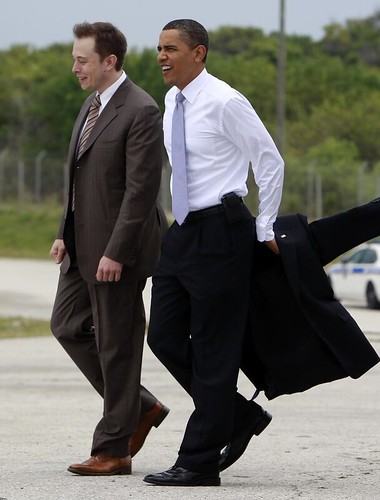
Image by jurvetson
From Cape Canaveral yesterday, President Obama toured the SpaceX facilities with Falcon 9 erect on the pad, and then joined Buzz Aldrin and Elon Musk to present a new vision for NASA.
Elon Musk summarizes: “Today, the President will articulate an ambitious and exciting new plan that will alter our destiny as a species. I believe this address could be as important as President Kennedy’s 1962 speech at Rice University. For the first time since Apollo, our country will have a plan for space exploration that inspires and excites all who look to the stars. Even more important, it will work.”
Here is the full text of President Obama’s speech and some excerpts:
“Few people — present company excluded — can claim the expertise of Buzz and Bill and Charlie when it comes to space exploration. I have to say that few people are as singularly unimpressed by Air Force One as those three. (Laughter.) Sure, it’s comfortable, but it can’t even reach low Earth orbit. And that obviously is in striking contrast to the Falcon 9 rocket we just saw on the launch pad, which will be tested for the very first time in the coming weeks.
The space race inspired a generation of scientists and innovators, including, I’m sure, many of you. It’s contributed to immeasurable technological advances that have improved our health and well-being, from satellite navigation to water purification, from aerospace manufacturing to medical imaging. Although, I have to say, during a meeting right before I came out on stage somebody said, you know, it’s more than just Tang — and I had to point out I actually really like Tang. (Laughter.)
For me, the space program has always captured an essential part of what it means to be an American — reaching for new heights, stretching beyond what previously did not seem possible. And so, as President, I believe that space exploration is not a luxury, it’s not an afterthought in America’s quest for a brighter future — it is an essential part of that quest.
So today, I’d like to talk about the next chapter in this story.
Let me start by being extremely clear: I am 100 percent committed to the mission of NASA and its future. (Applause.) Because broadening our capabilities in space will continue to serve our society in ways that we can scarcely imagine. Because exploration will once more inspire wonder in a new generation — sparking passions and launching careers. And because, ultimately, if we fail to press forward in the pursuit of discovery, we are ceding our future and we are ceding that essential element of the American character.
NASA, from the start, several months ago when I issued my budget, was one of the areas where we didn’t just maintain a freeze but we actually increased funding by billion. By doing that we will ramp up robotic exploration of the solar system, including a probe of the Sun’s atmosphere; new scouting missions to Mars and other destinations; and an advanced telescope to follow Hubble, allowing us to peer deeper into the universe than ever before.
We will increase Earth-based observation to improve our understanding of our climate and our world — science that will garner tangible benefits, helping us to protect our environment for future generations.
And we will extend the life of the International Space Station likely by more than five years, while actually using it for its intended purpose: conducting advanced research that can help improve the daily lives of people here on Earth, as well as testing and improving upon our capabilities in space. This includes technologies like more efficient life support systems that will help reduce the cost of future missions. And in order to reach the space station, we will work with a growing array of private companies competing to make getting to space easier and more affordable. (Applause.)
Now, I recognize that some have said it is unfeasible or unwise to work with the private sector in this way. I disagree. The truth is, NASA has always relied on private industry to help design and build the vehicles that carry astronauts to space, from the Mercury capsule that carried John Glenn into orbit nearly 50 years ago, to the space shuttle Discovery currently orbiting overhead. By buying the services of space transportation — rather than the vehicles themselves — we can continue to ensure rigorous safety standards are met. But we will also accelerate the pace of innovations as companies — from young startups to established leaders — compete to design and build and launch new means of carrying people and materials out of our atmosphere.
Next, we will invest more than billion to conduct research on an advanced “heavy lift rocket” — a vehicle to efficiently send into orbit the crew capsules, propulsion systems, and large quantities of supplies needed to reach deep space. In developing this new vehicle, we will not only look at revising or modifying older models; we want to look at new designs, new materials, new technologies that will transform not just where we can go but what we can do when we get there. And we will finalize a rocket design no later than 2015 and then begin to build it. (Applause.)
So the point is what we’re looking for is not just to continue on the same path — we want to leap into the future; we want major breakthroughs; a transformative agenda for NASA. (Applause.)
The bottom line is nobody is more committed to manned space flight, to human exploration of space than I am. (Applause.) But we’ve got to do it in a smart way, and we can’t just keep on doing the same old things that we’ve been doing and thinking that somehow is going to get us to where we want to go.
Some have said, for instance, that this plan gives up our leadership in space by failing to produce plans within NASA to reach low Earth orbit, instead of relying on companies and other countries. But we will actually reach space faster and more often under this new plan, in ways that will help us improve our technological capacity and lower our costs, which are both essential for the long-term sustainability of space flight. In fact, through our plan, we’ll be sending many more astronauts to space over the next decade. (Applause.)
There are also those who criticized our decision to end parts of Constellation as one that will hinder space exploration beyond low Earth orbit. But it’s precisely by investing in groundbreaking research and innovative companies that we will have the potential to rapidly transform our capabilities — even as we build on the important work already completed, through projects like Orion, for future missions. And unlike the previous program, we are setting a course with specific and achievable milestones.
Early in the next decade, a set of crewed flights will test and prove the systems required for exploration beyond low Earth orbit. (Applause.) And by 2025, we expect new spacecraft designed for long journeys to allow us to begin the first-ever crewed missions beyond the Moon into deep space. (Applause.) So we’ll start — we’ll start by sending astronauts to an asteroid for the first time in history. (Applause.) By the mid-2030s, I believe we can send humans to orbit Mars and return them safely to Earth. And a landing on Mars will follow. And I expect to be around to see it. (Applause.)
But I want to repeat — I want to repeat this: Critical to deep space exploration will be the development of breakthrough propulsion systems and other advanced technologies. So I’m challenging NASA to break through these barriers. And we’ll give you the resources to break through these barriers. And I know you will, with ingenuity and intensity, because that’s what you’ve always done. (Applause.)
So this is the next chapter that we can write together here at NASA. We will partner with industry. We will invest in cutting-edge research and technology. We will set far-reaching milestones and provide the resources to reach those milestones. And step by step, we will push the boundaries not only of where we can go but what we can do.
Fifty years after the creation of NASA, our goal is no longer just a destination to reach. Our goal is the capacity for people to work and learn and operate and live safely beyond the Earth for extended periods of time, ultimately in ways that are more sustainable and even indefinite. And in fulfilling this task, we will not only extend humanity’s reach in space — we will strengthen America’s leadership here on Earth.
Now, I’ll close by saying this. I know that some Americans have asked a question that’s particularly apt on Tax Day: Why spend money on NASA at all? Why spend money solving problems in space when we don’t lack for problems to solve here on the ground? And obviously our country is still reeling from the worst economic turmoil we’ve known in generations. We have massive structural deficits that have to be closed in the coming years.
But you and I know this is a false choice. We have to fix our economy. We need to close our deficits. But for pennies on the dollar, the space program has fueled jobs and entire industries. For pennies on the dollar, the space program has improved our lives, advanced our society, strengthened our economy, and inspired generations of Americans. And I have no doubt that NASA can continue to fulfill this role. (Applause.) But that is why — but I want to say clearly to those of you who work for NASA, but to the entire community that has been so supportive of the space program in this area: That is exactly why it’s so essential that we pursue a new course and that we revitalize NASA and its mission — not just with dollars, but with clear aims and a larger purpose.
Now, little more than 40 years ago, astronauts descended the nine-rung ladder of the lunar module called Eagle, and allowed their feet to touch the dusty surface of the Earth’s only Moon. This was the culmination of a daring and perilous gambit — of an endeavor that pushed the boundaries of our knowledge, of our technological prowess, of our very capacity as human beings to solve problems. It wasn’t just the greatest achievement in NASA’s history — it was one of the greatest achievements in human history.
And the question for us now is whether that was the beginning of something or the end of something. I choose to believe it was only the beginning.”
Novo Resources Strategizes Moving Beatons Creek Toward Bankable Feasibility
Further evidence for significant coarse gold comes from a suite of spot rock chip surface samples recently collected at Beatons Creek that was analyzed by screen metallic fire assay (data presented in nearby table). ….. The goal of this study will …
Read more on MarketWatch
Fortune Minerals Announces Preliminary Economic Assessment Report for the …
The underground workings have been rehabilitated and new surface facilities and an underground mill have been constructed. The mine is ramping up to a 400 ton per ….. A number of historical resource estimates were prepared for the Revenue Silver Mine …
Read more on PR Newswire (press release)
IDM Mining"s Red Mountain Preliminary Economic Assessment Demonstrates …
A surface exploration program targeting many of these newly discovered and highly prospective areas is currently underway. Risks. It is the conclusion of the Qualified …. At a nominal rate of 1,000 tpd, the fine mineralized material bin will feed a …
Read more on SYS-CON Media (press release)
Lastest Surface Grinding China Services News
Tuesday, July 29, 2014
Samsung Q430 14-Inch HD LED Laptop (Aluminum surface with Black finish)
Samsung Q430 14-Inch HD LED Laptop (Aluminum surface with Black finish)
Samsung Q430 Laptop is Powered with the Intel Core i5-460M Processor:
The Samsung Q430 Laptop comes with an 14-inch high definition LED display with a 16:9 aspect ratio. Hence, when you watch HD widescreen movies, it fills the whole screen. The LED Backlit display has edge-to-edge glass, providing you with bright and vivid colors, enriching your viewing experience. It also has excellent performance as it is powered with the Intel Core i5-460M processor that has turbo boost technology. Additionally, it is comes with a 500 GB hard drive and 4 GB of memory.
You get Outstanding Graphics on the Samsung Q430 Laptop:
You get outstanding graphics on the Samsung Q430 Laptop too as it has the NVIDIA® GeForce® GT 310 M graphics engine and 512 MB of dedicated graphics memory. The gives you excellent performance whether you are playing games or using multimedia applications and gives you the best experience from 3D games and high definition movies.
Samsung Q430 Laptop is also more Energy Efficient:
The Samsung Q430 Laptop also features a simple but chic design and has an ergonomically designed keyboard that is Island style. This design increases space between keys, allowing you to type faster and easier with less errors. It is also an EPEAT Silver product, meaning it is better for the environment and human health as it has reduced levels of cadmium, lead, and mercury. Furthermore, it is also more energy efficient.
Samsung Q430 Laptop is Backups your Data Automatically:
Another added benefit is Samsung Recovery Solution that backups your data automatically and at regular intervals. Hence, you need not worry about losing your precious data and need not back them up manually. Plus, you can start using your laptop in 3 seconds with Samsung’s Fast Start feature.
Samsung Q430 Laptop Features:
Other features of the Samsung Q430 Laptop includes a 3-in-1 memory card reader, 3 2.0 USB ports, 0.3 Megapixel built-in camera, integrated 802.11 b/g/n wireless capability. One of the USB ports has the functionality to charge your external device without booting the laptop. Hence, the Samsung Q430 Laptop is definitely a good buy if you are looking for a laptop.
Samsung Q430 Laptop Pros:
Build Quality- beautiful aluminum case around laptop, sturdy feel to it.
Awesome Keyboard
Battery has a button to push and it tells you how much charge it has
Glass to glass LED screen- Looks very nice
Specs: Core i5, 500GB hard drive and discrete graphics card for under 700
Fast Processor
Discrete Graphics with Optimus technology
Samsung Q430 Laptop Cons and Solutions:
The Wireless Card is below average and as what some reviews says that it disconnects occasionally is actually true. It happened to me but I was able to solve that problem. To repair it update your driver by downloading it on wikidrivers not on samsung site
The Samsung Fast Start Feature is not available on this laptop. I tried downloading the software but it says that this laptop does not support it. Is there anyone who can confirm this?
Trackpad issues, not true. Mine work perfectly except for the two finger scrolling which is not important since there is a traditional scrolling at the side that works fine. Some reviews says that the mouse is too sensitive, that is because the Momentum feature is turned on. Configure your mouse settings to remove undesired features.
Battery Life sucks! 2-3 hours of battery life on power saving mode. Wifi-on, Lowest brightness, and internet browsing. If you don’t mind staying near a power outlet this laptop is fine for you.
Issues in streaming videos like youtube during full screen, don’t use the update in samsung site. Search for Nvidia 310m driver 266.58, it will solve your problems.
For more actual user reviews and detailed product information on the “Samsung Q430 14-Inch HD LED Laptop“, Visit: TOP 5 LAPTOPS
Samsung Q430 14-Inch HD LED Laptop (Aluminum surface with Black finish)
Thursday, July 24, 2014
Nice Grinding China Surface photos
Check out these grinding China surface images:
Mauve Surface with Gray and White Grunge Paint
Image by shaire productions
By Sherrie Thai of ShaireProductions. Feel free to download and use these as a background for commercial or noncommercial projects. If you decide to use them, please let me know how it goes by sending a link or an image. Enjoy!
Stone Surface with Rust
Image by shaire productions
By Sherrie Thai of ShaireProductions.com
Feel free to download and use these as a background for commercial or noncommercial projects. If you decide to use them, please let me know how it goes by sending a link or an image. Enjoy!
Nice Grinding China Surface photos
Monday, July 21, 2014
Nice Surface Grinding China Stainless Steel photos
A few nice surface grinding China stainless steel images I found:
NYC: Chase Manhattan Plaza – Sunken Garden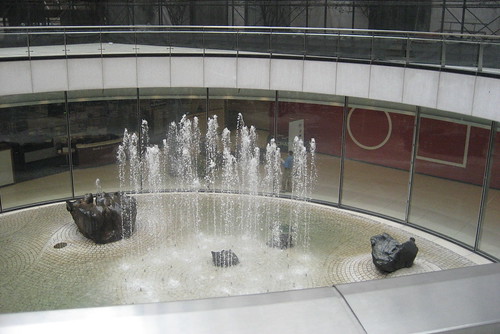
Image by wallyg
Isamu Noguchi’s Sunken Garden is situated in the open plaza in front of the Chase Manhattan Bank building. The base of the garden is set one story below street level in a circular space cut out from the plaza. This opening in the plaza is bordered on top by a metal railing, allowing viewers to stand comfortably at the edge and look into the sculpted space below. The space is surrounded on all sides by floor-to-ceiling windows, allowing the garden to be seen from the inside, and opening up the lower level of the building to the outdoors.
The "ground" of the garden is made up of small, light-colored stone bricks. The surface slopes gently, creating a series of low hills and valleys topped by seven black boulders of varying sizes that Noguchi collected from the bottom of the Uji River in Kyoto, Japan. The sloping of the surface is accentuated by the organization of the bricks, which circle around to show the contours of the ground. The lines from the bricks also serve to draw attention to the boulders, which are located on the highest points of the ground.
In the winter, Sunken Garden is dry. In the summer months, the garden turns into a fountain, with water spouting into the air, and flowing across the ground before disappearing around the edges of the space. Because of the variations in the level of the brick surface, some of the boulders are partly submerged, while others stand on dry ground, with water lapping around them.
Noguchi drew on the concept of Japanese Zen meditation gardens in his creation of Sunken Garden. As with these gardens, the viewer is not meant to enter Sunken Garden, but rather looks in from the outside. Additionally, the lines formed by the placement of the light-colored bricks are reminiscent of the raked sand found in Japanese gardens.
Although Noguchi found inspiration for Sunken Garden in traditional Japanese gardens, in particular the garden at the Ryoan-ji Temple in Kyoto, Noguchi veered from tradition in many aspects of his design. Noguchi comments, "…I have never been interested in doing a Japanese garden per se." Instead, Noguchi chose what he wanted to include from among the many rules governing the design of Japanese gardens, and adjusted the rest to fit his needs. In describing some of his choices in Sunken Garden, Noguchi writes, "I had said that in the West the ideal was to triumph over gravity, and that in doing a rock garden in America it would be logical to have the rocks themselves levitate…" This is especially true of Sunken Garden in the summer time, when water flows across the surface of the ground except at the highest points, where the boulders are placed. Noguchi also combines eastern and western traditions in his inclusion of the European-style fountain in the garden.
Los Angeles born Isamu Noguchi (野口 勇, 1904-1988) was a sculptor, theatrical and industrial designer best known for his abstract works and set designs for MArtha Graham productions. News was one of his last figurative works, and the only time he employed stainless steel as an artistic medium. His work can be found throughout major metropolitan cities, in museums, and in the Isamu Noguchi Garden Museum in Long Island City in New York. Noguchi’s work around New York includes the Red Cube in Helmsley Plaza and News at the Associated Press Building His Thunder Rock was also temporarily on display in Rockefeller Plaza.
Nice Surface Grinding China Stainless Steel photos
Nice Surface Grinding China Services photos
A few nice surface grinding China services images I found:
Steven F. Udvar-Hazy Center: Air France Concorde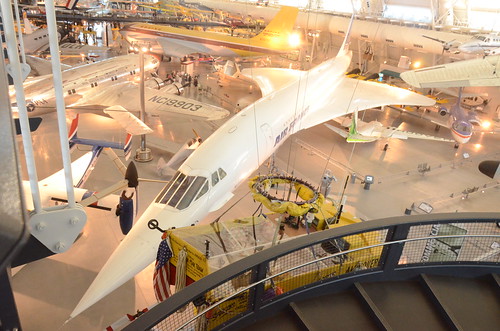
Image by Chris Devers
Quoting Smithsonian National Air and Space Museum | Concorde, Fox Alpha, Air France:
The first supersonic airliner to enter service, the Concorde flew thousands of passengers across the Atlantic at twice the speed of sound for over 25 years. Designed and built by Aérospatiale of France and the British Aviation Corporation, the graceful Concorde was a stunning technological achievement that could not overcome serious economic problems.
In 1976 Air France and British Airways jointly inaugurated Concorde service to destinations around the globe. Carrying up to 100 passengers in great comfort, the Concorde catered to first class passengers for whom speed was critical. It could cross the Atlantic in fewer than four hours – half the time of a conventional jet airliner. However its high operating costs resulted in very high fares that limited the number of passengers who could afford to fly it. These problems and a shrinking market eventually forced the reduction of service until all Concordes were retired in 2003.
In 1989, Air France signed a letter of agreement to donate a Concorde to the National Air and Space Museum upon the aircraft’s retirement. On June 12, 2003, Air France honored that agreement, donating Concorde F-BVFA to the Museum upon the completion of its last flight. This aircraft was the first Air France Concorde to open service to Rio de Janeiro, Washington, D.C., and New York and had flown 17,824 hours.
Gift of Air France.
Manufacturer:
Societe Nationale Industrielle Aerospatiale
British Aircraft Corporation
Dimensions:
Wingspan: 25.56 m (83 ft 10 in)
Length: 61.66 m (202 ft 3 in)
Height: 11.3 m (37 ft 1 in)
Weight, empty: 79,265 kg (174,750 lb)
Weight, gross: 181,435 kg (400,000 lb)
Top speed: 2,179 km/h (1350 mph)
Engine: Four Rolls-Royce/SNECMA Olympus 593 Mk 602, 17,259 kg (38,050 lb) thrust each
Manufacturer: Société Nationale Industrielle Aérospatiale, Paris, France, and British Aircraft Corporation, London, United Kingdom
Physical Description:
Aircaft Serial Number: 205. Including four (4) engines, bearing respectively the serial number: CBE066, CBE062, CBE086 and CBE085.
Also included, aircraft plaque: "AIR FRANCE Lorsque viendra le jour d’exposer Concorde dans un musee, la Smithsonian Institution a dores et deja choisi, pour le Musee de l’Air et de l’Espace de Washington, un appariel portant le couleurs d’Air France."
A-50 AWACS. Самолет ДРЛО А-50.
Image by Peer.Gynt
The Beriev A-50 (NATO reporting name "Mainstay") is a Soviet-built airborne warning and control system (AWACS) aircraft based on the Ilyushin Il-76 transport. Developed to replace the Tupolev Tu-126 "Moss", the A-50 first flew in 1978. It entered service in 1984, with about 40 produced by 1992.
The mission personnel of the 15-man crew derive data from the large Liana surveillance radar with its antenna in an over-fuselage rotordome, which has a diameter of 29 ft 9 in (9.00 m).
The A-50 can control up to 10 fighter aircraft for either air-to-air intercept or air-to-ground attack missions. The A-50 is capable of flying for 4 hours at 1000 km from its base at a maximum takeoff weight of 190 tons. The aircraft can be refuelled by Il-78 tankers.
The radar "Vega-M" is designed by MNIIP, Moscow, and produced by NPO Vega. The "Vega-M" is capable of tracking up to 50 targets simultaneously within 230 kilometers. Large targets, like surface ships, can be tracked at a distance of 400 km.
After completing State Joint Tests, Beriev has delivered the first upgraded Airborne Early Warning and Control aircraft to the Russian Air Force. The aircraft, ’47 Red’/RF-92957 was handed over at Beriev’s facility in Taganrog on October 31, 2011. It was accepted by an air crew serving with the 2457th Aviabaza Boevogo Primeneniya Samolotov Dalnego Radiolokatsionnogo Obnaruzheniya (Aviation Base for Combat Operation of Airborne Early Warning Aircraft) at Ivanovo Severny, which is the only base using the A-50 operationally. The 2457th operates 16 aircraft. A second aircraft, ’33 Red’ is getting upgraded and is due for delivery in 2012. These are the only two production upgrades ordered to date (January 2012), but Beriev anticipates further orders.
Development work on the A-50U commenced some years ago and State Tests started on September 10, 2008, using Russian Air Force A-50 ’37 Red’ as a prototype. The main element of the modernisation involves replacing the outdated analogue equipment with a new, digital avionics suite supplied by Russia’s Vega Radio Engineering China Corporation JSC. Notable improvements include: faster data processing, enhanced signal tracking and improved target detection. Crew rest, toilet and galley facilities are also included in the upgrade.
These upgrades form the basis of the concept for a new production aircraft, based on the Il-476 airframe (new built Il-76MD with PS-90A76 engines). Configuration will be similar to the A-50U, but with a new Vega Premier active phased array radar.
Nice Surface Grinding China Services photos
Saturday, July 19, 2014
Lastest Surface Grinding China Aluminum News
Post-Interpack Review: Triennial "tops" again
Moreover, the line"s unique configuration between a horizontal mixer, (water-cooled) grinding shaft, grinding tank and grinding media result in optimum use of grinding/cooling efficiency. The company has also …. white to dark chocolate. The EasyClean …
Read more on Candy Industry
China International Abrasives & Grinding Exposition
Production equipment: aluminum oxide smelting surface, Sic smelting surface, Crushing and grinding machine, magnetic separation and screening equipment, mixing, molding equipment, furnaces such as firing, hard (sulfur) equipment, grinding wheel …
Read more on Virtual-Strategy Magazine (press release)
Manufacturer wins award for work with Lake Technical College
Dr. Diane Culpepper, the director of the technical college, said that equipment includes a Computer Numerical Control mill, a surface grinder, a centerless grinder and a compressor. She said Schultz also has donated numerous hours of time, helping to …
Read more on Daily Commercial
Lastest Surface Grinding China Aluminum News
Friday, July 11, 2014
Cool Surface Grinding China Manufacturer images
A few nice surface grinding China manufacturer images I found:
Steven F. Udvar-Hazy Center: P-40 Warhawk with "sharktooth" nose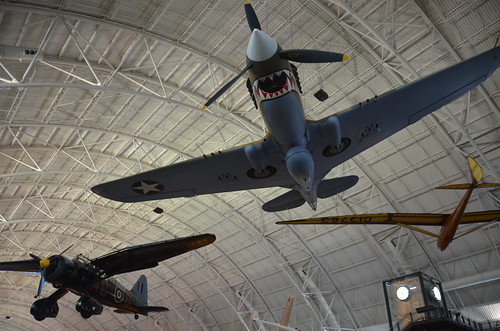
Image by Chris Devers
See more photos of this, and the Wikipedia article.
Details, quoting from Smithsonian National Air and Space Museum | Curtiss P-40E Warhawk (Kittyhawk IA):
Whether known as the Warhawk, Tomahawk, or Kittyhawk, the Curtiss P-40 proved to be a successful, versatile fighter during the first half of World War II. The shark-mouthed Tomahawks that Gen. Claire Chennault"s "Flying Tigers" flew in China against the Japanese remain among the most popular airplanes of the war. P-40E pilot Lt. Boyd D. Wagner became the first American ace of World War II when he shot down six Japanese aircraft in the Philippines in mid-December 1941.
Curtiss-Wright built this airplane as Model 87-A3 and delivered it to Canada as a Kittyhawk I in 1941. It served until 1946 in No. 111 Squadron, Royal Canadian Air Force. U.S. Air Force personnel at Andrews Air Force Base restored it in 1975 to represent an aircraft of the 75th Fighter Squadron, 23rd Fighter Group, 14th Air Force.
Donated by the Exchange Club in Memory of Kellis Forbes.
Manufacturer:
Curtiss Aircraft Company
Date:
1939
Country of Origin:
United States of America
Dimensions:
Overall: 330 x 970cm, 2686kg, 1140cm (10ft 9 15/16in. x 31ft 9 7/8in., 5921.6lb., 37ft 4 13/16in.)
Materials:
All-metal, semi-monocoque
Physical Description:
Single engine, single seat, fighter aircraft.
Long Description:
Whether it was the Tomahawk, Warhawk, or Kittyhawk, the Curtiss P-40 was a successful and versatile fighter aircraft during the first half of World War II. The shark-mouthed Tomahawks that General Claire Chennault led against the Japanese remain among the most popular airplanes of the war. In the Phillipines, Lt. Boyd D. Wagner became the first American ace of World War II while flying a P-40E when he shot down six Japanese aircraft during mid-December 1941. P-40s were first-line Army Air Corps fighters at the start of the war but they soon gave way to more advanced designs such as the Republic P-47 Thunderbolt and the Lockheed P-38 Lightning (see NASM collection for both aircraft). The P-40 is not ranked among the best overall fighters of the war but it was a rugged, effective design available in large numbers early in the war when America and her allies urgently required them. The P-40 remained in production from 1939 to the end of 1944 and a total of 13, 737 were built.
Design engineer Dr. Donovan R. Berlin layed the foundation for the P-40 in 1935 when he designed the agile, but lightly-armed, P-36 fighter equipped with a radial, air-cooled engine. The Curtiss-Wright Corporation won a production contract for 210 P-36 airplanes in 1937-the largest Army airplane contract awarded since World War I. Worldwide, fighter aircraft designs matured rapidly during the late 1930s and it was soon obvious that the P-36 was no match for newer European designs. High altitude performance in particular became a priceless commodity. Berlin attempted to improve the P-36 by redesigning it in to accommodate a turbo-supercharged Allison V-1710-11 inline, liquid-cooled engine. The new aircraft was designated the XP-37 but proved unpopular with pilots. The turbo-supercharger was not reliable and Berlin had placed the cockpit too far back on the fuselage, restricting the view to the front of the fighter. Nonetheless, when the engine was not giving trouble, the more-streamlined XP-37 was much faster than the P-36.
Curtiss tried again in 1938. Berlin had modified another P-36 with a new Allison V-1710-19 engine. It was designated the XP-40 and first flew on October 14, 1938. The XP-40 looked promising and Curtiss offered it to Army Air Corps leaders who evaluated the airplane at Wright Field, Ohio, in 1939, along with several other fighter proposals. The P-40 won the competition, after some modifications, and Curtiss received an order for 540. At this time, the armament package consisted of two .50 caliber machine guns in the fuselage and four .30 caliber machine guns in the wings.
After production began in March 1940, France ordered 140 P-40s but the British took delivery of these airplanes when Paris surrendered. The British named the aircraft Tomahawks but found they performed poorly in high-altitude combat over northern Europe and relegated them to low-altitude operations in North Africa. The Russians bought more than 2,000 P-40s but details of their operational history remain obscure.
When the United States declared war, P-40s equipped many of the Army Air Corps"s front line fighter units. The plucky fighter eventually saw combat in almost every theater of operations being the most effective in the China-Burma-India (CBI) Theater. Of all the CBI groups that gained the most notoriety of the entire war, and remains to this day synonymous with the P-40, is the American Volunteer Group (AVG) or the Flying Tigers. The unit was organized after the Chinese gave former U. S. Army Air Corps Captain Claire Lee Chennault almost 9 million dollars in 1940 to buy aircraft and recruit pilots to fly against the Japanese. Chennault"s most important support within the Chinese government came from Madam Chiang Kai-shek, a Lt. Colonel in the Chinese Air Force and for a time, the service"s overall commander.
The money from China diverted an order placed by the British Royal Air Force for 100 Curtiss-Wright P-40B Tomahawks but buying airplanes was only one important step in creating a fighting air unit. Trained pilots were needed, and quickly, as tensions across the Pacific escalated. On April 15, 1941, President Franklin D. Roosevelt quietly signed an Executive Order permitting Chennault to recruit directly from the ranks of American military reserve pilots. Within a few months, 350 flyers joined from pursuit (fighter), bomber, and patrol squadrons. In all, about half the pilots in the Flying Tigers came from the U. S. Navy and Marine Corps while the Army Air Corps supplied one-third. Factory test pilots at Bell, Consolidated, and other companies, and commercial airline pilots, filled the remaining slots.
The Flying Tigers flew their first mission on December 20. The unit"s name was derived from the ferocious fangs and teeth painted on the nose of AVG P-40s at either side of the distinctive, large radiator air intake. The idea is said to originate from pictures in a magazine that showed Royal Air Force Tomahawks of No. 112 Squadron, operating in the western desert of North Africa, adorned with fangs and teeth painted around their air intakes. The Flying Tigers were the first real opposition the Japanese military encountered. In less than 7 months of action, AVG pilots destroyed about 115 Japanese aircraft and lost only 11 planes in air-to-air combat. The AVG disbanded on July 4, 1942, and its assets, including a few pilots, became a part of the U. S. Army Air Forces (AAF) 23rd Fighter Group in the newly activated 14th Air Force. Chennault, now a Brigadier General, assumed command of the 14th AF and by war"s end, the 23rd was one of the highest-scoring Army fighter groups.
As wartime experience in the P-40 mounted, Curtiss made many modifications. Engineers added armor plate, better self-sealing fuel tanks, and more powerful engines. They modified the cockpit to improve visibility and changed the armament package to six, wing-mounted, .50 caliber machine guns. The P-40E Kittyhawk was the first model with this gun package and it entered service in time to serve in the AVG. The last model produced in quantity was the P-40N, the lightest P-40 built in quantity, and much faster than previous models. Curtiss built a single P-40Q. It was the fastest P-40 to fly (679 kph/422 mph) but it could not match the performance of the P-47 Thunderbolt and the P-51 Mustang so Curtiss ended development of the P-40 series with this model. In addition to the AAF, many Allied nations bought and flew P-40s including England, France, China, Russia, Australia, New Zealand, Canada, South Africa, and Turkey.
The Smithsonian P-40E did not serve in the U. S. military. Curtiss-Wright built it in Buffalo, New York, as Model 87-A3 and delivered it to Canada as a Kittyhawk IA on March 11, 1941. It served in No. 111 Squadron, Royal Canadian Air Force (RCAF). When the Japanese navy moved to attack Midway, they sent a diversionary battle group to menace the Aleutian Islands. Canada moved No. 111 Squadron to Alaska to help defend the region. After the Japanese threat diminished, the unit returned to Canada and eventually transferred to England without its P-40s. The RCAF declared the NASM Kittyhawk IA surplus on July 27, 1946, and the aircraft eventually returned to the United States. It had several owners before ending up with the Explorer Scouts youth group in Meridian, Mississippi. During the early 1960s, the Smithsonian began searching for a P-40 with a documented history of service in the AVG but found none. In 1964, the Exchange Club in Meridian donated the Kittyhawk IA to the National Aeronautical Collection, in memory of Mr. Kellis Forbes, a local man devoted to Boys Club activities. A U. S. Air Force Reserve crew airlifted the fighter to Andrews Air Force Base, Maryland, on March 13, 1964. Andrews personnel restored the airplane in 1975 and painted it to represent an aircraft of the 75th Fighter Squadron, 23rd Fighter Group, 14th Air Force.
• • •
Quoting from Wikipedia | Curtiss P-40 Warhawk:
The Curtiss P-40 Warhawk was an American single-engine, single-seat, all-metal fighter and ground attack aircraft that first flew in 1938. It was used by the air forces of 28 nations, including those of most Allied powers during World War II, and remained in front line service until the end of the war. It was the third most-produced American fighter, after the P-51 and P-47; by November 1944, when production of the P-40 ceased, 13,738 had been built, all at Curtiss-Wright Corporation"s main production facility at Buffalo, New York.
The P-40 design was a modification of the previous Curtiss P-36; this reduced development time and enabled a rapid entry into production and operational service.
Warhawk was the name the United States Army Air Corps adopted for all models, making it the official name in the United States for all P-40s. The British Commonwealth and Soviet air forces used the name Tomahawk for models equivalent to the P-40B and P-40C, and the name Kittyhawk for models equivalent to the P-40D and all later variants.
The P-40"s lack of a two-stage supercharger made it inferior to Luftwaffe fighters such as the Messerschmitt Bf 109 or the Focke-Wulf Fw 190 in high-altitude combat and it was rarely used in operations in Northwest Europe. Between 1941 and 1944, however, the P-40 played a critical role with Allied air forces in three major theaters: North Africa, the Southwest Pacific and China. It also had a significant role in the Middle East, Southeast Asia, Eastern Europe, Alaska and Italy. The P-40"s performance at high altitudes was not as critical in those theaters, where it served as an air superiority fighter, bomber escort and fighter bomber.
P-40s first saw combat with the British Commonwealth squadrons of the Desert Air Force (DAF) in the Middle East and North African campaigns, during June 1941. The Royal Air Force"s No. 112 Squadron was among the first to operate Tomahawks, in North Africa, and the unit was the first to feature the "shark mouth" logo, copying similar markings on some Luftwaffe Messerschmitt Bf 110 twin-engine fighters. [N 1]
Although it gained a post-war reputation as a mediocre design, suitable only for close air support, more recent research including scrutiny of the records of individual Allied squadrons indicates that the P-40 performed surprisingly well as an air superiority fighter, at times suffering severe losses, but also taking a very heavy toll on enemy aircraft. The P-40 offered the additional advantage of low cost, which kept it in production as a ground-attack fighter long after it was obsolete in the air superiority role.
As of 2008, 19 P-40s were airworthy.
Steven F. Udvar-Hazy Center: Space Shuttle Enterprise (starboard full view, aft)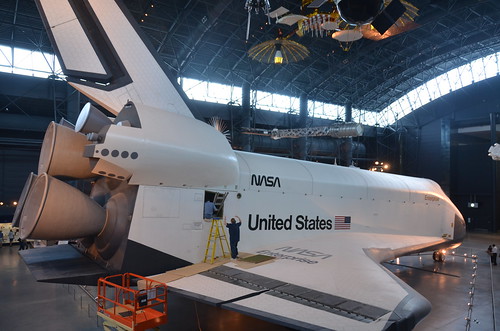
Image by Chris Devers
See more photos of this, and the Wikipedia article.
Details, quoting from Smithsonian National Air and Space Museum | Space Shuttle Enterprise:
Manufacturer:
Rockwell International Corporation
Country of Origin:
United States of America
Dimensions:
Overall: 57 ft. tall x 122 ft. long x 78 ft. wing span, 150,000 lb.
(1737.36 x 3718.57 x 2377.44cm, 68039.6kg)
Materials:
Aluminum airframe and body with some fiberglass features; payload bay doors are graphite epoxy composite; thermal tiles are simulated (polyurethane foam) except for test samples of actual tiles and thermal blankets.
The first Space Shuttle orbiter, "Enterprise," is a full-scale test vehicle used for flights in the atmosphere and tests on the ground; it is not equipped for spaceflight. Although the airframe and flight control elements are like those of the Shuttles flown in space, this vehicle has no propulsion system and only simulated thermal tiles because these features were not needed for atmospheric and ground tests. "Enterprise" was rolled out at Rockwell International"s assembly facility in Palmdale, California, in 1976. In 1977, it entered service for a nine-month-long approach-and-landing test flight program. Thereafter it was used for vibration tests and fit checks at NASA centers, and it also appeared in the 1983 Paris Air Show and the 1984 World"s Fair in New Orleans. In 1985, NASA transferred "Enterprise" to the Smithsonian Institution"s National Air and Space Museum.
Transferred from National Aeronautics and Space Administration
• • •
Quoting from Wikipedia | Space Shuttle Enterprise:
The Space Shuttle Enterprise (NASA Orbiter Vehicle Designation: OV-101) was the first Space Shuttle orbiter. It was built for NASA as part of the Space Shuttle program to perform test flights in the atmosphere. It was constructed without engines or a functional heat shield, and was therefore not capable of spaceflight.
Originally, Enterprise had been intended to be refitted for orbital flight, which would have made it the second space shuttle to fly after Columbia. However, during the construction of Columbia, details of the final design changed, particularly with regard to the weight of the fuselage and wings. Refitting Enterprise for spaceflight would have involved dismantling the orbiter and returning the sections to subcontractors across the country. As this was an expensive proposition, it was determined to be less costly to build Challenger around a body frame (STA-099) that had been created as a test article. Similarly, Enterprise was considered for refit to replace Challenger after the latter was destroyed, but Endeavour was built from structural spares instead.
Service
Construction began on the first orbiter on June 4, 1974. Designated OV-101, it was originally planned to be named Constitution and unveiled on Constitution Day, September 17, 1976. A write-in campaign by Trekkies to President Gerald Ford asked that the orbiter be named after the Starship Enterprise, featured on the television show Star Trek. Although Ford did not mention the campaign, the president—who during World War II had served on the aircraft carrier USS Monterey (CVL-26) that served with USS Enterprise (CV-6)—said that he was "partial to the name" and overrode NASA officials.
The design of OV-101 was not the same as that planned for OV-102, the first flight model; the tail was constructed differently, and it did not have the interfaces to mount OMS pods. A large number of subsystems—ranging from main engines to radar equipment—were not installed on this vehicle, but the capacity to add them in the future was retained. Instead of a thermal protection system, its surface was primarily fiberglass.
In mid-1976, the orbiter was used for ground vibration tests, allowing engineers to compare data from an actual flight vehicle with theoretical models.
On September 17, 1976, Enterprise was rolled out of Rockwell"s plant at Palmdale, California. In recognition of its fictional namesake, Star Trek creator Gene Roddenberry and most of the principal cast of the original series of Star Trek were on hand at the dedication ceremony.
Approach and landing tests (ALT)
Main article: Approach and Landing Tests
On January 31, 1977, it was taken by road to Dryden Flight Research Center at Edwards Air Force Base, to begin operational testing.
While at NASA Dryden, Enterprise was used by NASA for a variety of ground and flight tests intended to validate aspects of the shuttle program. The initial nine-month testing period was referred to by the acronym ALT, for "Approach and Landing Test". These tests included a maiden "flight" on February 18, 1977 atop a Boeing 747 Shuttle Carrier Aircraft (SCA) to measure structural loads and ground handling and braking characteristics of the mated system. Ground tests of all orbiter subsystems were carried out to verify functionality prior to atmospheric flight.
The mated Enterprise/SCA combination was then subjected to five test flights with Enterprise unmanned and unactivated. The purpose of these test flights was to measure the flight characteristics of the mated combination. These tests were followed with three test flights with Enterprise manned to test the shuttle flight control systems.
Enterprise underwent five free flights where the craft separated from the SCA and was landed under astronaut control. These tests verified the flight characteristics of the orbiter design and were carried out under several aerodynamic and weight configurations. On the fifth and final glider flight, pilot-induced oscillation problems were revealed, which had to be addressed before the first orbital launch occurred.
On August 12, 1977, the space shuttle Enterprise flew on its own for the first time.
Preparation for STS-1
Following the ALT program, Enterprise was ferried among several NASA facilities to configure the craft for vibration testing. In June 1979, it was mated with an external tank and solid rocket boosters (known as a boilerplate configuration) and tested in a launch configuration at Kennedy Space Center Launch Pad 39A.
Retirement
With the completion of critical testing, Enterprise was partially disassembled to allow certain components to be reused in other shuttles, then underwent an international tour visiting France, Germany, Italy, the United Kingdom, Canada, and the U.S. states of California, Alabama, and Louisiana (during the 1984 Louisiana World Exposition). It was also used to fit-check the never-used shuttle launch pad at Vandenberg AFB, California. Finally, on November 18, 1985, Enterprise was ferried to Washington, D.C., where it became property of the Smithsonian Institution.
Post-Challenger
After the Challenger disaster, NASA considered using Enterprise as a replacement. However refitting the shuttle with all of the necessary equipment needed for it to be used in space was considered, but instead it was decided to use spares constructed at the same time as Discovery and Atlantis to build Endeavour.
Post-Columbia
In 2003, after the breakup of Columbia during re-entry, the Columbia Accident Investigation Board conducted tests at Southwest Research Institute, which used an air gun to shoot foam blocks of similar size, mass and speed to that which struck Columbia at a test structure which mechanically replicated the orbiter wing leading edge. They removed a fiberglass panel from Enterprise"s wing to perform analysis of the material and attached it to the test structure, then shot a foam block at it. While the panel was not broken as a result of the test, the impact was enough to permanently deform a seal. As the reinforced carbon-carbon (RCC) panel on Columbia was 2.5 times weaker, this suggested that the RCC leading edge would have been shattered. Additional tests on the fiberglass were canceled in order not to risk damaging the test apparatus, and a panel from Discovery was tested to determine the effects of the foam on a similarly-aged RCC leading edge. On July 7, 2003, a foam impact test created a hole 41 cm by 42.5 cm (16.1 inches by 16.7 inches) in the protective RCC panel. The tests clearly demonstrated that a foam impact of the type Columbia sustained could seriously breach the protective RCC panels on the wing leading edge.
The board determined that the probable cause of the accident was that the foam impact caused a breach of a reinforced carbon-carbon panel along the leading edge of Columbia"s left wing, allowing hot gases generated during re-entry to enter the wing and cause structural collapse. This caused Columbia to spin out of control, breaking up with the loss of the entire crew.
Museum exhibit
Enterprise was stored at the Smithsonian"s hangar at Washington Dulles International Airport before it was restored and moved to the newly built Smithsonian"s National Air and Space Museum"s Steven F. Udvar-Hazy Center at Dulles International Airport, where it has been the centerpiece of the space collection. On April 12, 2011, NASA announced that Space Shuttle Discovery, the most traveled orbiter in the fleet, will be added to the collection once the Shuttle fleet is retired. When that happens, Enterprise will be moved to the Intrepid Sea-Air-Space Museum in New York City, to a newly constructed hangar adjacent to the museum. In preparation for the anticipated relocation, engineers evaluated the vehicle in early 2010 and determined that it was safe to fly on the Shuttle Carrier Aircraft once again.
Lastest Surface Grinding China Services News
SAM S-75 Dvina. ЗРК С-75 "Двина"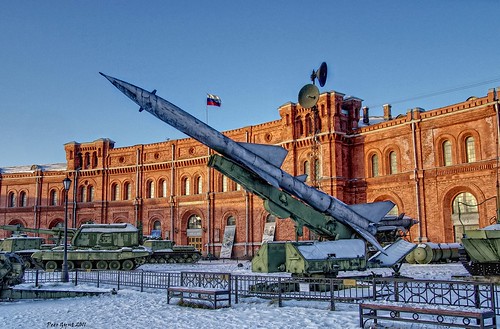
Image by Peer.Gynt
Saint-Petersburg. Artillery Museum.
The S-75 Dvina (Russian: С-75; NATO reporting name SA-2 Guideline) is a Soviet-designed, high-altitude, command guided, surface-to-air missile (SAM). Since its first deployment in 1957 it has become the most widely-deployed air defense missile in history. It scored the first destruction of an enemy aircraft by a SAM, shooting down a Taiwanese Martin RB-57D Canberra over China, on October 7, 1959 by hitting it with three V-750 (1D) missiles at an altitude of 20 km (65,600 ft). The success was attributed to Chinese fighters at the time in order to keep the S-75 program secret.
This system first gained international fame when an S-75 battery, using the newer, longer-range and higher-altitude V-750VN (13D) missile shot down the U-2 of Francis Gary Powers overflying the Soviet Union on May 1, 1960.[3] The system was also deployed in Cuba during the Cuban Missile Crisis, where on October 27, 1962, it shot down the U-2 flown by Rudolf Anderson, almost precipitating nuclear war.[4] North Vietnamese forces used the S-75 extensively during the Vietnam War to defend Hanoi and Haiphong. It has also been locally produced in the People"s Republic of China using the names HQ-1 and HQ-2. Other nations have produced so many local variants combining portions of the S-75 system with both indigenously-developed components or third-party systems that it has become virtually impossible to find a pure S-75 system today,
Development
In the early 1950s, the United States Air Force rapidly accelerated its development of long-range jet bombers carrying nuclear weapons. The USAF program led to the deployment of Boeing B-47 Stratojet supported by aerial refueling aircraft to extend its range deep into the Soviet Union. The USAF quickly followed the B-47 with the development of the Boeing B-52 Stratofortress, which had greater range and payload than the B-47. The range, speed, and payload of these U.S. bombers posed a significant threat to the Soviet Union in the event of a war between the two countries.
onsequently, the Soviets initiated the development of improved air defense systems. Although the Soviet Air Defence Forces had large numbers of anti-aircraft artillery (AAA), including radar-directed batteries, the limitations of guns versus high-altitude jet bombers was obvious. Therefore, the Soviet Air Defense Forces began the development of missile systems to replace the World War II-vintage gun defenses.
In 1953, KB-2 began the development of what became the S-75 under the direction of Pyotr Grushin. This program focused on producing a missile which could bring down a large, non-maneuvering, high-altitude aircraft. As such it did not need to be highly maneuverable, merely fast and able to resist aircraft counter-measures. For such a pioneering system, development proceeded rapidly, and testing began a few years later. In 1957, the wider public first became aware of the S-75 when the missile was shown at that year"s May Day parade in Moscow.
Initial deployment
Wide-scale deployment started in 1957, with various upgrades following over the next few years. The S-75 was never meant to replace the S-25 Berkut surface-to-air missile sites around Moscow, but it did replace high-altitude anti-aircraft guns, such as the 130 mm KS-30 and 100 mm KS-19. Between mid-1958 and 1964, U.S. intelligence assets located more than 600 S-75 sites in the USSR. These sites tended to cluster around population centers, industrial complexes, and government control centers. A ring of sites was also located around likely bomber routes into the Soviet heartland. By the mid-1960s, the Soviet Union had ended the deployment of the S-75 with perhaps 1,000 operational sites.
In addition to the Soviet Union, several S-75 batteries were deployed during the 1960s in East Germany to protect Soviet forces stationed in that country. Later the system was sold to most Warsaw Pact countries and was provided to China, North Korea, and eventually, North Vietnam.
Employment
While the shooting down of Francis Gary Powers" U-2 in 1960 is the first publicized success for the S-75, the first aircraft actually shot down by the S-75 was a Taiwanese Martin RB-57D Canberra high-altitude reconnaissance aircraft. In this case, the aircraft was hit by a Chinese-operated S-75 site near Beijing on October 7, 1959. Over the next few years, the Taiwanese ROCAF would lose a number of aircraft to the S-75: both RB-57s and various drones. On May 1, 1960, Gary Powers"s U-2 was shot down while flying over the testing site near Sverdlovsk, although it is thought to have taken 14 missiles to hit his high-flying plane. That action led to the U-2 Crisis of 1960. Additionally, Chinese S-75s downed five ROCAF-piloted U-2s based in Taiwan.[5]
During the Cuban Missile Crisis, a U-2 piloted by USAF Major Rudolf Anderson was shot down over Cuba by an S-75 in October 1962.[6]
In 1965, North Vietnam asked for some assistance against American airpower, for their own air-defense system lacked the ability to shoot down aircraft flying at high altitude. After some discussion it was agreed to supply the PAVN with the S-75. The decision was not made lightly, because it greatly increased the chances that one would fall into US hands for study. Site preparation started early in the year, and the US detected the program almost immediately on April 5, 1965. While military planners pressed for the sites to be attacked before they could become operational, their political leaders refused, fearing that Soviet technical staff might be killed.
On July 24, 1965, a USAF F-4C aircraft was shot down by an SA-2.[7] Three days later, the US responded with Operation Iron Hand to attack the other sites before they could become operational. Most of the S-75 were deployed around the Hanoi-Haiphong area and were off-limits to attack (as were local airfields) for political reasons. President Lyndon Johnson announced on public TV that one of the other sites would be attacked the next week. The Vietnamese removed the missiles and replaced them with decoys, while moving every available anti-aircraft gun into the approach routes. The tactic worked, causing heavy American casualties.
The missile system was used widely throughout the world, especially in the Middle East, where Egypt and Syria used them to defend against the Israeli Air Force, with the air defense net accounting for the majority of the downed Israeli aircraft. The last apparent success seems to have occurred during the War in Abkhazia (1992–1993), when Georgian missiles shot down a Russian Sukhoi Su-27 fighter near Gudauta on March 19, 1993.
Countermeasures and counter-countermeasures
Between 1965 and 1966, the US delivered a number of solutions to the S-75 problem. The Navy soon had the Shrike missile in service and mounted their first offensive strike on a site in October 1965. The Air Force responded by fitting B-66 bombers with powerful jammers (that blinded the early warning radars) and by developing smaller jamming pods for fighters (that denied range information to the radars). Later developments included the Wild Weasel aircraft, which were fitted with anti-radiation air-to-surface missile systems made to home in on the radar from the threat. This freed them to shoot the sites with Shrikes of their own.
The Soviets and Vietnamese, however, were able to adapt to some of these tactics. The USSR upgraded the radar several times to improve ECM (electronic counter measure) resistance. They also introduced a passive guidance mode, whereby the missile could lock on the jammer itself. This had an added advantage, because the radar had to be turned off, which prevented Shrikes from being fired. Moreover, some new tactics were developed to combat the Shrike. One of them was to point the radar to the side and then turn it off briefly. Since the Shrike was a relatively primitive anti-radiation missile, it would follow the beam away from the radar and then simply crash when it lost the signal (after the radar was turned off). Another was a "false launch" in which the tracking radar was turned on, but the missiles were not actually fired. This allowed the missile crew to see if the target was equipped with a Shrike. If the aircraft fired one, the Shrike could be neutralized with the side-pointing technique without sacrificing any S-75s.
Despite these advances, the US was able to come up with effective ECM packages for the B-52E models. These planes were able to fly raids against Hanoi with relatively few losses (though still significant enough to cause some concern; see Operation Linebacker II).
Replacement systems
Soviet Air Defence Forces started to replace the S-75 with the vastly superior SA-10 and SA-12 systems in the 1980s. Today only a few hundred, if any, of the 4,600 missiles are still in Russian service, even though they underwent a modernization program as late as 1993.[citation needed]
The S-75 remains in widespread service throughout the world, with some level of operational ability in 35 countries. Vietnam and Egypt are tied for the largest deployments at 280 missiles each, while North Korea has 270, and Poland has 240. The Chinese also deploy the HQ-2, an upgrade of the S-75, in relatively large numbers.
Soviet doctrinal organization
The Soviet Union used a fairly standard organizational structure for S-75 units. Other countries that have employed the S-75 may have modified this structure. Typically, the S-75 is organized into a regimental structure with three subordinate battalions. The regimental headquarters will control the early-warning radars and coordinate battalion actions. The battalions will contain several batteries with their associated acquisition and targeting radars.
Site layout
Each battalion will typically have six, semi-fixed, single-rail launchers for their V-750 missiles positioned approximately 60 to 100 m (200 to 330 ft) apart from each other in a hexagonal "flower" pattern, with radars and guidance systems placed in the center. It was this unique "flower" shape that led to the sites being easily recognizable in reconnaissance photos. Typically another six missiles are stored on tractor-trailers near the center of the site.
An example of a site can be seen here just to the west of the junction to Bosra on the M5 motorway in Syria, south of Damascus. This location covers the borders with both Israel and Jordan, so it is of strategic importance.
Missile
V-750
V-750V 1D missile on a launcher
TypeSurface-to-air missile
Place of origin Soviet Union
Production history
VariantsV-750, V-750V, V-750VK, V-750VN, V-750M, V-750SM, V-750AK
Specifications (V-750[9])
Weight2,300 kg (5,100 lb)
Length10,600 mm (420 in)
Diameter700 mm (28 in)
WarheadFrag-HE
Warhead weight200 kg (440 lb)
Detonation
mechanismCommand
PropellantSolid-fuel booster and a storable liquid-fuel upper stage
Operational
range45 km (28 mi)
Flight altitude20,000 m (66,000 ft)
Boost time5 s boost, then 20 s sustain
SpeedMach 3.5
Guidance
systemRadio control guidance
Accuracy65 m
Launch
platformSingle rail, ground mounted (not mobile)
The V-750 is a two-stage missile consisting of a solid-fuel booster and a storable liquid-fuel upper stage, which burns red fuming nitric acid as the oxidizer and kerosene as the fuel. The booster fires for about 4–5 seconds and the main engine for about 22 seconds, by which time the missile is traveling at about Mach 3. The booster mounts four large, cropped-delta wing fins that have small control surfaces in their trailing edges to control roll. The upper stage has smaller cropped-deltas near the middle of the airframe, with a smaller set of control surfaces at the extreme rear and (in most models) much smaller fins on the nose.
The missiles are guided using radio control signals (sent on one of three channels) from the guidance computers at the site. The earlier S-75 models received their commands via two sets of four small antennas in front of the forward fins, while the D model and later models used four much larger strip antennas running between the forward and middle fins. The guidance system at an S-75 site can handle only one target at a time, but it can direct three missiles against it. Additional missiles could be fired against the same target after one or more missiles of the first salvo had completed their run, freeing the radio channel.
The missile typically mounts a 195 kg (430 lb) fragmentation warhead, with proximity, contact, and command fusing. The warhead has a lethal radius of about 65 m (213 ft) at lower altitudes, but at higher altitudes the thinner atmosphere allows for a wider radius of up to 250 m (820 ft). The missile itself is accurate to about 75 m (246 ft), which explains why two were typically fired in a salvo. One version, the SA-2E, mounted a 295 kg (650 lb) nuclear warhead of an estimated 15 Kiloton yield or a conventional warhead of similar weight.
Typical range for the missile is about 45 km (28 mi), with a maximum altitude around 20,000 m (66,000 ft). The radar and guidance system imposed a fairly long short-range cutoff of about 500 to 1,000 m (1,600 to 3,300 ft), making them fairly safe for engagements at low level.
en.wikipedia.org/wiki/S-75_Dvina
The next step – rotational planing
One of the challenges faced by track engineers, both in the UK and around the world, is keeping the rail profile in good condition. Writes Maurice Verheijen. Many studies have been undertaken to determine the interaction between rails and wheels, and ...
Read more on The Rail Engineer
Food safety myths dispelled
Since then, companies have learned how to make their product safer by using pasteurized eggs and adding “acidifying agents” like lemon juice and vinegar. Today, when illnesses are linked to potato salad, the culprit ... These bacteria, invisible to the ...
Read more on The Missoulian
In the Groove with Diamond Grooving and Grinding
And the resulting smoother profile reduces dynamic loading on the pavement, thus extending its service life, according to the International Grooving & Grinding China Association (IGGA), so grooving and grinding China – as does surface texturing, by use of mobile ...
Read more on Better Roads Magazine
Tuesday, July 8, 2014
Nice Surface Grinding China Services photos
Some cool surface grinding China services images:
Steven F. Udvar-Hazy Center: View down onto SR-71 Blackbird & Boeing P-26A Peashooter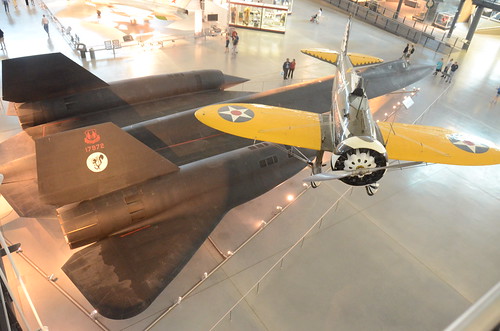
Image by Chris Devers
See more photos of this, and the Wikipedia article.
Details, quoting from Smithsonian National Air and Space Museum | Boeing P-26A Peashooter:
The Boeing P-26A of the mid-to-late 1930s introduced the concept of the high-performance, all-metal monoplane fighter design, which would become standard during World War II. A radical departure from wood-and-fabric biplanes, the Peashooter nonetheless retained an open cockpit, fixed landing gear, and external wing bracing.
Most P-26As stationed overseas were eventually sold to the Philippines or assigned to the Panama Canal Department Air Force, a branch of the U.S. Army Air Corps. Several went to China and one to Spain. This one was based at Selfridge Field in Michigan and Fairfield Air Depot in Ohio between its acceptance by the U.S. Army Air Corps in 1934 and its transfer to the Canal Zone in 1938. It was given to Guatemala in 1942 and flew in the Guatemalan air force until 1954. Guatemala donated it to the Smithsonian in 1957.
Gift of the Guatemalan Air Force, Republic of Guatemala
Manufacturer:
Boeing Aircraft Co.
Date:
1934
Country of Origin:
United States of America
Dimensions:
Wingspan: 8.5 m (27 ft 11 in)
Length:7.3 m (23 ft 11 in)
Height:3.1 m (10 ft 2 in)
Weight, empty:996 kg (2,196 lb)
Weight, gross:1,334 kg (2,935 lb)
Top speed:377 km/h (234 mph)
Engine:Pratt & Whitney R-1340-27, 600 hp
Armament:two .30 cal. M2 Browning aircraft machine guns
• • •
Quoting from Boeing History | P-26 "Peashooter" Fighter:
The all-metal, single-wing P-26, popularly known as the "Peashooter," was an entirely new design for Boeing, and its structure drew heavily on the Monomail. The Peashooter"s wings were braced with wire, rather than with the rigid struts used on other airplanes, so the airplane was lighter and had less drag. Its initial high landing speeds were reduced by the addition of wing flaps in the production models.
Because the P-26 flew 27 mph faster and outclimbed biplane fighters, the Army ordered 136 production-model Peashooters. Acclaimed by pilots for its speed and maneuverability, the small but feisty P-26 formed the core of pursuit squadrons throughout the United States.
Twelve export versions, 11 for China and one for Spain, were built. One of a group of P-26s, turned over to the Philippine Army late in 1941, was among the first Allied fighters to down a Japanese airplane in World War II.
Funds to buy the export version of the Peashooter were partly raised by Chinese Americans. Contribution boxes were placed on the counters of Chinese restaurants.
Specifications
• First flight: March 20, 1932
• Model number: 248/266
• Classification: Fighter
• Span: 28 feet
• Length: 23 feet 7 inches
• Gross weight: 2,995 pounds
• Top speed: 234 mph
• Cruising speed: 200 mph
• Range: 635 miles
• Ceiling: 27,400 feet
• Power: 600-horsepower P&W Wasp engine
• Accommodation: 1 pilot
• Armament: 2 machine guns, 200-pound bomb load
• • • • •
See more photos of this, and the Wikipedia article.
Details, quoting from Smithsonian National Air and Space Museum | Lockheed SR-71 Blackbird:
No reconnaissance aircraft in history has operated globally in more hostile airspace or with such complete impunity than the SR-71, the world"s fastest jet-propelled aircraft. The Blackbird"s performance and operational achievements placed it at the pinnacle of aviation technology developments during the Cold War.
This Blackbird accrued about 2,800 hours of flight time during 24 years of active service with the U.S. Air Force. On its last flight, March 6, 1990, Lt. Col. Ed Yielding and Lt. Col. Joseph Vida set a speed record by flying from Los Angeles to Washington, D.C., in 1 hour, 4 minutes, and 20 seconds, averaging 3,418 kilometers (2,124 miles) per hour. At the flight"s conclusion, they landed at Washington-Dulles International Airport and turned the airplane over to the Smithsonian.
Transferred from the United States Air Force.
Manufacturer:
Lockheed Aircraft Corporation
Designer:
Clarence L. "Kelly" Johnson
Date:
1964
Country of Origin:
United States of America
Dimensions:
Overall: 18ft 5 15/16in. x 55ft 7in. x 107ft 5in., 169998.5lb. (5.638m x 16.942m x 32.741m, 77110.8kg)
Other: 18ft 5 15/16in. x 107ft 5in. x 55ft 7in. (5.638m x 32.741m x 16.942m)
Materials:
Titanium
Physical Description:
Twin-engine, two-seat, supersonic strategic reconnaissance aircraft; airframe constructed largley of titanium and its alloys; vertical tail fins are constructed of a composite (laminated plastic-type material) to reduce radar cross-section; Pratt and Whitney J58 (JT11D-20B) turbojet engines feature large inlet shock cones.
Long Description:
No reconnaissance aircraft in history has operated in more hostile airspace or with such complete impunity than the SR-71 Blackbird. It is the fastest aircraft propelled by air-breathing engines. The Blackbird"s performance and operational achievements placed it at the pinnacle of aviation technology developments during the Cold War. The airplane was conceived when tensions with communist Eastern Europe reached levels approaching a full-blown crisis in the mid-1950s. U.S. military commanders desperately needed accurate assessments of Soviet worldwide military deployments, particularly near the Iron Curtain. Lockheed Aircraft Corporation"s subsonic U-2 (see NASM collection) reconnaissance aircraft was an able platform but the U. S. Air Force recognized that this relatively slow aircraft was already vulnerable to Soviet interceptors. They also understood that the rapid development of surface-to-air missile systems could put U-2 pilots at grave risk. The danger proved reality when a U-2 was shot down by a surface to air missile over the Soviet Union in 1960.
Lockheed"s first proposal for a new high speed, high altitude, reconnaissance aircraft, to be capable of avoiding interceptors and missiles, centered on a design propelled by liquid hydrogen. This proved to be impracticable because of considerable fuel consumption. Lockheed then reconfigured the design for conventional fuels. This was feasible and the Central Intelligence Agency (CIA), already flying the Lockheed U-2, issued a production contract for an aircraft designated the A-12. Lockheed"s clandestine "Skunk Works" division (headed by the gifted design engineer Clarence L. "Kelly" Johnson) designed the A-12 to cruise at Mach 3.2 and fly well above 18,288 m (60,000 feet). To meet these challenging requirements, Lockheed engineers overcame many daunting technical challenges. Flying more than three times the speed of sound generates 316° C (600° F) temperatures on external aircraft surfaces, which are enough to melt conventional aluminum airframes. The design team chose to make the jet"s external skin of titanium alloy to which shielded the internal aluminum airframe. Two conventional, but very powerful, afterburning turbine engines propelled this remarkable aircraft. These power plants had to operate across a huge speed envelope in flight, from a takeoff speed of 334 kph (207 mph) to more than 3,540 kph (2,200 mph). To prevent supersonic shock waves from moving inside the engine intake causing flameouts, Johnson"s team had to design a complex air intake and bypass system for the engines.
Skunk Works engineers also optimized the A-12 cross-section design to exhibit a low radar profile. Lockheed hoped to achieve this by carefully shaping the airframe to reflect as little transmitted radar energy (radio waves) as possible, and by application of special paint designed to absorb, rather than reflect, those waves. This treatment became one of the first applications of stealth technology, but it never completely met the design goals.
Test pilot Lou Schalk flew the single-seat A-12 on April 24, 1962, after he became airborne accidentally during high-speed taxi trials. The airplane showed great promise but it needed considerable technical refinement before the CIA could fly the first operational sortie on May 31, 1967 - a surveillance flight over North Vietnam. A-12s, flown by CIA pilots, operated as part of the Air Force"s 1129th Special Activities Squadron under the "Oxcart" program. While Lockheed continued to refine the A-12, the U. S. Air Force ordered an interceptor version of the aircraft designated the YF-12A. The Skunk Works, however, proposed a "specific mission" version configured to conduct post-nuclear strike reconnaissance. This system evolved into the USAF"s familiar SR-71.
Lockheed built fifteen A-12s, including a special two-seat trainer version. Two A-12s were modified to carry a special reconnaissance drone, designated D-21. The modified A-12s were redesignated M-21s. These were designed to take off with the D-21 drone, powered by a Marquart ramjet engine mounted on a pylon between the rudders. The M-21 then hauled the drone aloft and launched it at speeds high enough to ignite the drone"s ramjet motor. Lockheed also built three YF-12As but this type never went into production. Two of the YF-12As crashed during testing. Only one survives and is on display at the USAF Museum in Dayton, Ohio. The aft section of one of the "written off" YF-12As which was later used along with an SR-71A static test airframe to manufacture the sole SR-71C trainer. One SR-71 was lent to NASA and designated YF-12C. Including the SR-71C and two SR-71B pilot trainers, Lockheed constructed thirty-two Blackbirds. The first SR-71 flew on December 22, 1964. Because of extreme operational costs, military strategists decided that the more capable USAF SR-71s should replace the CIA"s A-12s. These were retired in 1968 after only one year of operational missions, mostly over southeast Asia. The Air Force"s 1st Strategic Reconnaissance Squadron (part of the 9th Strategic Reconnaissance Wing) took over the missions, flying the SR-71 beginning in the spring of 1968.
After the Air Force began to operate the SR-71, it acquired the official name Blackbird-- for the special black paint that covered the airplane. This paint was formulated to absorb radar signals, to radiate some of the tremendous airframe heat generated by air friction, and to camouflage the aircraft against the dark sky at high altitudes.
Experience gained from the A-12 program convinced the Air Force that flying the SR-71 safely required two crew members, a pilot and a Reconnaissance Systems Officer (RSO). The RSO operated with the wide array of monitoring and defensive systems installed on the airplane. This equipment included a sophisticated Electronic Counter Measures (ECM) system that could jam most acquisition and targeting radar. In addition to an array of advanced, high-resolution cameras, the aircraft could also carry equipment designed to record the strength, frequency, and wavelength of signals emitted by communications and sensor devices such as radar. The SR-71 was designed to fly deep into hostile territory, avoiding interception with its tremendous speed and high altitude. It could operate safely at a maximum speed of Mach 3.3 at an altitude more than sixteen miles, or 25,908 m (85,000 ft), above the earth. The crew had to wear pressure suits similar to those worn by astronauts. These suits were required to protect the crew in the event of sudden cabin pressure loss while at operating altitudes.
To climb and cruise at supersonic speeds, the Blackbird"s Pratt & Whitney J-58 engines were designed to operate continuously in afterburner. While this would appear to dictate high fuel flows, the Blackbird actually achieved its best "gas mileage," in terms of air nautical miles per pound of fuel burned, during the Mach 3+ cruise. A typical Blackbird reconnaissance flight might require several aerial refueling operations from an airborne tanker. Each time the SR-71 refueled, the crew had to descend to the tanker"s altitude, usually about 6,000 m to 9,000 m (20,000 to 30,000 ft), and slow the airplane to subsonic speeds. As velocity decreased, so did frictional heat. This cooling effect caused the aircraft"s skin panels to shrink considerably, and those covering the fuel tanks contracted so much that fuel leaked, forming a distinctive vapor trail as the tanker topped off the Blackbird. As soon as the tanks were filled, the jet"s crew disconnected from the tanker, relit the afterburners, and again climbed to high altitude.
Air Force pilots flew the SR-71 from Kadena AB, Japan, throughout its operational career but other bases hosted Blackbird operations, too. The 9th SRW occasionally deployed from Beale AFB, California, to other locations to carryout operational missions. Cuban missions were flown directly from Beale. The SR-71 did not begin to operate in Europe until 1974, and then only temporarily. In 1982, when the U.S. Air Force based two aircraft at Royal Air Force Base Mildenhall to fly monitoring mission in Eastern Europe.
When the SR-71 became operational, orbiting reconnaissance satellites had already replaced manned aircraft to gather intelligence from sites deep within Soviet territory. Satellites could not cover every geopolitical hotspot so the Blackbird remained a vital tool for global intelligence gathering. On many occasions, pilots and RSOs flying the SR-71 provided information that proved vital in formulating successful U. S. foreign policy. Blackbird crews provided important intelligence about the 1973 Yom Kippur War, the Israeli invasion of Lebanon and its aftermath, and pre- and post-strike imagery of the 1986 raid conducted by American air forces on Libya. In 1987, Kadena-based SR-71 crews flew a number of missions over the Persian Gulf, revealing Iranian Silkworm missile batteries that threatened commercial shipping and American escort vessels.
As the performance of space-based surveillance systems grew, along with the effectiveness of ground-based air defense networks, the Air Force started to lose enthusiasm for the expensive program and the 9th SRW ceased SR-71 operations in January 1990. Despite protests by military leaders, Congress revived the program in 1995. Continued wrangling over operating budgets, however, soon led to final termination. The National Aeronautics and Space Administration retained two SR-71As and the one SR-71B for high-speed research projects and flew these airplanes until 1999.
On March 6, 1990, the service career of one Lockheed SR-71A Blackbird ended with a record-setting flight. This special airplane bore Air Force serial number 64-17972. Lt. Col. Ed Yeilding and his RSO, Lieutenant Colonel Joseph Vida, flew this aircraft from Los Angeles to Washington D.C. in 1 hour, 4 minutes, and 20 seconds, averaging a speed of 3,418 kph (2,124 mph). At the conclusion of the flight, "972 landed at Dulles International Airport and taxied into the custody of the Smithsonian"s National Air and Space Museum. At that time, Lt. Col. Vida had logged 1,392.7 hours of flight time in Blackbirds, more than that of any other crewman.
This particular SR-71 was also flown by Tom Alison, a former National Air and Space Museum"s Chief of Collections Management. Flying with Detachment 1 at Kadena Air Force Base, Okinawa, Alison logged more than a dozen "972 operational sorties. The aircraft spent twenty-four years in active Air Force service and accrued a total of 2,801.1 hours of flight time.
Wingspan: 55"7"
Length: 107"5"
Height: 18"6"
Weight: 170,000 Lbs
Reference and Further Reading:
Crickmore, Paul F. Lockheed SR-71: The Secret Missions Exposed. Oxford: Osprey Publishing, 1996.
Francillon, Rene J. Lockheed Aircraft Since 1913. Annapolis, Md.: Naval Institute Press, 1987.
Johnson, Clarence L. Kelly: More Than My Share of It All. Washington D.C.: Smithsonian Institution Press, 1985.
Miller, Jay. Lockheed Martin"s Skunk Works. Leicester, U.K.: Midland Counties Publishing Ltd., 1995.
Lockheed SR-71 Blackbird curatorial file, Aeronautics Division, National Air and Space Museum.
DAD, 11-11-01
Subscribe to:
Posts (Atom)