Showing posts with label F4U1D. Show all posts

Saturday, August 16, 2014

Steven F. Udvar-Hazy Center: Vought F4U-1D Corsair

A few nice surface grinding services images I found:


Steven F. Udvar-Hazy Center: Vought F4U-1D Corsair
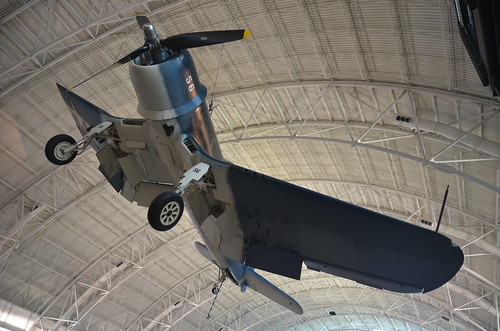

Image by Chris Devers
See more photos of this, and the Wikipedia article.


Details, quoting from Smithsonian National Air and Space Museum | Vought F4U-1D Corsair:


By V-J Day, September 2, 1945, Corsair pilots had amassed an 11:1 kill ratio against enemy aircraft. The aircraft’s distinctive inverted gull-wing design allowed ground clearance for the huge, three-bladed Hamilton Standard Hydromatic propeller, which spanned more than 4 meters (13 feet). The Pratt and Whitney R-2800 radial engine and Hydromatic propeller was the largest and one of the most powerful engine-propeller combinations ever flown on a fighter aircraft.


Charles Lindbergh flew bombing missions in a Corsair with Marine Air Group 31 against Japanese strongholds in the Pacific in 1944. This airplane is painted in the colors and markings of the Corsair Sun Setter, a Marine close-support fighter assigned to the USS Essex in July 1944.


Transferred from the United States Navy.


Manufacturer:
Vought Aircraft Company


Date:

1940


Country of Origin:

United States of America


Dimensions:

Overall: 460 x 1020cm, 4037kg, 1250cm (15ft 1 1/8in. x 33ft 5 9/16in., 8900lb., 41ft 1/8in.)


Materials:

All metal with fabric-covered wings behind the main spar.


Physical Description:

R-2800 radial air-cooled engine with 1,850 horsepower, turned a three-blade Hamilton Standard Hydromatic propeller with solid aluminum blades spanning 13 feet 1 inch; wing bent gull-shaped on both sides of the fuselage.


Long Description:

On February 1, 1938, the United States Navy Bureau of Aeronautics requested proposals from American aircraft manufacturers for a new carrier-based fighter airplane. During April, the Vought Aircraft Corporation responded with two designs and one of them, powered by a Pratt & Whitney R-2800 engine, won the competition in June. Less than a year later, Vought test pilot Lyman A. Bullard, Jr., first flew the Vought XF4U-1 prototype on May 29, 1940. At that time, the largest engine driving the biggest propeller ever flown on a fighter aircraft propelled Bullard on this test flight. The R-2800 radial air-cooled engine developed 1,850 horsepower and it turned a three-blade Hamilton Standard Hydromatic propeller with solid aluminum blades spanning 13 feet 1 inch.


The airplane Bullard flew also had another striking feature, a wing bent gull-shaped on both sides of the fuselage. This arrangement gave additional ground clearance for the propeller and reduced drag at the wing-to-fuselage joint. Ironically for a 644-kph (400 mph) airplane, Vought covered the wing with fabric behind the main spar, a practice the company also followed on the OS2U Kingfisher (see NASM collection).


When naval air strategists had crafted the requirements for the new fighter, the need for speed had overridden all other performance goals. With this in mind, the Bureau of Aeronautics selected the most powerful air-cooled engine available, the R-2800. Vought assembled a team, lead by chief designer Rex Biesel, to design the best airframe around this powerful engine. The group included project engineer Frank Albright, aerodynamics engineer Paul Baker, and propulsion engineer James Shoemaker. Biesel and his team succeeded in building a very fast fighter but when they redesigned the prototype for production, they were forced to make an unfortunate compromise.


The Navy requested heavier armament for production Corsairs and Biesel redesigned each outboard folding wing panel to carry three .50 caliber machine guns. These guns displaced fuel tanks installed in each wing leading edge. To replace this lost capacity, an 897-liter (237 gal) fuselage tank was installed between the cockpit and the engine. To maintain the speedy and narrow fuselage profile, Biesel could not stack the cockpit on top of the tank, so he moved it nearly three feet aft. Now the wing completely blocked the pilot’s line of sight during the most critical stages of landing. The early Corsair also had a vicious stall, powerful torque and propeller effects at slow speed, a short tail wheel strut, main gear struts that often bounced the airplane at touchdown, and cowl flap actuators that leaked oil onto the windshield. These difficulties, combined with the lack of cockpit visibility, made the airplane nearly impossible to land on the tiny deck of an aircraft carrier. Navy pilots soon nicknamed the F4U the ‘ensign eliminator’ for its tendency to kill these inexperienced aviators. The Navy refused to clear the F4U for carrier operations until late in 1944, more than seven years after the project started.


This flaw did not deter the Navy from accepting Corsairs because Navy and Marine pilots sorely needed an improved fighter to replace the Grumman F4F Wildcat (see NASM collection). By New Year’s Eve, 1942, the service owned 178 F4U-1 airplanes. Early in 1943, the Navy decided to divert all Corsairs to land-based United States Marine Corps squadrons and fill Navy carrier-based units with the Grumman F6F Hellcat (see NASM collection). At its best speed of 612 kph (380 mph) at 6,992 m (23,000 ft), the Hellcat was about 24 kph (15 mph) slower than the Corsair but it was a joy to fly aboard the carrier. The F6F filled in splendidly until improvements to the F4U qualified it for carrier operations. Meanwhile, the Marines on Guadalcanal took their Corsairs into combat and engaged the enemy for the first time on February 14, 1943, six months before Hellcat pilots on that battle-scared island first encountered enemy aircraft.


The F4U had an immediate impact on the Pacific air war. Pilots could use the Corsair’s speed and firepower to engage the more maneuverable Japanese airplanes only when the advantage favored the Americans. Unprotected by armor or self-sealing fuel tanks, no Japanese fighter or bomber could withstand for more than a few seconds the concentrated volley from the six .50 caliber machine guns carried by a Corsair. Major Gregory "Pappy" Boyington assumed command of Marine Corsair squadron VMF-214, nicknamed the ‘Black Sheep’ squadron, on September 7, 1943. During less than 5 months of action, Boyington received credit for downing 28 enemy aircraft. Enemy aircraft shot him down on January 3, 1944, but he survived the war in a Japanese prison camp.


In May and June 1944, Charles A. Lindbergh flew Corsair missions with Marine pilots at Green Island and Emirau. On September 3, 1944, Lindbergh demonstrated the F4U’s bomb hauling capacity by flying a Corsair from Marine Air Group 31 carrying three bombs each weighing 450 kg (1,000 lb). He dropped this load on enemy positions at Wotje Atoll. On the September 8, Lindbergh dropped the first 900-kg (2,000 lb) bomb during an attack on the atoll. For the finale five days later, the Atlantic flyer delivered a 900-kg (2,000 lb) bomb and two 450-kg (1,000 lb) bombs. Lindbergh went ahead and flew these missions after the commander of MAG-31 informed him that if he was forced down and captured, the Japanese would almost certainly execute him.


As of V-J Day, September 2, 1945, the Navy credited Corsair pilots with destroying 2,140 enemy aircraft in aerial combat. The Navy and Marines lost 189 F4Us in combat and 1,435 Corsairs in non-combat accidents. Beginning on February 13, 1942, Marine and Navy pilots flew 64,051 operational sorties, 54,470 from runways and 9,581 from carrier decks. During the war, the British Royal Navy accepted 2,012 Corsairs and the Royal New Zealand Air Force accepted 364. The demand was so great that the Goodyear Aircraft Corporation and the Brewster Aeronautical Corporation also produced the F4U.


Corsairs returned to Navy carrier decks and Marine airfields during the Korean War. On September 10, 1952, Captain Jesse Folmar of Marine Fighter Squadron VMF-312 destroyed a MiG-15 in aerial combat over the west coast of Korea. However, F4U pilots did not have many air-to-air encounters over Korea. Their primary mission was to support Allied ground units along the battlefront.


After the World War II, civilian pilots adapted the speedy bent-wing bird from Vought to fly in competitive air races. They preferred modified versions of the F2G-1 and -2 originally built by Goodyear. Corsairs won the prestigious Thompson Trophy twice. In 1952, Vought manufactured 94 F4U-7s for the French Navy, and these aircraft saw action over Indochina but this order marked the end of Corsair production. In production longer than any other U.S. fighter to see service in World War II, Vought, Goodyear, and Brewster built a total of 12,582 F4Us.


The United States Navy donated an F4U-1D to the National Air and Space Museum in September 1960. Vought delivered this Corsair, Bureau of Aeronautics serial number 50375, to the Navy on April 26, 1944. By October, pilots of VF-10 were flying it but in November, the airplane was transferred to VF-89 at Naval Air Station Atlantic City. It remained there as the squadron moved to NAS Oceana and NAS Norfolk. During February 1945, the Navy withdrew the airplane from active service and transferred it to a pool of surplus aircraft stored at Quantico, Virginia. In 1980, NASM craftsmen restored the F4U-1D in the colors and markings of a Corsair named "Sun Setter," a fighter assigned to Marine Fighter Squadron VMF-114 when that unit served aboard the "USS Essex" in July 1944.


• • •


Quoting from Wikipedia | Vought F4U Corsair:


The Chance Vought F4U Corsair was a carrier-capable fighter aircraft that saw service primarily in World War II and the Korean War. Demand for the aircraft soon overwhelmed Vought’s manufacturing capability, resulting in production by Goodyear and Brewster: Goodyear-built Corsairs were designated FG and Brewster-built aircraft F3A. From the first prototype delivery to the U.S. Navy in 1940, to final delivery in 1953 to the French, 12,571 F4U Corsairs were manufactured by Vought, in 16 separate models, in the longest production run of any piston-engined fighter in U.S. history (1942–1953).


The Corsair served in the U.S. Navy, U.S. Marines, Fleet Air Arm and the Royal New Zealand Air Force, as well as the French Navy Aeronavale and other, smaller, air forces until the 1960s. It quickly became the most capable carrier-based fighter-bomber of World War II. Some Japanese pilots regarded it as the most formidable American fighter of World War II, and the U.S. Navy counted an 11:1 kill ratio with the F4U Corsair.


F4U-1D (Corsair Mk IV): Built in parallel with the F4U-1C, but was introduced in April 1944. It had the new -8W water-injection engine. This change gave the aircraft up to 250 hp (190 kW) more power, which, in turn, increased performance. Speed, for example, was boosted from 417 miles per hour (671 km/h) to 425 miles per hour (684 km/h). Because of the U.S. Navy’s need for fighter-bombers, it had a payload of rockets double the -1A’s, as well as twin-rack plumbing for an additional belly drop tank. Such modifications necessitated the need for rocket tabs (attached to fully metal-plated underwing surfaces) and bomb pylons to be bolted on the fighter, however, causing extra drag. Additionally, the role of fighter-bombing was a new task for the Corsair and the wing fuel cells proved too vulnerable and were removed.[] The extra fuel carried by the two drop tanks would still allow the aircraft to fly relatively long missions despite the heavy, un-aerodynamic load. The regular armament of six machine guns were implemented as well. The canopies of most -1Ds had their struts removed along with their metal caps, which were used — at one point — as a measure to prevent the canopies’ glass from cracking as they moved along the fuselage spines of the fighters.[] Also, the clear-view style "Malcolm Hood" canopy used initially on Supermarine Spitfire and P-51C Mustang aircraft was adopted as standard equipment for the -1D model, and all later F4U production aircraft. Additional production was carried out by Goodyear (FG-1D) and Brewster (F3A-1D). In Fleet Air Arm service, the latter was known as the Corsair III, and both had their wingtips clipped by 8" per wing to allow storage in the lower hangars of British carriers.


Steven F. Udvar-Hazy Center: Vought F4U-1D Corsair

Thursday, July 17, 2014

X-35B Joint Strike Fighter

A few nice tool grinding services images I found:


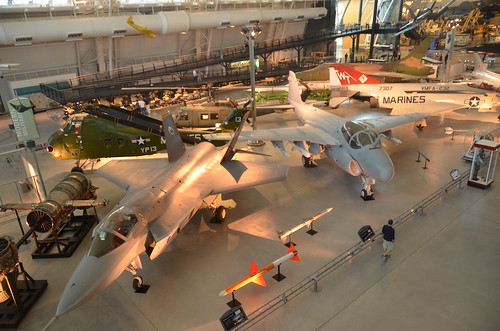
Steven F. Udvar-Hazy Center: X-35B Joint Strike Fighter, A-6E Intruder, F-4S Phantom II, Sikorsky UH-34D Seahorse, UH-1H Iroquois “Huey” Smokey III, F-105D Thunderchief, F4U-1D Corsair, P-40E, SR-71 Blackbird, et al


Image by Chris Devers

Quoting Smithsonian National Air and Space Museum | Lockheed Martin X-35B STOVL:


This aircraft is the first X-35 ever built. It was originally the X-35A and was modified to include the lift-fan engine for testing of the STOVL concept. Among its many test records, this aircraft was the first in history to achieve a short takeoff, level supersonic dash, and vertical landing in a single flight. It is also the first aircraft to fly using a shaft-driven lift-fan propulsion system. The X-35B flight test program was one of the shortest, most effective in history, lasting from June 23, 2001 to August 6, 2001.


The lift-fan propulsion system is now displayed next to the X-35B at the Steven F. Udvar-Hazy Center near Dulles Airport.


On July 7, 2006, the production model F-35 was officially named F-35 Lightning II by T. Michael Moseley, Chief of Staff USAF.


Transferred from the United States Air Force.


Date:

2001


Dimensions:

Wing span: 10.05 m (33 ft 0 in)

Length: 15.47 m (50 ft 9 in)

Height: approximately 5 m (15 ft 0 in)

Weight: approximately 35,000 lb.


Materials:

Composite material aircraft skin, alternating steel and titanium spars. Single-engine, single-seat configuration includes lift-fan and steering bars for vertical flight.


Physical Description:

Short takeoff/vertical landing variant to be used by U.S. Air Force, U.S. Marines and the United Kingdom, equipped with a shaft-driven lift fan propulsion system which enables the aircraft to take off from a short runway or small aircraft carrier and to land vertically.

Engine: Pratt & Whitney JSF 119-PW-611 turbofan deflects thrust downward for short takeoff/vertical landing capability. The Air Force and Navy versions use a thrust-vectoring exhaust nozzle. The Marine Corps and Royal Air Force/Navy version has a swivel-duct nozzle; an engine-driven fan behind the cockpit and air-reaction control valves in the wings to provide stability at low speeds.

Other major subcontractors are Rolls Royce and BAE.


• • • • •


Quoting Smithsonian National Air and Space Museum | Grumman A-6E Intruder:


The Navy’s experience in the Korean War showed the need for a new long-range strike aircraft with high subsonic performance at very low altitude–an aircraft that could penetrate enemy defenses and find and destroy small targets in any weather. The Grumman A-6 Intruder was designed with these needs in mind. The Intruder first flew in 1960 and was delivered to the Navy in 1963 and the Marine Corps in 1964.


The Navy accepted this airplane as an “A” model in 1968. It served under harsh combat conditions in the skies over Vietnam and is a veteran of the 1991 Desert Storm campaign, when it flew missions during the first 72 hours of the war. It has accumulated more than 7,500 flying hours, over 6,500 landings, 767 carrier landings, and 712 catapult launches.


Transferred from the United States Navy, Office of the Secretary


Date:

1960


Country of Origin:

United States of America


Dimensions:

Overall: 16ft 2in. x 52ft 12in. x 54ft 9in., 26745.8lb. (4.928m x 16.154m x 16.688m, 12131.8kg)


Materials:

Conventional all-metal, graphite/epoxy wing (retrofit), aluminium control surfaces, titanium high-strength fittings (wing-fold).


Physical Description:

Dual place (side by side), twin-engine, all-weather attack aircraft; multiple variants.


• • • • •


Quoting Smithsonian National Air and Space Museum | McDonnell F-4S Phantom II:


The U.S. Air Force, Navy, and Marine Corps and the air forces of 12 other nations have flown the multi-role Phantom II. In this aircraft, then a Navy F-4J, on June 21, 1972, Cmdr. S. C. Flynn and his radar intercept officer, Lt. W. H. John, spotted three enemy MiG fighters off the coast of Vietnam and shot down one MiG-21 with a Sidewinder air-to-air missile. This Phantom also flew combat air patrols and bombing missions during the Linebacker II bombing campaign that same year.


Later assigned to the Marine Corps, this F-4J was extensively modernized and designated an F-4S. Changes included improving the engines (smokeless), hydraulics, electronics, and wiring; modifying the wings to increase maneuverability; and adding a radar homing and warning antenna, as well as formation tape lights on the fuselage and vertical tail.


Transferred from the United States Navy.


Manufacturer:
McDonnell Douglas Corporation


Date:

1958


Country of Origin:

United States of America


Dimensions:

Overall: 16ft 3in. x 38ft 5in. x 58ft 3in., 39999.6lb. (4.953m x 11.709m x 17.755m, 18143.7kg)

Other: 58ft 3in. x 16ft 3in. x 38ft 5in. (17.755m x 4.953m x 11.709m)


Materials:

All metal, semi-monocoque structure


Physical Description:

Twin-turbojet (J79-GE-8), two-seat (tandem) fighter / bomber. All metal, semi-monocoque structure. Cantilever, low-wing, monoplane. Dog-toothed leading edge of wing (12 degrees), anhedral tail (23 degrees).


• • • • •


Quoting Smithsonian National Air and Space Museum | Republic F-105D Thunderchief :


The F-105 was designed as a supersonic, single-seat, fighter-bomber capable of carrying nuclear weapons or heavy bomb loads at supersonic speeds. The F-105D variant was an all-weather fighter-bomber version, fitted with mono-pulse and Doppler radar for night or bad weather operations. The original weapons bay, designed for nuclear stores, was sealed and fitted with additional fuel tanks. Bombs were carried on multiple weapons racks on the centerline of the fuselage, and on wing pylons. The aircraft was fitted with a retractable in-flight refueling probe. The first F-105D flew on 9 June 1959 and 610 F-105Ds were eventually built.


This aircraft has served in several F-105 units around the world and is restored to its 1967 Vietnam-era 388th Tactical Fighter Wing, 421st Tactical Fighter Squadron camouflage as it flew during its assignment to Korat RTAB, Thailand. This jet also was briefly assigned to the 355 TFW located at Takhli RTAB in 1968. After this “Thud” finished its combat tour-which certainly included missions supporting Operation “Rolling Thunder,” “Steel Tiger,” and “Barrel Roll”-it returned stateside and began more than a decade assigned to the District of Columbia Air National Guard and was transferred to the Air and Space Museum in late 1981.


Transferred from the United States Air Force.


Manufacturer:
Republic Aviation Corporation


Date:

1961


Country of Origin:

United States of America


Dimensions:

Overall: 19ft 8in., 26854.8lb. (5.994m, 12181.2kg)

Other: 19ft 8in. x 64ft 5in. x 34ft 11in. (5.994m x 19.634m x 10.642m)


Materials:

All metal monoplane, supersonic single-engine jet fighter.


Physical Description:

Single-seat, single-engine, jet, fighter/bomber; USAF.


• • • • •


Beginning in 1962, the H-34 served as the primary Marine Corps assault helicopter of the Vietnam War until its replacement by the turbine-powered CH-46. It began in 1952 as a Navy anti-submarine warfare helicopter evolved from the Sikorsky S-55 series. Initially designated as the HSS-1, it would also go on to see significant service in the combat assault and utility roles with the Army and Marine Corps. Great Britain and France also deployed versions in some of the first helicopter combat assault operations.


A large payload capacity and generous center-of-gravity range made the H-34 series an effective transport helicopter for the1950s. Its weaknesses were a reciprocating engine that struggled in the heat and humidity of Southeast Asia and maintenance intensive mechanical components. This Marine Corps UH-34D never served overseas, but wears the markings of Marine Medium Helicopter Squadron 163 that did see extensive combat in Vietnam.


Transferred from the United States Marine Corps


Manufacturer:
Sikorsky Aircraft


Country of Origin:

United States of America


Physical Description:

All equipment that came with the helicopter that is not attached to it is contained in box A19750823002 with the exception of two items. The VIP steps that attach to the side of the aircraft and the long-handled tool to assist with main rotor blade deployment are stored inside the helicopter’s cabin.


• • • • •


Quoting Smithsonian National Air and Space Museum | Bell UH-1H Iroquois “Huey” Smokey III:


In 1956, the Iroquois, commonly known as the Huey, first flew as an Army replacement for the H-13 medevac helicopter of Korean War fame. By the end of the 20th century, Bell had produced more Hueys than any other American military aircraft, except for the Consolidated B-24. Superbly suited to the air mobility and medical evacuation missions in Vietnam, the Huey became an indelible symbol of that conflict.


This UH-1 compiled a distinguished combat record in Vietnam from 1966 to 1970 with four units, including the 229th Assault Helicopter Battalion of the 1st Cavalry and the 118th and 128th Assault Helicopter Companies. Numerous patches on its skin attest to the ferocity of missions flown while operating as a “Smoke Ship,” laying down smokescreens for air assault operations with the 11th Combat Aviation Battalion.


Transferred from the United States Army Aviation Museum


Manufacturer:
Bell Helicopter Company


Date:

1966


Country of Origin:

United States of America


Dimensions:

Rotor Diameter: 14.7 m (48 ft 3 in)

Length: 12.6 m (41 ft 5 in)

Height: 4.2 m (13 ft 7 in)

Weight, empty: 2,580 kg (5,687 lb)

Weight, gross: 4,309 kg (9,500 lb)


Materials:

Overall: Metal airframe, plexiglass windows.


Physical Description:

Utility helicopter, two-blade main and tail rotors, powered by a single GE T-53L13BA turbo-shaft engine. There are oil stains on the lower aft fuselage and beneath the tail rotor gear box. The horizontal stabilizer was removed.


X-35B Joint Strike Fighter

Steven F. Udvar-Hazy Center: X-35B Joint Strike Fighter, A-6E Intruder, F-4S Phantom II, Sikorsky UH-34D Seahorse, UH-1H Iroquois "Huey" Smokey III, F-105D Thunderchief, F4U-1D Corsair, P-40E, SR-71 Blackbird, et al

A few nice tool grinding services images I found:


Steven F. Udvar-Hazy Center: X-35B Joint Strike Fighter, A-6E Intruder, F-4S Phantom II, Sikorsky UH-34D Seahorse, UH-1H Iroquois “Huey” Smokey III, F-105D Thunderchief, F4U-1D Corsair, P-40E, SR-71 Blackbird, et al


Image by Chris Devers

Quoting Smithsonian National Air and Space Museum | Lockheed Martin X-35B STOVL:


This aircraft is the first X-35 ever built. It was originally the X-35A and was modified to include the lift-fan engine for testing of the STOVL concept. Among its many test records, this aircraft was the first in history to achieve a short takeoff, level supersonic dash, and vertical landing in a single flight. It is also the first aircraft to fly using a shaft-driven lift-fan propulsion system. The X-35B flight test program was one of the shortest, most effective in history, lasting from June 23, 2001 to August 6, 2001.


The lift-fan propulsion system is now displayed next to the X-35B at the Steven F. Udvar-Hazy Center near Dulles Airport.


On July 7, 2006, the production model F-35 was officially named F-35 Lightning II by T. Michael Moseley, Chief of Staff USAF.


Transferred from the United States Air Force.


Date:

2001


Dimensions:

Wing span: 10.05 m (33 ft 0 in)

Length: 15.47 m (50 ft 9 in)

Height: approximately 5 m (15 ft 0 in)

Weight: approximately 35,000 lb.


Materials:

Composite material aircraft skin, alternating steel and titanium spars. Single-engine, single-seat configuration includes lift-fan and steering bars for vertical flight.


Physical Description:

Short takeoff/vertical landing variant to be used by U.S. Air Force, U.S. Marines and the United Kingdom, equipped with a shaft-driven lift fan propulsion system which enables the aircraft to take off from a short runway or small aircraft carrier and to land vertically.

Engine: Pratt & Whitney JSF 119-PW-611 turbofan deflects thrust downward for short takeoff/vertical landing capability. The Air Force and Navy versions use a thrust-vectoring exhaust nozzle. The Marine Corps and Royal Air Force/Navy version has a swivel-duct nozzle; an engine-driven fan behind the cockpit and air-reaction control valves in the wings to provide stability at low speeds.

Other major subcontractors are Rolls Royce and BAE.


• • • • •


Quoting Smithsonian National Air and Space Museum | Grumman A-6E Intruder:


The Navy’s experience in the Korean War showed the need for a new long-range strike aircraft with high subsonic performance at very low altitude–an aircraft that could penetrate enemy defenses and find and destroy small targets in any weather. The Grumman A-6 Intruder was designed with these needs in mind. The Intruder first flew in 1960 and was delivered to the Navy in 1963 and the Marine Corps in 1964.


The Navy accepted this airplane as an "A" model in 1968. It served under harsh combat conditions in the skies over Vietnam and is a veteran of the 1991 Desert Storm campaign, when it flew missions during the first 72 hours of the war. It has accumulated more than 7,500 flying hours, over 6,500 landings, 767 carrier landings, and 712 catapult launches.


Transferred from the United States Navy, Office of the Secretary


Date:

1960


Country of Origin:

United States of America


Dimensions:

Overall: 16ft 2in. x 52ft 12in. x 54ft 9in., 26745.8lb. (4.928m x 16.154m x 16.688m, 12131.8kg)


Materials:

Conventional all-metal, graphite/epoxy wing (retrofit), aluminium control surfaces, titanium high-strength fittings (wing-fold).


Physical Description:

Dual place (side by side), twin-engine, all-weather attack aircraft; multiple variants.


• • • • •


Quoting Smithsonian National Air and Space Museum | McDonnell F-4S Phantom II:


The U.S. Air Force, Navy, and Marine Corps and the air forces of 12 other nations have flown the multi-role Phantom II. In this aircraft, then a Navy F-4J, on June 21, 1972, Cmdr. S. C. Flynn and his radar intercept officer, Lt. W. H. John, spotted three enemy MiG fighters off the coast of Vietnam and shot down one MiG-21 with a Sidewinder air-to-air missile. This Phantom also flew combat air patrols and bombing missions during the Linebacker II bombing campaign that same year.


Later assigned to the Marine Corps, this F-4J was extensively modernized and designated an F-4S. Changes included improving the engines (smokeless), hydraulics, electronics, and wiring; modifying the wings to increase maneuverability; and adding a radar homing and warning antenna, as well as formation tape lights on the fuselage and vertical tail.


Transferred from the United States Navy.


Manufacturer:
McDonnell Douglas Corporation


Date:

1958


Country of Origin:

United States of America


Dimensions:

Overall: 16ft 3in. x 38ft 5in. x 58ft 3in., 39999.6lb. (4.953m x 11.709m x 17.755m, 18143.7kg)

Other: 58ft 3in. x 16ft 3in. x 38ft 5in. (17.755m x 4.953m x 11.709m)


Materials:

All metal, semi-monocoque structure


Physical Description:

Twin-turbojet (J79-GE-8), two-seat (tandem) fighter / bomber. All metal, semi-monocoque structure. Cantilever, low-wing, monoplane. Dog-toothed leading edge of wing (12 degrees), anhedral tail (23 degrees).


• • • • •


Quoting Smithsonian National Air and Space Museum | Republic F-105D Thunderchief :


The F-105 was designed as a supersonic, single-seat, fighter-bomber capable of carrying nuclear weapons or heavy bomb loads at supersonic speeds. The F-105D variant was an all-weather fighter-bomber version, fitted with mono-pulse and Doppler radar for night or bad weather operations. The original weapons bay, designed for nuclear stores, was sealed and fitted with additional fuel tanks. Bombs were carried on multiple weapons racks on the centerline of the fuselage, and on wing pylons. The aircraft was fitted with a retractable in-flight refueling probe. The first F-105D flew on 9 June 1959 and 610 F-105Ds were eventually built.


This aircraft has served in several F-105 units around the world and is restored to its 1967 Vietnam-era 388th Tactical Fighter Wing, 421st Tactical Fighter Squadron camouflage as it flew during its assignment to Korat RTAB, Thailand. This jet also was briefly assigned to the 355 TFW located at Takhli RTAB in 1968. After this "Thud" finished its combat tour-which certainly included missions supporting Operation "Rolling Thunder," "Steel Tiger," and "Barrel Roll"-it returned stateside and began more than a decade assigned to the District of Columbia Air National Guard and was transferred to the Air and Space Museum in late 1981.


Transferred from the United States Air Force.


Manufacturer:
Republic Aviation Corporation


Date:

1961


Country of Origin:

United States of America


Dimensions:

Overall: 19ft 8in., 26854.8lb. (5.994m, 12181.2kg)

Other: 19ft 8in. x 64ft 5in. x 34ft 11in. (5.994m x 19.634m x 10.642m)


Materials:

All metal monoplane, supersonic single-engine jet fighter.


Physical Description:

Single-seat, single-engine, jet, fighter/bomber; USAF.


• • • • •


Beginning in 1962, the H-34 served as the primary Marine Corps assault helicopter of the Vietnam War until its replacement by the turbine-powered CH-46. It began in 1952 as a Navy anti-submarine warfare helicopter evolved from the Sikorsky S-55 series. Initially designated as the HSS-1, it would also go on to see significant service in the combat assault and utility roles with the Army and Marine Corps. Great Britain and France also deployed versions in some of the first helicopter combat assault operations.


A large payload capacity and generous center-of-gravity range made the H-34 series an effective transport helicopter for the1950s. Its weaknesses were a reciprocating engine that struggled in the heat and humidity of Southeast Asia and maintenance intensive mechanical components. This Marine Corps UH-34D never served overseas, but wears the markings of Marine Medium Helicopter Squadron 163 that did see extensive combat in Vietnam.


Transferred from the United States Marine Corps


Manufacturer:
Sikorsky Aircraft


Country of Origin:

United States of America


Physical Description:

All equipment that came with the helicopter that is not attached to it is contained in box A19750823002 with the exception of two items. The VIP steps that attach to the side of the aircraft and the long-handled tool to assist with main rotor blade deployment are stored inside the helicopter’s cabin.


• • • • •


Quoting Smithsonian National Air and Space Museum | Bell UH-1H Iroquois "Huey" Smokey III:


In 1956, the Iroquois, commonly known as the Huey, first flew as an Army replacement for the H-13 medevac helicopter of Korean War fame. By the end of the 20th century, Bell had produced more Hueys than any other American military aircraft, except for the Consolidated B-24. Superbly suited to the air mobility and medical evacuation missions in Vietnam, the Huey became an indelible symbol of that conflict.


This UH-1 compiled a distinguished combat record in Vietnam from 1966 to 1970 with four units, including the 229th Assault Helicopter Battalion of the 1st Cavalry and the 118th and 128th Assault Helicopter Companies. Numerous patches on its skin attest to the ferocity of missions flown while operating as a "Smoke Ship," laying down smokescreens for air assault operations with the 11th Combat Aviation Battalion.


Transferred from the United States Army Aviation Museum


Manufacturer:
Bell Helicopter Company


Date:

1966


Country of Origin:

United States of America


Dimensions:

Rotor Diameter: 14.7 m (48 ft 3 in)

Length: 12.6 m (41 ft 5 in)

Height: 4.2 m (13 ft 7 in)

Weight, empty: 2,580 kg (5,687 lb)

Weight, gross: 4,309 kg (9,500 lb)


Materials:

Overall: Metal airframe, plexiglass windows.


Physical Description:

Utility helicopter, two-blade main and tail rotors, powered by a single GE T-53L13BA turbo-shaft engine. There are oil stains on the lower aft fuselage and beneath the tail rotor gear box. The horizontal stabilizer was removed.


Steven F. Udvar-Hazy Center: X-35B Joint Strike Fighter, A-6E Intruder, F-4S Phantom II, Sikorsky UH-34D Seahorse, UH-1H Iroquois "Huey" Smokey III, F-105D Thunderchief, F4U-1D Corsair, P-40E, SR-71 Blackbird, et al